
 rifanmuazin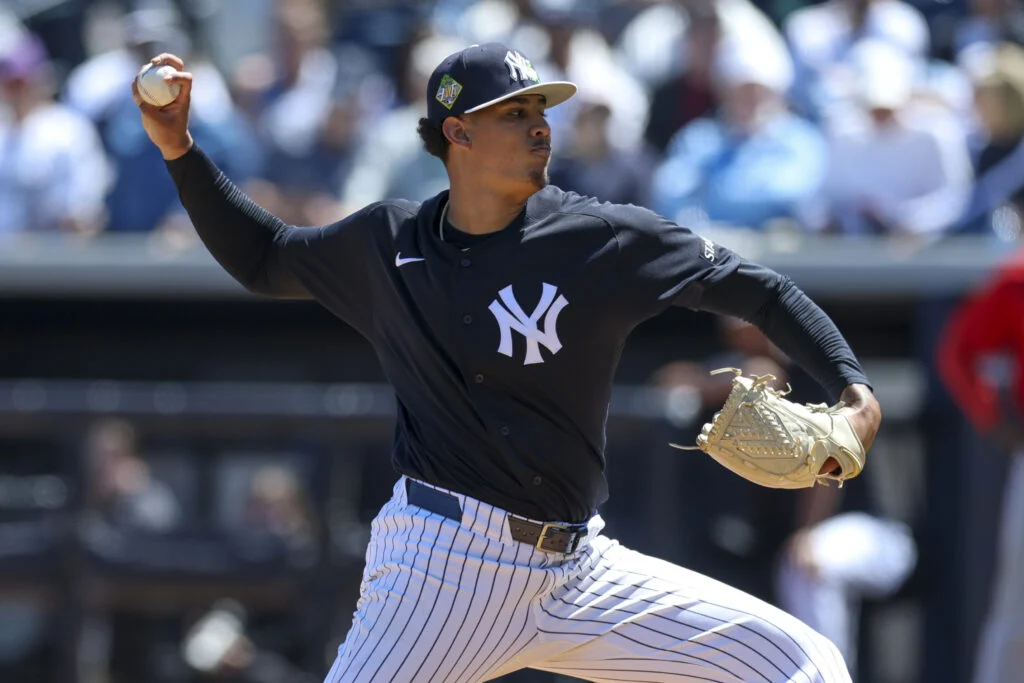
By Industry Correspondent
July 4, 2026
The New York Yankees’ quest for organizational depth and high-leverage bullpen reinforcements suffered a significant blow this week. On Thursday, the club officially placed promising right-handed pitching prospect Carlos Lagrange on the Triple-A injured list, confirming concerns that had been circulating within the Scranton/Wilkes-Barre clubhouse. According to an official media release issued yesterday, the 23-year-old is battling a capsular sprain in his throwing shoulder—an injury that necessitates a strict period of inactivity and places his 2026 campaign in a state of precarious uncertainty.
The Nature of the Injury and Immediate Prognosis
The medical directive provided by the Yankees’ training staff is clear: Lagrange will be completely shut down from all throwing activities for approximately six weeks. This period of rest is intended to allow the inflammation and structural stress within the shoulder capsule to subside without further intervention.
While six weeks is the initial recovery window, the timeline for a return to competitive action is far more complex. Following the shutdown, Lagrange will require a comprehensive, multi-phase throwing program to ramp up his arm strength and regain his command. When factoring in this rehabilitation schedule, team officials suggest that the earliest possible date for Lagrange to return to game action is late August.
This timeline is particularly grueling given the current point in the season. With the MLB trade deadline looming in late July, the Yankees are operating in a window where roster stability and immediate impact players are at a premium. The unfortunate reality, as acknowledged by several league analysts, is that there is a non-zero probability that Lagrange has already thrown his final pitch for the 2026 season. Should the rehab process encounter even minor setbacks, the Yankees will likely prioritize his long-term health over a late-season return, potentially shelving him until spring training 2027.
A Strategic Shift Interrupted: The Transition to the Bullpen
The injury is particularly disheartening because it halts what the organization viewed as a pivotal transition phase for the young right-hander. Throughout the 2026 season, Lagrange had been splitting his duties between the starting rotation and the bullpen. He made 11 starts in his first 18 appearances for Triple-A Scranton/Wilkes-Barre, but over the last month, the team opted to move him exclusively into a relief role.
Manager Aaron Boone and the Yankees’ front office had been transparent about this move. It was never intended as a permanent abandonment of Lagrange’s development as a starter, but rather a strategic shift to expedite his path to the Major Leagues. By focusing on shorter, high-intensity stints, the team hoped to leverage Lagrange’s four-pitch arsenal—highlighted by a fastball that has consistently touched triple digits and a devastating plus-slider—to bolster a bullpen that, while statistically impressive, has been looking for additional strikeout upside.
"We want to see how his stuff plays in high-leverage spots," Boone had remarked earlier this summer. "The move to the pen allows us to get him comfortable in a role where he can potentially help us at the big league level sooner rather than later."
That experiment has now been put on indefinite hold. The efficiency of his recovery may be aided slightly by the fact that he was already working in shorter bursts, meaning he will not need the extensive "stretching out" period required by a starting pitcher returning from injury. However, the physical reality of a shoulder sprain is unforgiving, and the Yankees must now pivot their strategy entirely for the remainder of the summer.
Chronology of a Rising Prospect
To understand the weight of this injury, one must look at the trajectory Lagrange has enjoyed since signing with the Yankees as an international free agent in 2022.
- 2022-2024: Lagrange began his journey in the lower levels of the minor leagues, rapidly gaining a reputation for elite velocity and a raw, albeit developing, command profile.
- 2025: This proved to be his breakout year. Dominating at both High-A and Double-A levels, Lagrange forced his way onto national prospect lists, securing spots on several prominent top-100 rankings. Scouts praised his "plus" slider and his ability to miss bats at a rate that suggested he could be a future middle-of-the-rotation starter or a premier late-inning arm.
- Early 2026: Lagrange earned a promotion to Triple-A Scranton/Wilkes-Barre. Through his first 63 1/3 innings of the season, he posted a 4.55 ERA. While the ERA may not jump off the page, the underlying metrics were highly encouraging: a 29.5% strikeout rate paired with an 11.7% walk rate demonstrated that when he was in the zone, he was virtually unhittable.
- June 2026: The organization formalized his transition to the bullpen, aiming to fast-track his arrival in the Bronx.
- July 2026: The discovery of the capsular sprain leads to the current six-week shutdown, effectively freezing his development at a critical juncture.
Implications for the Yankees’ Roster Construction
The timing of this injury creates a significant void in the Yankees’ contingency planning for the trade deadline. Currently, the Yankees boast the second-best bullpen ERA in Major League Baseball—a testament to the effectiveness of the pitching development department. However, advanced metrics reveal that the pen is somewhat lacking in "swing-and-miss" capability.
While the team has relied on efficiency and contact management to navigate the first half of the season, the high-octane nature of Lagrange’s pitching profile was viewed as the "missing piece" to inject more strikeouts into the late innings. Without the possibility of calling upon him in September or for a potential postseason push, the front office is forced to re-evaluate its strategy.
Many analysts speculated that if Lagrange could not master the control necessary to remain a starter, his future would naturally gravitate toward the bullpen. In that role, his high-velocity fastball and breaking ball become even more dangerous. The injury forces the Yankees into a difficult position: do they trust their internal depth to fill the void, or do they aggressively pursue an external, high-leverage reliever on the trade market?
With the loss of Lagrange as a potential internal "call-up," the urgency to make a trade has undoubtedly increased. The Yankees are not just playing for the division; they are building a roster designed to survive the high-pressure environment of the postseason. A lack of strikeout power in the bullpen is often exposed in October, and losing a player of Lagrange’s caliber—who was specifically being groomed to fill that exact role—is a blow that cannot be easily mitigated.
The Road Ahead
For Carlos Lagrange, the next six weeks will be defined by rest, physical therapy, and the mental challenge of dealing with a long-term injury for the first time as a professional. The Yankees’ training staff is notoriously cautious with young pitchers, and there is no incentive for the team to rush him back. If the shoulder does not respond perfectly, the organization will likely choose to shut him down for the remainder of the year to ensure he is at full strength for the 2027 season.
The fans and the organization will wait with bated breath for updates in mid-August. If the reports are favorable, the "what if" scenario of a September debut might still be on the table. But for now, the Yankees must proceed as if their best internal bullpen reinforcement is unavailable. The challenge for general manager Brian Cashman and his staff is now twofold: maintain the team’s current success while addressing the specific need for high-leverage, high-strikeout pitching that Lagrange was supposed to provide.
As the calendar turns toward the heat of July, the Yankees find themselves at a crossroads. The road to the World Series is rarely paved without setbacks, and the injury to Carlos Lagrange is a stark reminder of the volatility inherent in pitching prospects. Whether this serves as a temporary detour or a significant hurdle in the development of one of their brightest stars, the coming months will be a true test of the Yankees’ organizational depth and their resolve to fill the gaps in a championship-caliber bullpen.

 Nana Wu
 Siti Muinah
 Neng Nana

 Lina Hope
 Sagoh
Sagoh
 Iffa Jayyana