
 rifanmuazin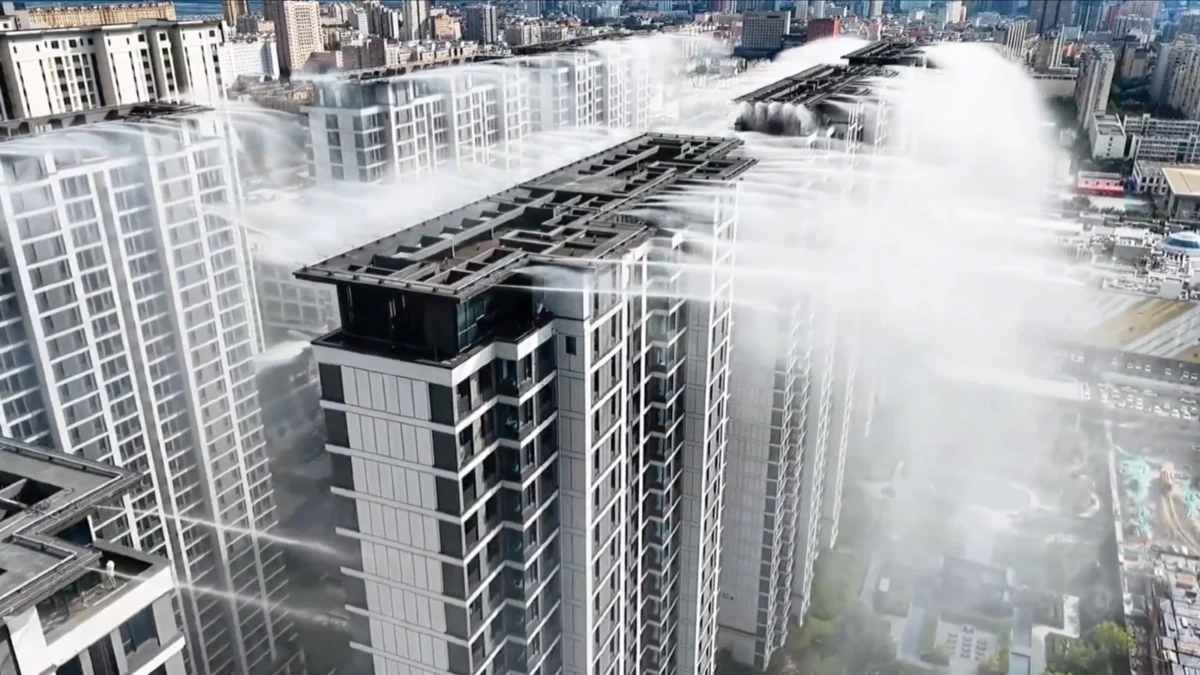
As global temperatures continue to climb, pushing urban environments to their breaking point, architects and city planners are being forced to rethink traditional climate control. While the world has long relied on air conditioning as the primary defense against the summer swelter, its limitations—including exorbitant energy costs, the production of waste heat, and its contribution to global warming—have necessitated a search for more sustainable alternatives.
In the heart of China’s Shanxi province, a creative solution has emerged, capturing global attention and igniting a debate on social media: "Rooftop Rain." This innovative, low-cost urban cooling system, which utilizes high-pressure water misting to combat extreme heat, is transforming residential high-rises in Yuncheng into active cooling towers. As heatwaves become more frequent and lethal across Europe, North America, and Asia, this Chinese experiment may represent a pivotal shift in how we approach cooling the modern city.
The Mechanics of "Rooftop Rain": Science Over Scale
At its core, the "Rooftop Rain" system is a masterclass in the application of thermodynamics. The system operates on the principle of evaporative cooling, a natural phenomenon that has been used for centuries, though rarely on the scale of a multi-story residential complex.
How it Works
The process involves the installation of high-pressure nozzles along the perimeter of apartment rooftops. These nozzles disperse water in a microscopic, atomized mist. As these fine droplets enter the air, they undergo a phase change from liquid to vapor. This phase change is endothermic, meaning it absorbs a significant amount of heat from the surrounding atmosphere. As the water evaporates, the ambient air temperature drops almost instantly.
The Thermal Threshold
The system is highly sensitive to meteorological conditions. Its efficacy is entirely dependent on the dryness and temperature of the air. On days of extreme heat, the air is often dry enough to facilitate rapid evaporation. If the system is activated during cooler or more humid conditions, the evaporation rate slows, potentially resulting in the water simply falling as rain, which would offer little cooling benefit and create unnecessary moisture for pedestrians below. Consequently, the systems are typically calibrated to activate only when ambient temperatures hit a specific, predetermined threshold, ensuring maximum efficiency and minimal water waste.
A Chronology of the Initiative
The deployment of the "Rooftop Rain" system in Yuncheng did not happen overnight. It is the result of years of escalating urban heat stress and a push by local municipal governments to find "green" cooling alternatives.
- Early 2024: Local planners in Shanxi province begin pilot programs to address the "Urban Heat Island" (UHI) effect, which sees dense cities trapped in a cycle of heat absorption due to concrete and asphalt.
- Summer 2025: The first large-scale installation of rooftop misting nozzles is completed on a select group of residential high-rises. Preliminary data indicates a noticeable reduction in surface temperatures.
- July 2026: The system gains global notoriety. Following a record-breaking heatwave in central China, footage of the misting systems goes viral on social media platforms, including X (formerly Twitter).
- Present Day: The success of the Yuncheng project has led to discussions regarding the potential implementation of similar systems in other major urban hubs, as local residents report a decrease of 5–8°C in their immediate environment within minutes of activation.
Supporting Data: Can Mist Lower the Mercury?
The efficacy of evaporative cooling is well-documented in agricultural and industrial sectors, but its application to high-density residential areas provides a new set of data points for environmental scientists.
According to municipal reports from Yuncheng, the "Rooftop Rain" system has successfully mitigated the localized UHI effect. By cooling the air at the top of the building, the system creates a "cool air sink." Because cold air is denser than warm air, this cooled, mist-laden air begins to sink toward the lower floors, creating a natural air-conditioning effect that penetrates even the mid-levels of the high-rise.
This is a stark contrast to traditional AC units, which are often installed on the exterior of buildings, venting hot exhaust air directly into the streets and worsening the ambient temperature for everyone else. By cooling the air at the source, the "Rooftop Rain" system works with the physics of the environment rather than against it.
Official Responses and Public Sentiment
The reaction to the "Rooftop Rain" initiative has been a mixture of admiration, skepticism, and urgent calls for adoption.
Mao Ning, a prominent voice tracking the development, noted that the community in Shanxi has become a model for rapid environmental response. The viral footage has prompted a wave of questions from urban planners in the West: If a residential community in central China can drop the temperature by up to 8°C in mere minutes, why are North American and European cities still relying exclusively on energy-intensive air conditioning?
The Social Media Discourse
The internet has been particularly vocal regarding the disparity between the innovation seen in China and the stagnation in the West. As major cities in Europe face record-breaking death tolls—with recent data from France showing over 1,000 excess deaths linked to extreme heat—the public is demanding more creative solutions. Critics of current urban policies argue that Western cities have become "concrete ovens," with little infrastructure designed to breathe or self-cool.
Implications for Global Urban Planning
The success of "Rooftop Rain" poses a significant question for the future of city living: Is it time to stop treating cooling as an individual, indoor luxury and start treating it as a collective, outdoor necessity?
Sustainability and Water Usage
One of the primary concerns regarding any water-based cooling system is the impact on water resources. Critics argue that in drought-prone areas, spraying water into the air is an irresponsible use of a precious commodity. Proponents, however, point out that these systems are often integrated with gray-water recycling—using treated household wastewater for the misting process—thereby closing the loop and minimizing the environmental footprint.
The Shift in Architecture
The "Rooftop Rain" model suggests that the buildings of the future must be designed with "breathing" capabilities. Architects are now exploring how to integrate misting systems into the structural design of new skyscrapers, rather than retrofitting them as an afterthought. This could involve rooftop basins that collect rainwater, which is then filtered and pumped through the misting nozzles during the heat of the day.
The Human Cost of Inaction
The rising death tolls associated with heatwaves in Europe and North America demonstrate that the status quo is failing. As heat-related fatalities become a yearly headline, the need for passive, low-energy cooling solutions is no longer a matter of convenience; it is a matter of public health. The "Rooftop Rain" project serves as a wake-up call that technology exists, but the political and urban-planning will to implement it is lagging.
Conclusion: A Blueprint for a Cooler Future
The "Rooftop Rain" system in Yuncheng is more than just a viral social media trend; it is a practical, scalable, and scientifically sound approach to the defining challenge of our century: living in a warming world. By leveraging the natural physics of evaporation, China has demonstrated that urban cooling does not always require massive electrical grids or carbon-heavy industrial equipment.
As we look toward the future, the integration of such systems into our urban landscapes will likely become a standard, rather than an exception. While the West continues to debate the efficacy and logistics of these systems, the residents of Shanxi are already reaping the benefits of a cooler, more breathable urban environment. The question is no longer whether we can cool our cities using such methods, but how quickly we can adapt our architectural and municipal frameworks to embrace them before the next heatwave strikes.
In the battle against climate change, the most effective weapons may not be the most complex, but rather the most elegant—turning our rooftops into the very rain that brings relief.


 Sagoh
Sagoh
 Neng Nana
 Nila Kartika Wati

 Ali Ikhwan
 Dwi Wanna