 Ammar Sabilarrohman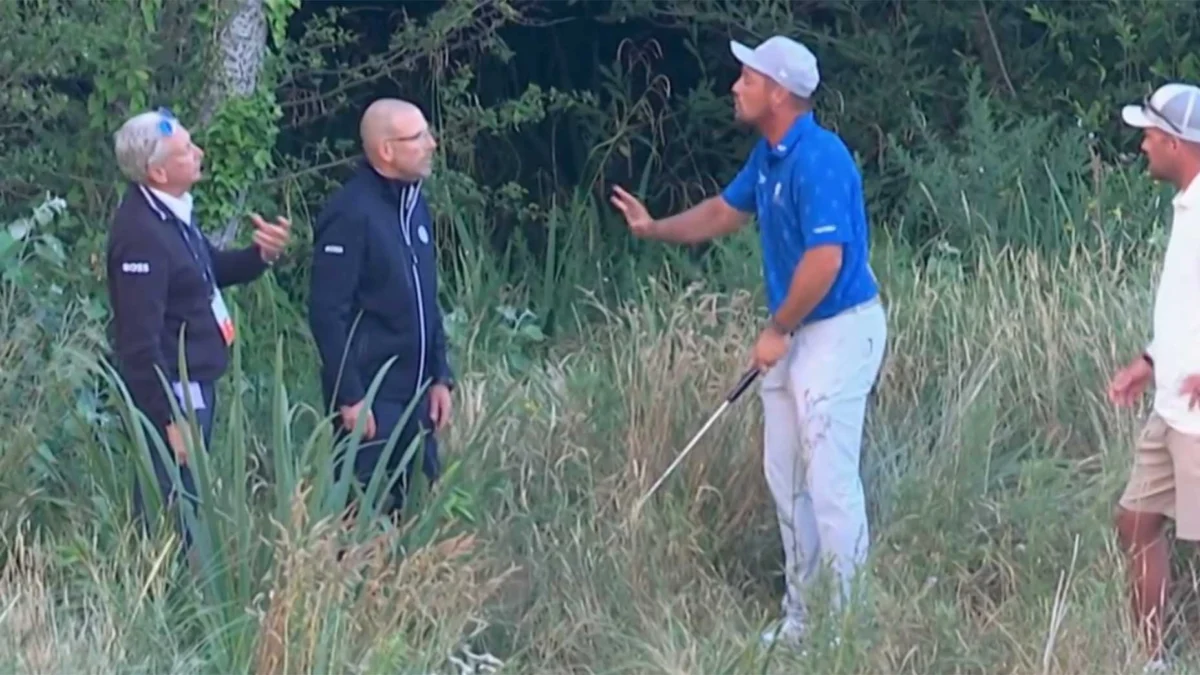
By GOLF Editors | July 17, 2026
The 2026 Open Championship at Royal Birkdale has been thrown into a state of competitive uncertainty following a high-stakes rules infraction that has pitted one of the game’s biggest stars against the sport’s most traditional governing body. Bryson DeChambeau, a favorite to lift the Claret Jug, found himself at the center of a storm late Friday after officials from the R&A assessed him a two-stroke penalty for “inadvertently improving the area of his intended swing” during the second round.
The ruling, which dropped DeChambeau from solo second place into a tie for fifth, has ignited a fierce debate regarding the application of golf’s complex rulebook, the role of television technology in officiating, and the temperament of modern professional golfers. As the tournament moves into the weekend, the narrative has shifted from the leaderboard to the locker room, where DeChambeau’s future participation remains the subject of intense speculation.
The Incident: A Moment of Friction on the Fifth
The controversy centers on the fifth hole at Royal Birkdale. While navigating a challenging lie in the deep, links-style fescue, DeChambeau was captured on footage maneuvering his feet and body to assess the ball’s position. In the process, his movements around the tall grass were flagged by officials.
According to the R&A, the two-shot penalty was levied under Rule 8.1a, which prohibits players from moving, bending, or breaking natural growing objects in a way that improves the conditions affecting the stroke—including the area of the intended backswing. While DeChambeau’s camp maintains that the movements were merely part of a standard pre-shot routine and that no physical advantage was gained, the governing body held firm, arguing that the letter of the law does not distinguish between intent and accidental outcome.
Chronology of a Controversy
The timeline of the decision reveals a rapid escalation from a routine play to a major officiating scandal:
- Mid-Round (Friday): DeChambeau encounters a difficult lie in the thick fescue on the fifth hole. He spends several moments carefully navigating the area to identify his ball and determine his stance.
- Post-Round Review: R&A officials, prompted by footage and subsequent scrutiny of the broadcast, initiate a formal review of the incident.
- The Verdict: Shortly after his round concludes, officials inform DeChambeau that he is being docked two strokes.
- The Confrontation: A tense scene unfolds on the course perimeter, where DeChambeau is seen engaging in a heated discussion with officials. The golfer expresses profound frustration, feeling that the penalty ignores the realities of playing out of extreme conditions.
- The Fallout: As news of the penalty breaks, reports emerge suggesting that DeChambeau is contemplating a protest withdrawal from the tournament, leading to a massive social media firestorm.
Understanding Rule 8.1a: The "Letter of the Law"
To understand the severity of the penalty, one must look at the specific language of the Rules of Golf. Rule 8.1a is designed to maintain the integrity of the game by ensuring that players do not alter the course to favor their own execution.
"You are not allowed to move, bend or break any natural growing object in a way that might improve the area of your intended swing," noted Grant Moir, the R&A’s executive director of governance. The controversy, however, arises from the word "inadvertently."
Critics of the ruling—including many of our own GOLF editorial staff—argue that the rule is being applied with a level of pedantry that ignores the nature of professional golf. When a player is standing in thick fescue, it is physically impossible to stand perfectly still. To penalize a player for movements that are incidental to finding a ball or taking a stance—when there is no clear evidence of a deliberate clearing of the path—is seen by many as a "disservice to the sport."
Perspectives from the Field: The GOLF Roundtable
The reaction within the golf community has been polarized. Our team of writers and editors provided their unfiltered analysis on the situation:

Jessica Marksbury, Senior Editor: "Judging by the footage, I think Bryson deserves the benefit of the doubt. It doesn’t appear he was intentionally stomping around. I find this intense, microscopic analysis of a player’s feet in the milliseconds before a shot to be exhausting. Golf is a game of integrity, and when we take a magnifying glass to ambiguous infractions, we move away from the spirit of the game."
Jake Morrow, Gear Content Manager: "It shouldn’t have been a discussion. The lie itself was never improved. They admitted it was accidental, yet they still applied the penalty. What did they want him to do? Hover? The R&A had clearly made up their minds before they even approached him."
Josh Sens, Senior Writer: "I’m all for giving him the benefit of the doubt on intent, but rules are rules. If he stepped on the grass and made it easier to swing, the rule was triggered. However, his threat not to play the weekend is juvenile. He should take the medicine, move on, and try to win anyway."
Josh Schrock, Associate News Editor: "While the penalty feels harsh, it is the correct application of the rule. These calls should be made more consistently on the PGA Tour. If he wants to be a champion, he needs to play through the adversity rather than threatening to walk away."
Implications for the Open and Beyond
The potential withdrawal of a marquee player like DeChambeau would be a black eye for the R&A and a significant blow to the momentum of the 2026 Open Championship. However, most observers believe that common sense will prevail and that DeChambeau will ultimately tee off for the third round.
The broader implication of "FescueGate" is the ongoing tension between technological surveillance and human judgment. As high-definition cameras capture every blade of grass, the margin for error for officials—and the potential for "gotcha" officiating—has never been higher. If the R&A and other bodies, like the USGA and PGA Tour, continue to penalize players for incidental movements, the game risks becoming a litigation-heavy exercise rather than a contest of skill.
Official Responses and the Path Forward
At the time of this writing, the R&A has stood by its decision, citing the necessity of protecting the field and ensuring that no player gains an advantage, regardless of intent. DeChambeau has remained largely silent since his initial outburst, leaving fans and pundits to wonder how he will channel his anger.
Will this serve as a "Jordan-esque" motivation for a historic weekend charge, or will the weight of the penalty and the frustration of the officiating process derail his campaign?
For the game of golf, this incident serves as a stark reminder: the rules are absolute, but their interpretation remains a deeply human, and often deeply flawed, process. As we head into the weekend at Royal Birkdale, all eyes will be on the fifth hole—and on the man in the blue shirt—to see how this chapter of golf history concludes.
Whether one views this as a triumph of justice or a miscarriage of common sense, one thing is certain: the Open Championship has never been more intense.


 Lina Hope
 Iffa Jayyana
 Neng Nana
 Nana Wu
 Sagoh
Sagoh