
 Jia Lissa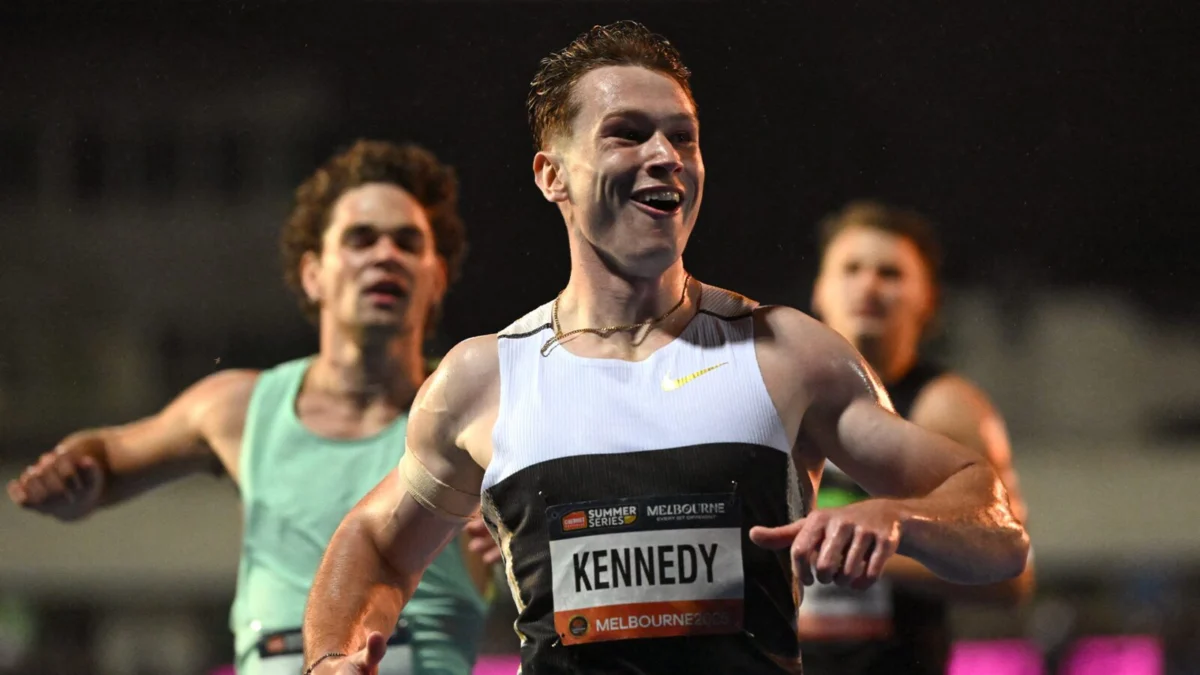
In the high-stakes, hyper-focused world of elite sprinting, few athletes have navigated the transition from grassroots team sports to the global stage with as much velocity as Australia’s Lachlan Kennedy. At 22, the Brisbane-based sprinter has evolved from a reluctant schoolboy runner into one of the most formidable contenders in the 100m sprint. As he prepares to represent Australia at the upcoming Commonwealth Games in Glasgow, Kennedy is no longer just a participant; he is a hunter, driven by an insatiable desire to claim gold and cement his status as a premier global talent.
The Crucible of Competition: Why the 100m Remains King
There is an intoxicating, almost primal tension that defines a major 100m final. It is a discipline that commands the world’s undivided attention, a fleeting ten seconds where legacies are forged and broken. For Kennedy, the moments leading up to the starting gun are not a source of anxiety, but rather a catalyst for peak performance.
“It’s thrilling,” Kennedy explains. “Nothing can even replace it. It’s this indescribable feeling: adrenaline, excitement, maybe a little bit of nerves. But I don’t think I get nervous much. I just get so pumped. I love the big moments; I welcome the pressure.”
This mental fortitude is arguably his most dangerous weapon. While many young athletes are stifled by the weight of expectation, Kennedy views the pressure of the Commonwealth Games as a privilege. His ambition is unambiguous: “I want to win. I want to win every race I’m in, to be fair. But I really want to win Comm Games and I think I can. I know there are some cracking runners there and I’ll have to run my best if I want to have a chance. But I welcome that. That’s how it should be.”
A Chronology of Speed: From the Wing to the World Stage
Kennedy’s path to the world stage was anything but conventional. Born in south London in 2006 before relocating to Australia as a toddler, his early athletic identity was anchored in the camaraderie of the rugby pitch.
Early Days and the Rugby Influence
By age five, Kennedy was fully immersed in the brotherhood of rugby. It was here, in the private school system of Brisbane, that his raw speed first became apparent. He thrived on the wing, though he admits his defensive capabilities left much to be desired. “I was good with the ball in hand, but as soon as the ball left my hand, I was a bit of a liability on defence,” he laughs. “I didn’t like tackling. I didn’t like getting tackled.”
The Pivot to Athletics
Between the ages of 11 and 13, Kennedy dabbled in school athletics, though he confesses he found the sport “a bit corny” at the time. It wasn’t until his penultimate year of high school that a serendipitous push from his rugby coach forced him to reconsider. After recording the fastest time in a school trial, he was drafted into the relay team and eventually entered the individual 100m. By graduation, he had lowered his personal best to 10.5 seconds, signaling a clear shift in his athletic trajectory.
The Professional Breakout
Kennedy’s commitment to sprinting deepened significantly in 2023 when he aligned with coach Andrew Iselin. His training regimen became a calculated mix of three track sessions and three gym sessions per week.
- 2024: Kennedy became an Olympian, helping the Australian relay squad set an Oceanian record in the 4x100m at the Paris Games.
- 2025: A watershed year. Kennedy equaled the Australian 60m record with a blistering 6.43 seconds and secured a historic silver medal at the World Indoors in Nanjing, China.
- 2026/Current: After battling back injuries and refining his training load, Kennedy has returned to the track with a 100m personal best of 9.96 seconds, solidified during his victory at the Australian national championships.
Data-Driven Recovery and Tactical Shifts
The road to success has not been without significant setbacks. During his breakout 2025 season, Kennedy fell victim to the "more is better" trap, competing in an unsustainable number of races. After clocking a sub-10-second 9.98 in Nairobi, he was sidelined by a stress fracture in his L4/L5 disc.
The recovery process taught the young sprinter the value of load management. “I had that in February, but I kept pushing through it—I just can’t say no. I thought everyone had a sore back,” he admits.
Under the guidance of his team, Kennedy has since overhauled his preparation. His current gym routine has been stripped of "axial loading"—weights that compress the spine—and his race calendar is now governed by precision rather than volume. By bypassing the indoor season this year, he has ensured that his body is primed for the outdoor intensity of the Commonwealth Games.
The Gout Gout Rivalry: A Rising Tide
The emergence of 18-year-old Gout Gout has added a fascinating layer to the Australian sprint landscape. With Gout breaking youth records and generating massive viral interest, the rivalry between the veteran-by-comparison Kennedy and the teenage phenom has become a focal point of the sport.
Kennedy has been a vocal supporter of his rival. “He’s a great athlete, with all the potential in the world,” Kennedy says. “He has the mindset and the team around him to live up to that potential. He’s a great competitor. I love running against him. I’d rather see him succeed than fail, because if he’s doing well, it means that next time I run, there are more eyes on me.”
This symbiotic relationship is pushing both men to new heights, elevating the profile of Australian athletics on the global stage.
Implications: The Road to Brisbane 2032
As the sporting world begins to look toward the 2032 Brisbane Olympics, Kennedy’s career trajectory seems to be perfectly calibrated for a home-soil swan song. At 28, he will be in the physical prime of his career when the flame is lit in his home city.
“It just feels like perfect alignment, you couldn’t have written a better story,” Kennedy notes. “I’d have never said as a kid that I’d be a track and field athlete, but now that I am, and it’s a Brisbane Olympic Games… it just feels perfect.”
Conclusion: Ready for the Moment
Lachlan Kennedy’s journey is a testament to the power of adaptation. By shedding the skin of a rugby winger and embracing the solitary, unforgiving discipline of the sprint track, he has placed himself among the world’s elite.
As he prepares for the high-octane environment of Glasgow, the message he sends is clear: he is no longer just a fast kid from Brisbane. He is a calculated, focused, and hungry competitor who has learned that the secret to running faster isn’t just about raw effort—it’s about the intelligence to manage the engine and the courage to thrive when the world is watching. Whether he walks away from Glasgow with a gold medal or not, Kennedy has already proven that he belongs in the lane next to the best in the world. And for a young man who thrives on being the underdog, the pressure is exactly where he wants to be.

 Nana Wu
 Siti Muinah
 Neng Nana

 Lina Hope
 Sagoh
Sagoh
 Iffa Jayyana