
 Layla Zulfa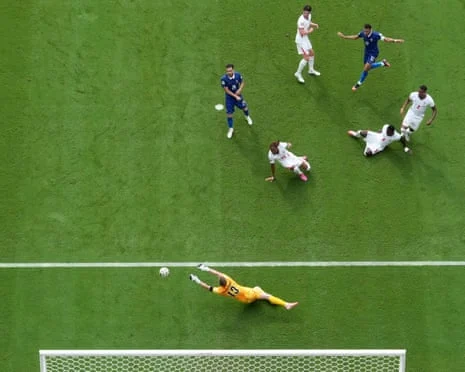
Miami, USA – July 19, 2026 – In a match widely anticipated with a mixture of apathy and curiosity, England delivered a stunning performance, particularly in a dominant first half, to defeat France 4-2 in the World Cup third-place playoff. The Three Lions, fielding what many considered a reserve squad, secured their best World Cup finish since their legendary 1966 triumph, overwhelming a lacklustre French side that mounted a spirited but ultimately insufficient second-half comeback.
The fixture, often dubbed "the game nobody wants to play," nevertheless offered significant talking points, from England’s tactical masterclass under Thomas Tuchel to Kylian Mbappe’s historic individual achievement. Played under the humid Miami night sky, the contest transcended its consolation status to provide an unexpectedly thrilling spectacle, especially after a four-goal English blitz in the opening 45 minutes.
Match Overview: England’s First-Half Masterclass, France’s Late Surge
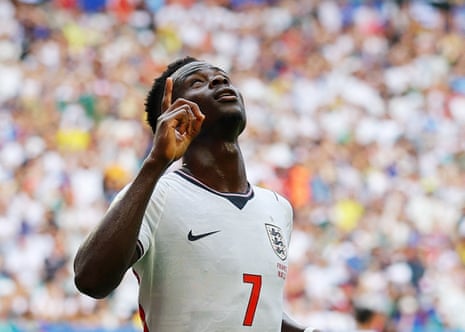
England, still reeling from their semi-final exit, approached the third-place encounter with an intensity that completely blindsided their French counterparts. The first half was a testament to clinical finishing and sharp tactical execution, as Declan Rice, Ezri Konsa, and a brace from Bukayo Saka propelled England to a seemingly unassailable 4-0 lead by the interval. The French defence appeared to be in a state of disarray, offering little resistance to England’s fluid attacks.
However, the second half saw a dramatic shift in momentum. Sparked by a flurry of substitutions and a renewed sense of urgency, France clawed two goals back through their talisman Kylian Mbappe, who etched his name further into World Cup history, and substitute Bradley Barcola. Despite the French resurgence and a palpable tension in the stadium, England managed to weather the storm, largely thanks to crucial saves from goalkeeper Dean Henderson, to hold on for a memorable victory.
Chronology of a High-Stakes Consolation
The atmosphere preceding the match in Miami was tinged with the bittersweet taste of semi-final defeat for both nations. For England, it was an opportunity to cap off a campaign with a morale-boosting win, securing their highest World Cup finish in decades and offering some solace after the "Shame of Atlanta" – a likely reference to their semi-final loss. Manager Thomas Tuchel, whose reputation was under scrutiny, opted for a lineup that hinted at experimentation but ultimately proved potent. France, meanwhile, led by Didier Deschamps, sought a dignified exit, with the added motivation of individual records for stars like Kylian Mbappe, who was chasing the Golden Boot, and Olise, eyeing an assist record.

Kick-off and Early Chaos
The game began at a relatively slow pace, perhaps indicative of the humid conditions and the nature of the match. Intriguingly, France deviated from tournament tradition by not immediately clearing the ball long, suggesting a desire to play from the back. England’s Djed Spence and Marcus Rashford quickly linked up on the left, signalling their attacking intent, while Jarrell Quansah positioned himself on the right.
Almost immediately, England carved out an opportunity that hinted at the defensive frailties of Les Bleus. Bukayo Saka found the net after a precise pass from Quansah, only for the goal to be chalked off for a marginal offside. It was an early warning shot that France, perhaps still mentally recovering from their own semi-final heartbreak, failed to heed.
England’s First-Half Blitz
Goal! France 0-1 England (Rice, 3′)
The breakthrough came swiftly, catching France entirely off guard. A loose ball from French midfielder Doue was pounced upon by England’s midfield anchor, Declan Rice. With clinical precision, Rice drilled a shot past French goalkeeper Mike Maignan, giving England an astonishingly early lead. His celebration, while energetic, also carried a hint of surprise, as if even he couldn’t quite believe how easily England had taken control. The goal was a clear statement of intent and a stark reminder of France’s vulnerability.
Goal! France 0-2 England (Konsa, 19′)
England doubled their advantage just over a quarter of an hour later, further exposing France’s defensive woes. Declan Rice, turning provider this time, delivered a "pearler" of a ball – a cross of exceptional quality – into the French box. Ezri Konsa rose highest, completely unmarked, to powerfully head home, extending England’s lead. The ease with which Konsa scored from a set-piece highlighted the lack of concentration and organisation within the French backline, raising questions about their preparedness for the match. Coach Thomas Tuchel, though maintaining a composed demeanour, offered warm applause, acknowledging his team’s unexpected dominance.
Goal! France 0-3 England (Saka, 37′)
The game descended into what was described as "chaos" for France. England’s relentless attacking pressure continued to pay dividends. Marcus Rashford initiated a move, playing a ball into Saka. The Arsenal winger rounded Maignan, but his path to goal was comically obstructed by the referee. The ball eventually fell to Cherki, whose shot was saved by Dean Henderson. The rebound then travelled all the way back to Rashford, who, after taking a moment, teed up Saka. Saka smashed the ball in off a French boot, completing a truly bizarre sequence of events and putting England three goals to the good. The commentator’s observation that "France are all over the place" felt like an understatement.
Goal! France 0-4 England (Saka, 45+1′)
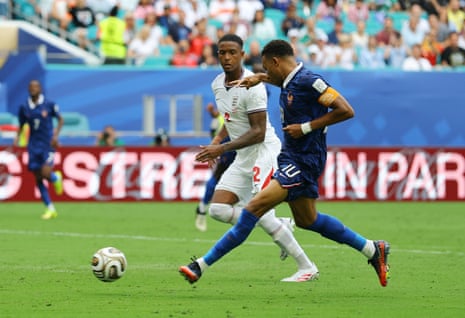
Just before the half-time whistle, England rubbed salt into French wounds with a fourth goal, and Saka’s second of the game. The "formula" remained the same: a pass from Eze found an England forward, who slotted with ease. This time, it was Saka again, demonstrating both style and composure. The growing despair among the French players was evident, contrasting sharply with Thomas Tuchel’s approving applause. Statistics revealed the extent of France’s defensive collapse, with only Malo Gusto credited with a tackle throughout the half, underscoring a complete lack of defensive engagement.
Half-Time Reflections
As the teams headed into the break, the scoreboard read France 0-4 England. It was, as the commentary noted, a "French surrender, an English triumph when it barely matters." Declan Rice, despite his earlier goal, appeared "embarrassed" by the sheer magnitude of England’s lead, reflecting the surreal nature of the occasion. It was a half that defied expectations, transforming a mere consolation match into a stunning display of English attacking prowess against a surprisingly passive French defence.
The French Fightback
The second half began with a flurry of French substitutions, a desperate attempt by Didier Deschamps to inject some life and structure into his demoralised squad. Digne, Upamecano, Dembele, and Barcola were introduced, replacing Konate, Theo Hernandez, Olise, and Doue. England made a single change, with Ollie Watkins coming on for Marcus Rashford.
Goal! France 1-4 England (Mbappe, 48′)
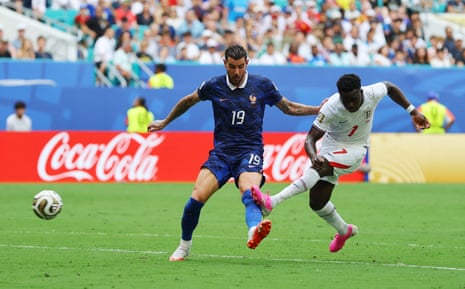
France’s star man, Kylian Mbappe, wasted no time in making his mark, pulling a goal back just three minutes into the second half. Olise, despite being substituted moments later, played a crucial ball to Mbappe, who clinically finished for his ninth goal of the tournament. This strike cemented his place as the joint all-time World Cup scorer alongside Lionel Messi, a phenomenal individual achievement. His "half-celebration" spoke volumes of his hunger for more, even in a losing effort, and his relentless pursuit of personal accolades.
France’s Renewed Pressure
The French comeback instilled a new sense of urgency and "needle" into the game. England, now facing a revitalised opponent, found themselves defending more frequently, almost playing with the hesitancy that characterised France’s first half. Rabiot had a chance after a rare French tackle, further highlighting the shift in momentum.
Goal! France 2-4 England (Barcola, 54′)
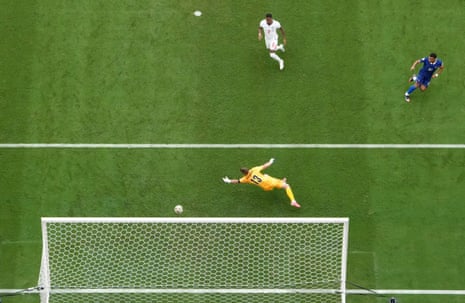
The tension escalated dramatically when France scored their second. Eze, attempting an audacious solo chip from distance, lost possession. France swiftly countered, and Bradley Barcola "galloped on," slotting the ball past Henderson. The scoreboard now read 4-2, immediately triggering warnings from viewers about the "most dangerous lead in football." The prospect of England squandering a four-goal advantage loomed, threatening to turn Thomas Tuchel’s "warm applause" into the "deepest hue of mud."
Henderson and Maignan Called into Action
The match became a more even, end-to-end affair. Maignan, who had a torrid first half, made a "brilliant save" from a Toney flick that came off Watkins from a Rice corner, denying England a fifth goal and keeping France’s hopes alive. At the other end, Dembele escaped on the left, forcing a fine save from Henderson, a stop that earned the approval of substitute Jordan Pickford, even though an offside flag would have nullified the danger.
Despite the intensity, England managed to see out the remaining minutes, preventing any further French goals and securing their hard-fought third-place finish.
Supporting Data and Key Performances
- England’s Historic Achievement: This third-place finish represents England’s best performance at a World Cup since their victory in 1966. Previous third-place playoffs in 1990 and 2018 ended in losses to Italy and Belgium, respectively.
- Kylian Mbappe’s Milestone: With his ninth goal of the tournament, Mbappe drew level with Lionel Messi as the joint all-time World Cup top scorer. This individual brilliance underscores his status as one of football’s living legends, even amidst his team’s disappointment.
- Olise’s Record Assists: Olise registered his fifth assist of the tournament, equalling the World Cup record held by Pelé, demonstrating his exceptional playmaking ability for France.
- French Defensive Woes: The stark statistic that only Malo Gusto made a tackle for France in the first half highlights a collective defensive failure that allowed England to build their commanding lead.
- High-Scoring Tournament: The World Cup 2026 has been a goal-fest, with this match contributing to a tally of 300 goals in the tournament, indicating a trend of expansive, attacking football.
Official Responses and Managerial Insights
Anthony Barry’s Emotional Half-Time Address:
England’s assistant coach, Anthony Barry, provided a poignant insight into the team’s mindset at half-time. Speaking to the BBC, Barry expressed profound pride in his players: "To be honest there’s no frustration. I’m a little bit emotional. I can’t find the words to describe how proud I am of these players. They’re playing a game with broken hearts. I see 11 lads on the field with broken hearts. I’ve seen them in the hotel the last few days with broken hearts. And they can build a performance like that through pride of playing for England."
He acknowledged the potential cynicism surrounding the match but emphasised the team’s spirit: "I know what the cynics will say, ‘it’s too late’, but we’re still playing against a world-class opponent and that 45 minutes I’m so proud of the boys. There’s 45 minutes to go, the game’s not done, anything can happen. In isolation I’m proud of the team and I hope everyone back home is as well." Barry’s words painted a picture of a squad driven by national pride, overcoming the emotional fatigue of a gruelling tournament.
Arsène Wenger on Hydration Breaks:
Amidst the on-field drama, FIFA’s chief of global football development, Arsène Wenger, addressed the ongoing debate surrounding hydration breaks. Introduced as mandatory three-minute pauses midway through each half of World Cup matches, these breaks had drawn criticism for disrupting the flow of play and offering additional commercial opportunities for broadcasters.
Wenger, however, denied that the breaks had any significant impact on the games’ outcomes. "No," Wenger stated at a press conference, when asked about their influence. "Sometimes they did not like them and we have to analyse after the World Cup what is the impact. It did not look to me that it [hydration break] changed the results of the competition. But we are here to serve people who watch football." His comments suggest that while FIFA is open to reviewing their effectiveness, the primary concern remains the fan experience and the integrity of the game.
Implications: Pride, Records, and a Farewell
For England, a Resurgent Finale:
This third-place victory, while not the ultimate prize, provides a significant morale boost for England. It demonstrates the depth of their squad, with several "reserve" players stepping up on a global stage. Thomas Tuchel, despite the underlying "shame of Atlanta," can point to a strong finish and a team that responded positively under pressure. The performance, especially the first half, offers a blueprint for attacking football and suggests a promising future for some of the younger talents. It also lays down a marker for future tournaments, showcasing England’s capability to compete at the highest level consistently.
For France, a Disappointing Conclusion:
For France, this match marked a disappointing end to a campaign that promised so much. Having been champions or finalists in previous tournaments, a third-place playoff loss, particularly with such a heavy first-half deficit, will undoubtedly sting. While Mbappe’s record-breaking feat and Olise’s impressive assist tally are individual highlights, they are overshadowed by the team’s collective defensive shortcomings. Didier Deschamps’ tenure may conclude with questions about his tactical choices in this match and the overall defensive solidity of his side. The performance in Miami will necessitate a period of reflection and re-evaluation for Les Bleus.
The Debate on Consolation Matches and Innovations:
The match itself reignited the perennial debate about the relevance of third-place playoffs. While some fans, like "Jeff Sax," dismissed it as a "pointless match, pointless result," the thrilling six-goal encounter and the pursuit of individual records clearly provided entertainment. The emotional response from Anthony Barry and the players also underscored the enduring pride associated with representing one’s country, regardless of the trophy at stake.
Furthermore, the discussion around hydration breaks highlights FIFA’s ongoing efforts to adapt the game while facing scrutiny from fans and pundits. The tournament’s high goal count may be a factor in these discussions, as football administrators seek to balance player welfare, commercial interests, and the purity of the sport.
In conclusion, England’s emphatic victory over France in the World Cup third-place playoff was far from a meaningless encounter. It was a match filled with individual brilliance, tactical contrasts, and emotional depth, offering a dramatic conclusion to an intriguing World Cup campaign for both nations.


 Azzam Bilal Chamdy
 Sagoh
Sagoh
 Neng Nana
 Nana Wu
 Lina Hope

 Iffa Jayyana