
 rifanmuazin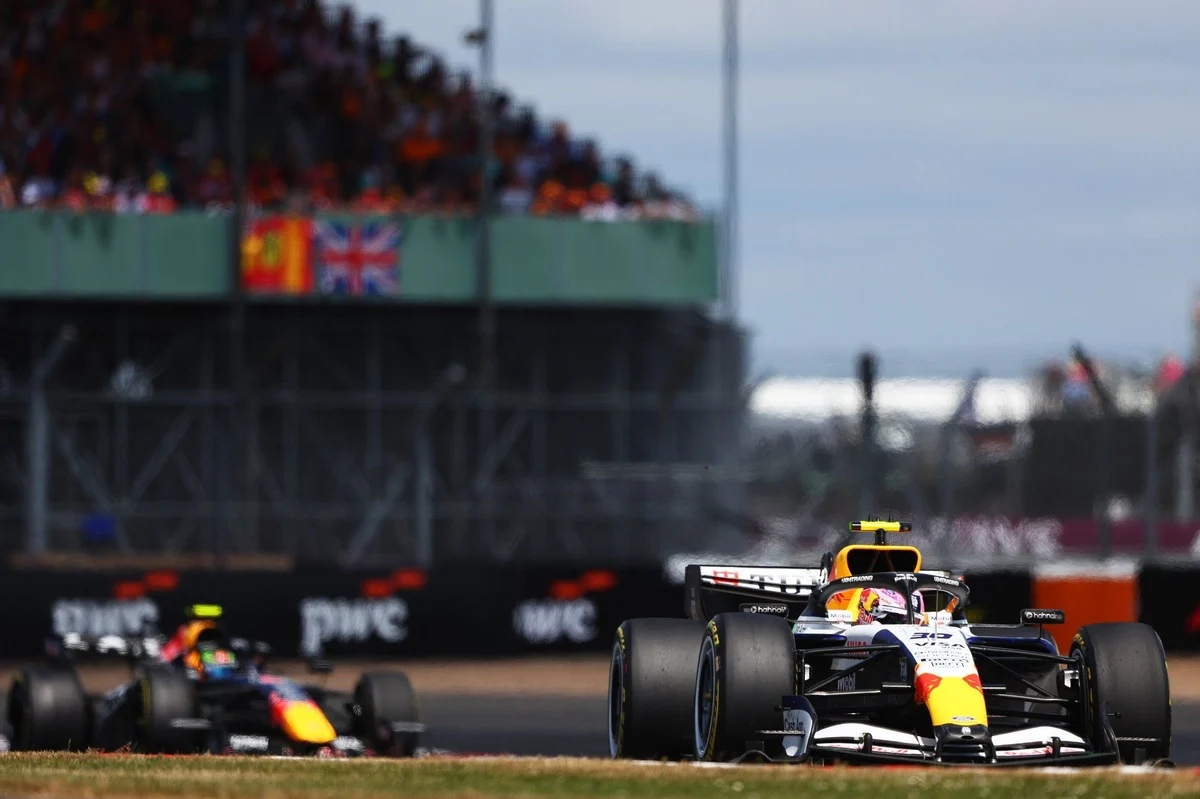
The British Grand Prix sprint race at the iconic Silverstone Circuit provided a masterclass in tactical defense and wheel-to-wheel intensity. At the heart of the action was Liam Lawson, who managed to cling to the final points-paying position—eighth place—despite a high-stakes investigation into his defensive maneuvers against Red Bull’s Isack Hadjar. While the move sparked a post-race inquiry, the ultimate outcome saw Lawson keep his position, albeit with a formal warning from the FIA stewards that underscored the fine line between aggressive racing and regulatory overreach.
The Chronology: How the Battle Unfolded
The sprint race began with a flurry of action that shuffled the order significantly. Isack Hadjar, who started in a promising position, suffered a difficult opening lap that saw him plummet down the order. This instability allowed Liam Lawson to capitalize, moving into the top eight after executing a clean overtake on a fast-starting Pierre Gasly.
As the race settled into its rhythm, Lawson found himself comfortably within the points, but the status quo was short-lived. Hadjar, possessing superior pace and energy levels, began a determined charge through the field. By the closing stages, the Frenchman was looming large in Lawson’s mirrors, setting the stage for a tense penultimate-lap showdown at Stowe corner.
As the duo approached the high-speed entry to the corner, Hadjar sensed an opportunity to reclaim the eighth position. He committed to an overtake, only for Lawson to shift his car across the track in an abrupt defensive move. The "chop" was sharp enough to force Hadjar to adjust, effectively neutralizing the threat. Lawson held his line, finishing seven-tenths of a second ahead of his former Racing Bulls teammate to secure the final point of the sprint.
Official Investigation and Stewards’ Findings
The incident did not go unnoticed by the race officials. The FIA stewards immediately flagged the maneuver as an "abnormal change of direction" and opened an investigation. The primary point of contention was whether Lawson had moved under braking, a move strictly prohibited by the sporting regulations to ensure driver safety.
The official report from the FIA provided a granular look into the decision-making process. The stewards acknowledged that while the move was indeed "abrupt," the mitigating factors provided by both drivers were pivotal in the final verdict.
"The matter concerned the defensive move by Car 30 [Lawson] on the approach to Turn 15 on Lap 16 while defending position against Car 6 [Hadjar]," the report stated. "The driver of Car 30 stated that, at the relevant time, he was still at full throttle and had not yet commenced braking, and that the movement of the car was part of deceleration and preparation for the corner rather than a movement under braking."
Crucially, the stewards validated this defense. They accepted that Lawson had not yet entered the braking phase when he initiated his defensive line. Furthermore, the varying energy states of the two vehicles—with Hadjar having more to deploy—made it exceptionally difficult for Lawson to gauge the closing speed of his rival.

Sportsmanship and the ‘Victim’s’ Testimony
Perhaps the most surprising element of the investigation was the testimony provided by Hadjar himself. In a display of commendable sportsmanship, the Red Bull driver conceded that while the move was "sharp," it did not warrant a penalty. Hadjar’s testimony to the stewards was clear: he felt that despite the aggression, Lawson had left him sufficient room to avoid contact.
Hadjar’s perspective served as a key piece of evidence for the stewards. "The driver of Car 6 stated that the move by Car 30 was sharp, but also that sufficient room was left and that contact was avoided. In his view, the incident did not merit a penalty," the report noted.
This camaraderie suggests a level of mutual respect between the two drivers, both of whom are navigating the highly competitive landscape of F1 feeder series and junior development programs. By refusing to lobby for a penalty, Hadjar prioritized the spirit of hard racing over a potentially "cheap" points gain via the steward’s office.
The Fine Line of Compliance: A Formal Caution
Despite the lack of a time penalty, the stewards did not let Lawson off entirely unscathed. They determined that the move, while technically legal regarding the timing of the braking phase, was nonetheless "marginally over the limit" of acceptable defensive conduct.
The resulting "Warning" serves as a middle ground—a regulatory "yellow card." The stewards justified this by noting that the move was, at the very least, sufficiently late to potentially endanger other drivers had they not been as alert as Hadjar.
"The Stewards consider that the defensive move by Car 30 was sufficiently late and abrupt that it warranted a formal caution," the report concluded. "Although the Stewards were not satisfied that the circumstances justified a stronger penalty, they considered that the move was marginally over the limit of what is acceptable when defending into a corner."
Driver Perspectives: Lawson’s Take
In the aftermath of the race, Lawson remained pragmatic about the incident. Speaking to Sky Sports, he addressed the aggression of the move, balancing his need to defend with the reality of his car’s performance.
"We were still full throttle when I was trying to defend, but maybe it was aggressive, I don’t know, we’ll see," Lawson remarked. He acknowledged the performance gap, noting, "It was a good race. I think we struggled towards the end; we didn’t really expect to have the pace to fight Red Bulls anyway today."

Lawson’s comments reflect the high-pressure environment of the sprint format, where a single mistake can result in a significant loss of championship standing. His willingness to defend hard is a hallmark of his driving style, one that has earned him both fans and, occasionally, the scrutiny of the authorities.
Implications for the Championship
The retention of that single point for eighth place may seem minor in the grand scheme of a long season, but in the highly congested mid-field, every point is a potential decider. By holding off Hadjar, Lawson successfully defended his territory, ensuring that his momentum remained intact heading into the main Grand Prix.
For the FIA, this incident highlights the ongoing difficulty of officiating "defensive movement under braking." As cars become faster and the gaps between teams continue to shrink, the closing speeds into heavy braking zones like Stowe are becoming increasingly dynamic. The stewards’ decision to issue a warning rather than a penalty sets a precedent: if you defend aggressively, you must ensure you have not yet entered the braking zone, and you must provide your rival with a "racing chance" to avoid contact.
Conclusion: The Spirit of Silverstone
The sprint at Silverstone was defined by the thin margin between a hard-fought defense and an illegal block. Lawson walked that line with precision—perhaps unintentionally, but successfully nonetheless. The intervention of the stewards, tempered by the honesty of Hadjar, ensured that the final point was decided on the track rather than in the boardroom.
As the paddock looks toward the remainder of the season, the "Lawson-Hadjar" incident will likely be cited in drivers’ briefings. It stands as a reminder that while the stewards are vigilant in enforcing safety, they are also listening to the drivers themselves. In this instance, the sport was the winner, with two young talents demonstrating that even in the heat of battle, professional respect remains the bedrock of Formula 1 racing.
Lawson leaves Silverstone with his point, his reputation for uncompromising defense intact, and a formal warning that will keep him on his toes for the races to come. For the fans, it was a glimpse of the intensity that defines the pinnacle of motorsport, proving that even in a short sprint, the drama can be as profound as any full-distance Grand Prix.


 Pevita Pearce
 Evan Lee Salim
 Neng Nana
 Nana Wu
 Lina Hope

 Sagoh
Sagoh
 Iffa Jayyana