
 rifanmuazin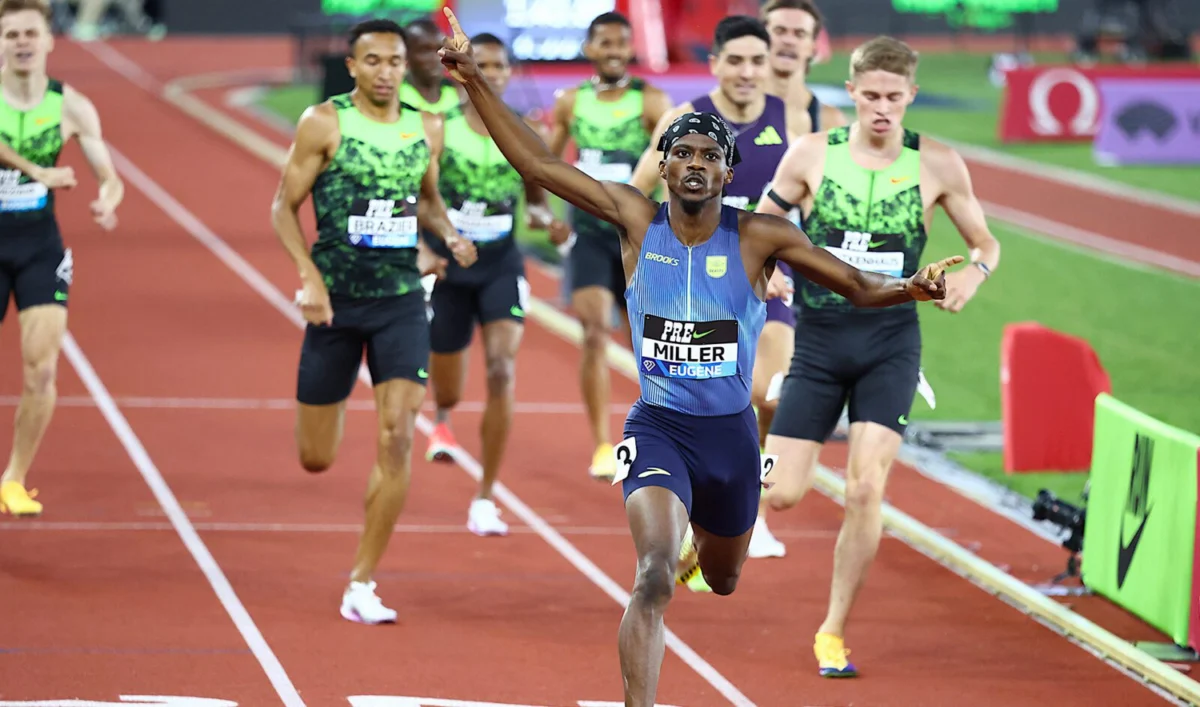
The Surge at Hayward Field: A Victory Defined by Patience
In the high-stakes theater of professional middle-distance running, few skills are as revered—or as feared—as the "kick." On the evening of July 3, 2026, at the legendary Hayward Field in Eugene, Oregon, Brandon Miller provided a masterclass in tactical patience, overcoming a ninth-place position on the final lap to secure his third consecutive 800m victory at the Prefontaine Classic.
Clocking an impressive 1:43.68, the 23-year-old Brooks Beasts athlete demonstrated that he is currently the man to beat in a discipline defined by razor-thin margins. His performance was not merely a display of raw speed, but a calculated execution of a race strategy that appears to be becoming his signature.
The Rivalry: Miller vs. Lutkenhaus
The buildup to the race was dominated by the narrative surrounding 17-year-old sensation Cooper Lutkenhaus. Having captured the world indoor 800m title in March and maintaining an unblemished record throughout the season—including dominant victories at the Oslo and Stockholm Diamond League meets—Lutkenhaus entered the Prefontaine Classic as the undisputed favorite.
For much of the race, the teenager appeared to be in control, dictating the tempo and positioning himself perfectly to strike. However, as the field rounded the final bend, the dynamics shifted. While Lutkenhaus held the inside lane, Miller, who had been buried in the pack, found a second gear. His explosive transition from ninth place to the front of the field left the spectators in awe and the field scrambling for position.
Lutkenhaus crossed the line in 1:44.62, a commendable time for any athlete, but one that left him visibly frustrated. The race served as a humbling reminder that in championship-level athletics, momentum is fragile and experience—even at the age of 23—is a potent weapon.
Chronology of the 800m Final
The race began with a frenetic pace, characteristic of the world-class field assembled in Eugene. The first 400 meters were covered with tactical aggression, with athletes jostling for the optimal lane positioning. As the bell rang for the final lap, the pack remained tightly bunched.
At the 600-meter mark, Brandon Miller was still languishing in ninth position, appearing to be an unlikely candidate for the podium. To the casual observer, he seemed trapped behind a wall of runners. However, Miller, who trains under the tutelage of middle-distance stalwart Josh Kerr, remained composed.
As the runners hit the final straightaway, the separation began. Miller moved to the outside, utilizing the outer lanes to avoid the congestion that stifled his competitors. With 100 meters remaining, he surged past the leaders, his stride lengthening as he pulled away to secure the win. The victory was reminiscent of his performance last month at the Los Angeles Grand Prix, where he employed a nearly identical strategy to overtake a stacked field and clock a 1:43.94 finish.
A Legacy of Excellence: The Brooks Beasts Factor
The success of Brandon Miller is inextricably linked to the environment at the Brooks Beasts Track Club. His training partner, Josh Kerr, has been a pivotal influence, fostering a culture of rigorous, analytical preparation.
The relationship between the two is symbiotic. While Miller dominates the 800m, Kerr is currently setting his sights on history, preparing to challenge Hicham El Guerrouj’s world mile record of 3:43.13 at the upcoming London Diamond League meet on July 18. This high-performance training ground has clearly provided Miller with the psychological resilience required to navigate the high-pressure environment of the Diamond League circuit.
Tactical Brilliance Beyond the 800m
The Prefontaine Classic was not limited to the excitement of the 800m. The event, which has seen a resurgence in its Friday night format—reinvoking the spirit of the historic "Distance Night"—delivered across multiple disciplines.
The Men’s Two-Mile Battle
In an intriguing and tactical two-mile race, Parker Wolfe emerged victorious. The 2024 NCAA 5000m champion demonstrated a mature racing intelligence, crossing the line in 8:10.13. The race was a tight affair, with Germany’s Mohamed Abdilaahi pushing him to the limit, setting a personal best of 8:10.34. American standout Grant Fisher rounded out the top three with an 8:10.96 finish, further highlighting the incredible depth of talent currently competing in the American distance circuit.
Hammer Throw Dominance
The field events were equally spectacular, headlined by the return of Canadian powerhouse Ethan Katzberg. The Olympic and double world hammer throw champion produced a statement performance, launching the implement to a world-leading and Diamond League record distance of 83.33m. This mark, the fourth-best of his illustrious career, left second-place finisher Rudy Winkler of the United States trailing by over two meters (81.12m). Katzberg’s consistency and technical precision continue to set a standard that few in the sport can match.
The Women’s 400m Narrative
The women’s 400m provided both celebration and cautionary tales. Jamaica’s Dejanea Oakley continued her meteoric rise, backing up her collegiate record of 48.79 set last month at the NCAA Championships with a commanding 49.64 victory. Oakley’s ability to perform at such a high level so soon after her collegiate season suggests that she is firmly on track for global dominance.
Conversely, the race marked the return of Ireland’s Rhasidat Adeleke, who had been sidelined by injury. While her 52.26 finish for ninth place was far from her personal best of 49.07, the focus for the Irish record-holder was strictly on competitive re-entry. Her presence on the track signals a critical step in her rehabilitation process as she eyes the remainder of the season.
Implications for the Season
The results at Hayward Field have significant implications for the global track and field landscape. For Brandon Miller, the victory solidifies his status as the primary threat in the 800m heading into the latter half of the season. His ability to win from behind suggests that he is not reliant on a specific pace, making him the most versatile runner in the event.
For Cooper Lutkenhaus, the defeat provides valuable data. At 17, the teenager has already accomplished more than most athletes do in a decade. The challenge for his camp will be to adjust his training to handle the late-race speed of veterans like Miller, who are clearly targeting his tactical approach.
Furthermore, the revival of the "Friday Night" format at the Prefontaine Classic has proven successful. By blending distance-heavy events with marquee field events like the hammer throw, organizers have created a cohesive, high-energy atmosphere that appeals to both purists and casual fans. As the sport looks toward the London Diamond League and subsequent championship meets, the performances in Eugene suggest that the current generation of athletes is operating at an unprecedented level of efficiency.
Looking Ahead
As the track and field community turns its attention to the upcoming Diamond League fixtures, the pressure on athletes like Josh Kerr and Brandon Miller will only intensify. With record-breaking attempts on the horizon and rising stars continuing to challenge the status quo, the 2026 season is shaping up to be one of the most competitive in recent memory.
The takeaway from the Prefontaine Classic is clear: track and field is in a golden age of tactical nuance. Whether it is the patient surge of an 800m runner or the technical perfection of a hammer thrower, the pursuit of excellence continues to push the boundaries of human performance. Athletes are not just running faster; they are racing smarter, and in the case of Brandon Miller, that intelligence is proving to be the difference between a podium finish and a historic win.

 Nana Wu
 Siti Muinah
 Neng Nana

 Lina Hope
 Sagoh
Sagoh
 Iffa Jayyana