
 Layla Zulfa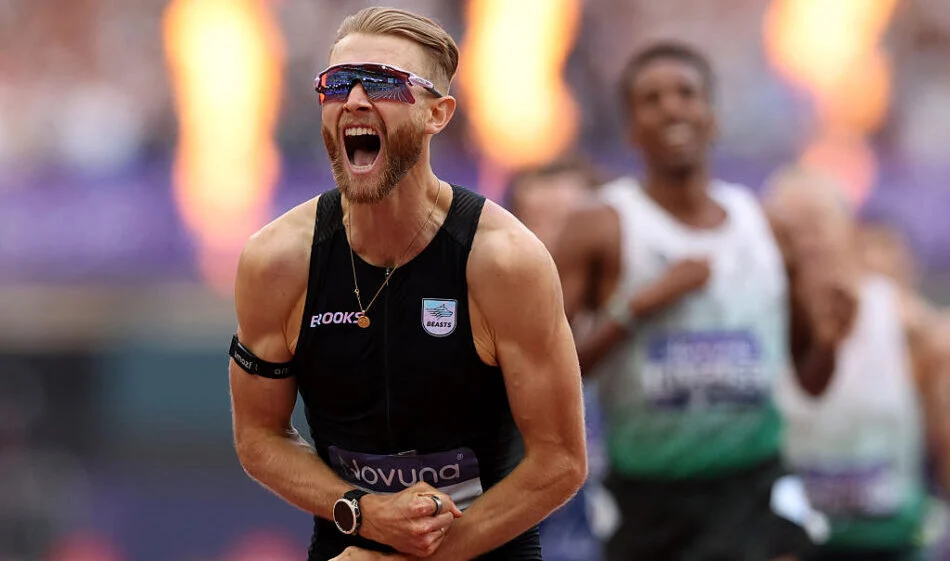
By Athletics Correspondent
In the hallowed history of middle-distance running, few barriers have carried the mythic weight of Hicham El Guerrouj’s world mile record. For 27 years, the mark of 3:43.13 stood as a testament to the Moroccan legend’s otherworldly endurance—a "soft" record to none, and an insurmountable peak to the world’s elite. Yet, on a crisp, electrically charged Saturday evening at the London Stadium, Scotland’s Josh Kerr did the unthinkable. With a blend of calculated aggression and pure, unadulterated grit, Kerr stopped the clock at 3:42.66, officially ushering in a new era for the discipline and cementing his status as one of the greatest milers to ever lace up spikes.
A Promise Kept: The Architecture of ‘Project 222’
The path to this record was not born of spontaneity; it was an act of architectural precision. Months ago, with the trademark bravado that has defined his rise to the top of the sport, Kerr publicly declared his intent to dismantle El Guerrouj’s time. He dubbed the endeavor "Project 222"—a numerical nod to the seconds required to etch his name into the annals of athletics history.
While many athletes shy away from the scrutiny of public declarations, Kerr embraced the spotlight, turning the London meet into the most anticipated event of the summer. "Will he do it?" was the singular question reverberating through the London Stadium as fans gathered. To the veteran observer who witnessed El Guerrouj’s own record-breaking performances in the late 90s, the skepticism was palpable. The stars, one thought, would have to align in a rare, celestial configuration for such a record to fall. On Saturday, they did more than align—they bowed to Kerr’s sheer force of will.
The Chronology of a Perfect Race
The evening began with a slight reprieve from the brutal heatwave that had recently gripped the city. By the time the men’s mile field gathered at the start line, the temperature had settled into a manageable 23-24°C, accompanied by a cooling cloud cover and a near-absence of wind—the perfect conditions for a record-breaking attempt.
The race plan was executed with mechanical efficiency. Pacemakers Brannon Kidder and Zan Rudolf set a searing, controlled tempo, guiding the pack through the 800m mark in 1:50.63. Kerr, maintaining a disciplined third position, remained tucked behind the leaders, acutely aware of the danger lurking in his shadow: American sensation Yared Nuguse.
As the race entered its critical phase with 600 meters to go, the tactical mask dropped. Kerr surged to the front, seizing control of the race and the rhythm. Passing the bell in 2:46.39, he began the long, agonizing extraction of pace required to break the record. With 350 meters remaining, he shifted gears, lengthening his stride and pulling away from the field with a majestic, fluid motion that left his competitors chasing ghosts.
As he crossed the finish line, the stadium erupted. The digital clock confirmed the feat: 3:42.66. Behind him, Nuguse finished a respectable second in 3:45.69, while Wales’ Jake Heyward—marking a triumphant return from a prolonged injury hiatus—clocked a Welsh record of 3:46.73 to secure third. Arlo Ludwick, the British champion, rounded out a historic day for the home contingent with a 3:48.17.
Supporting Data: The Anatomy of the Record
The analytical breakdown of Kerr’s performance highlights the brutal intensity of his final lap. The splits tell the story of a man pushing against the limits of human physiology:
- 440 yards (1/4 mile): 55.4 seconds
- 880 yards (1/2 mile): 1:51.4 seconds
- 1320 yards (1207m): 2:47.3 seconds
- 1500m split: 3:27.62
To put this into context, Kerr was effectively running at the pace of a world-class 1500m record attempt, then sustaining that effort for an additional 109 meters. His ability to maintain form while his body undoubtedly begged for respite in the final 110 meters—a point at which he admitted to being "deaf" from the roar of the crowd and the sheer physiological strain—is a testament to his conditioning.
Voices from the Track: Official Responses
The emotional weight of the achievement was not lost on the champion. "It is very overwhelming," an exhausted but radiant Kerr told reporters trackside. "There was a lot of hype. I am surrounded by amazing people, so I have continued to put the work in, and I knew I had a 3:42 in me. I nearly lost it there at the end, but I got over the line."
Kerr’s metaphor for his training camp—a "kitchen full of incredible chefs"—perfectly encapsulates the collaborative effort required to reach such heights. "I am just the body," he remarked, "but there is an incredible amount of work behind the scenes. This is the dish I wanted to make."
World Athletics President Sebastian Coe, a man who knows a thing or two about mile records, was among the first to congratulate the Scot. As he presented Kerr with the prestigious Emsley Carr Mile trophy and the £50,000 world record prize, Coe was visibly moved.
"It was unbelievable, executed brilliantly, foot perfect," Coe stated. "It’s as good a record as there is. This will have blown the wall away. He will go on to do incredible things. It’s just nice to see it back in the hands of a Brit. We’ve had a few, but Josh is as good as they get."
The Implications: A New Era for British Athletics
The repercussions of Saturday’s performance extend far beyond the record books. For British athletics, this is a signal that the nation remains a global powerhouse in middle-distance running. In an era where football often dominates the national consciousness, Kerr’s victory serves as a powerful reminder of the individual brilliance cultivated within the UK’s track programs.
Following a period of mixed results in other sports, the success of athletes like Kerr, as well as Keely Hodgkinson’s thrilling win in the women’s 800m later that evening, provides a much-needed shot in the arm for British sports fans. The performance shifts the narrative, creating a momentum that is expected to carry into the upcoming Commonwealth Games in Glasgow and the European Championships in Birmingham.
Kerr has not only broken a record; he has redefined the ceiling for his peers. By succeeding after a long, public, and high-pressure build-up, he has echoed the legendary footsteps of Roger Bannister. Like Bannister in 1954, Kerr faced the skepticism of the masses and the weight of history, and he emerged victorious.
As the sun sets on this historic day in London, one thing is certain: the sport of athletics has a new titan. Josh Kerr has moved from the realm of the talented to the realm of the legendary. Project 222 is complete, but for a man who treats his career as a culinary masterpiece, one suspects the menu is only just beginning to expand. The world of running now waits, with bated breath, to see what this extraordinary Scotsman will cook up next.


 Nana Wu
 Siti Muinah
 Neng Nana

 Lina Hope
 Sagoh
Sagoh
 Iffa Jayyana