
 Layla Zulfa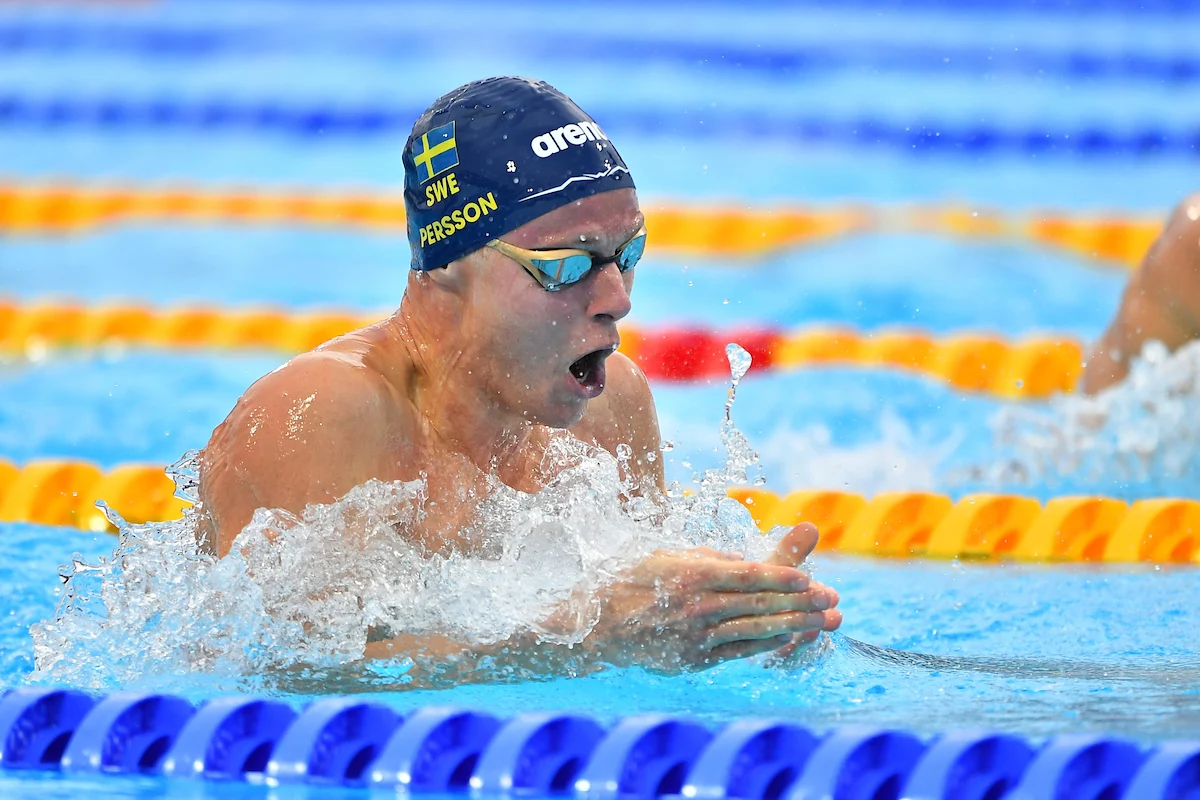
In a quiet conclusion to a decorated career, Erik Persson—undoubtedly one of the most significant figures in the history of Swedish men’s swimming—has officially announced his retirement from competitive sports. The 32-year-old, whose mastery of the breaststroke defined a generation of Nordic aquatic excellence, stepped away from the starting blocks with the same understated grace that characterized his years of elite performance.
While the news recently surfaced through an interview with the Swedish publication Norra Halland, the transition had been in motion for months. Having taken a hiatus from competition to pivot toward coaching, Persson’s official departure marks the end of a tenure that saw him become the face of Swedish breaststroke on the global stage.
The Architect of Swedish Breaststroke: A Career in Review
Erik Persson’s career was not merely a collection of medals; it was a testament to longevity and technical evolution. For over a decade, he served as the standard-bearer for Swedish swimming, earning the prestigious title of "Swedish Swimmer of the Year" on six separate occasions.
His competitive DNA was rooted in his home region of Kungsbacka, located on Sweden’s southwest coast. From these humble beginnings, Persson ascended to the peak of the sport, eventually relocating to the epicenter of Swedish swimming to train at the highest possible level. His dominance was reflected in the record books, where he still stands as the Swedish national record holder in the 100-meter breaststroke (1:00.08) and the 200-meter breaststroke (2:07.66).
A Timeline of Excellence
- 2016 Rio de Janeiro: Persson makes his Olympic debut, signaling his arrival as a force in the 100m breaststroke.
- 2019 Glasgow: He secures a silver medal in the 200m breaststroke at the European Short Course Championships, proving his mettle in high-intensity formats.
- 2020/2021 Budapest/Tokyo: Persson claims a bronze medal at the European Long Course Championships in Budapest, followed by his second Olympic appearance in Tokyo, where he competed in the 200m breaststroke.
- 2022 Budapest: The crowning moment of his career arrives at the FINA World Championships, where he clinches a silver medal in the 200m breaststroke, cementing his status as a world-class athlete.
- 2024 Belgrade/Paris: Persson captures the gold medal at the European Championships in Belgrade, providing a golden coda to his international career, followed by his final Olympic appearance in Paris.
- December 2024: His final competitive bow at the Swedish National Championships, where he finished 1st in the 200m breaststroke and 4th in the 100m breaststroke.
Supporting Data: By the Numbers
To understand the magnitude of Persson’s contribution, one must look at the consistency of his output. Unlike many swimmers who peak in a single Olympic cycle, Persson maintained a competitive edge across three distinct Olympic Games.
| Event | Achievement | Year |
|---|---|---|
| 100m Breaststroke (National Record) | 1:00.08 | N/A |
| 200m Breaststroke (National Record) | 2:07.66 | N/A |
| 200m Breaststroke (World Champs) | Silver | 2022 |
| 200m Breaststroke (Euro Champs) | Gold | 2024 |
| 200m Breaststroke (Euro Champs) | Bronze | 2020 |
| 200m Breaststroke (Short Course) | Silver | 2019 |
While he never advanced to an Olympic final—a hurdle that remained the only unclimbed mountain in his storied career—his record at the Continental and World level compensates for the narrow margins of the Olympic pool. His ability to perform under the lights of the European Championships and the World Championships elevated Sweden’s profile in a discipline historically dominated by larger nations.
Reflections on a Legacy
In his candid conversation with Norra Halland, Persson revealed a sense of peace regarding his decision. There was no grand press conference, no fanfare, and no final farewell tour; just a quiet transition into a new phase of life. He noted that all his medals, symbols of years of grueling morning training sessions and international travel, are now safely stowed away at his father’s home in Kungsbacka.
This detail is telling of the man behind the athlete. Persson was never one to court the spotlight for its own sake. His motivation was internal, driven by a desire for technical perfection in the water rather than the trappings of fame. Even as he exits the pool for the final time, he remains focused on the future, utilizing his extensive knowledge of the sport to mentor the next generation of Swedish swimmers.
Implications for Swedish Swimming
The retirement of Erik Persson leaves a significant vacuum in the Swedish national team. In elite swimming, a veteran of his caliber provides more than just points on a scoreboard; they provide a blueprint for training, preparation, and professional mindset.
The Coaching Transition
Persson’s move into coaching is a promising development for the Swedish Swimming Federation. The transition from an elite athlete to a coach is a path fraught with challenges, but Persson brings with him the nuanced understanding of the breaststroke that only a multi-time record holder can possess. By passing on the technical rigors of the 200-meter event to younger swimmers, he is essentially ensuring that the knowledge he accumulated over 15 years does not vanish with his retirement.
The Search for a Successor
The Swedish men’s team must now navigate a post-Persson era. While the depth of Swedish swimming is robust, replacing a six-time Swimmer of the Year is a monumental task. The focus will likely shift to younger prospects who were nurtured in the shadow of Persson’s success. The challenge for these athletes will be to replicate his consistency—a hallmark of his career that saw him remain relevant well into his thirties.
A Final Bow: Looking Ahead
As the swimming world reflects on his departure, the narrative surrounding Erik Persson is one of immense respect. In a sport where the shelf life of an athlete is often brutally short, Persson’s ability to remain at the top of the European ranks for over a decade is the true measure of his greatness.
His final race in December 2024 was a fitting end: a victory in the 200m breaststroke at the Swedish Nationals. He left the sport on his own terms, as a champion, and without the injuries or decline that force so many athletes to retire prematurely.
"I’m done," he told Norra Halland, a simple sentence that carried the weight of a decade of international competition. While his competitive chapter has closed, his influence on the sport—both as a mentor and as the standard-setter for future Swedish breaststrokers—is only beginning to take root.
Erik Persson leaves behind a legacy defined by national records, international hardware, and a profound commitment to his craft. For those who watched him in the water, he was a steady, reliable, and technically gifted athlete who proved that even from a quiet town on the Swedish coast, one could touch the walls of the world’s greatest arenas. He moves on now to the role of coach, where he will surely continue to shape the sport he served with such distinction.
The medals in his father’s home serve as a physical history, but his true legacy will be the swimmers who look at his national records and strive, as he did, to push the boundaries of what is possible in the water.

 Lina Hope
 Raul Delapena Setiawan
 Pevita Pearce
 Basiran
 rifanmuazin
 Nila Kartika Wati
 Nana
Nana