
 Iffa Jayyana
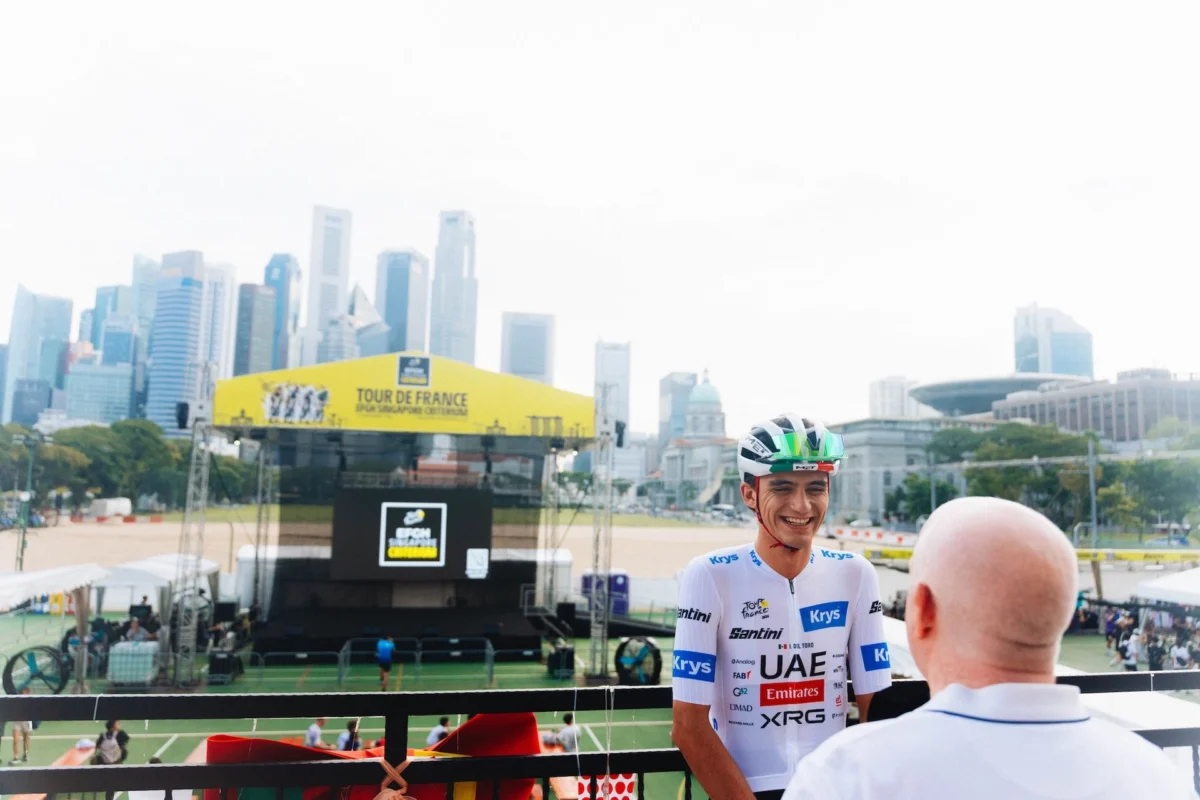
SINGAPORE — Over the past two years, the professional cycling landscape has witnessed the rapid ascension of one of its most dynamic and versatile young talents. Since his explosive breakthrough at the 2024 Tour Down Under, Isaac del Toro has transcended the traditional arc of a neo-pro.
Competing at the absolute zenith of the sport with UAE Team Emirates-XRG, the Mexican prodigy has not merely accumulated victories; he has systematically metabolized both his triumphs and his missteps into a masterclass in professional maturity. Ahead of the Singapore Criterium, del Toro reflected on a stellar 2026 campaign that positioned him firmly in the conversation as the future of general classification racing.
Following a remarkable season featuring four WorldTour stage-race overall victories and a stunning podium finish on his Tour de France debut, del Toro’s trajectory suggests that cycling’s balance of power is shifting toward a new generation of multi-faceted contenders.
Main Facts: The Anatomy of a Breakout Season
The 2026 professional road cycling season will be remembered as the year Isaac del Toro transitioned from a high-ceiling prospect into a bona fide WorldTour dominator. Operating within the powerhouse ecosystem of UAE Team Emirates-XRG, del Toro compiled a palmarès that would define the career of many seasoned veterans—all before his mid-20s.
- Overall WorldTour Victories (4): Del Toro claimed the general classification crowns at the UAE Tour, Tirreno-Adriatico, the Tour Auvergne-Rhône-Alpes, and the Grand Prix Cycliste de Montréal.
- Grand Tour Breakthrough: On his maiden appearance at the Tour de France, the Mexican climber captured a stage victory and secured a sensational third-place finish overall.
- Tactical and Team Synergy: Beyond his personal victories, del Toro played a pivotal domestique and co-leader role, instrumental in helping teammate Tadej Pogačar secure his historic fifth Tour de France yellow jersey.
- Philosophy of Growth: Throughout his meteoric rise, del Toro has repeatedly emphasized in media engagements that his success is inextricably linked to analyzing his errors—viewing every cracked day or mistimed tactical move as essential data points for his development.
Chronology: From the 2024 Tour Down Under to Singapore
To understand the magnitude of del Toro’s 2026 campaign, one must retrace the stepping stones of his professional career, a timeline defined by geometric acceleration.
Phase 1: The Inaugural Splash (January 2024)
When Isaac del Toro stepped onto the WorldTour stage at the 2024 Tour Down Under, he was largely an unknown quantity to the casual fanbase, though scouts recognized his immense engine honed in the rugged terrains of Baja California and European development squads. His aggressive racing style and instinctual climbing ability immediately turned heads, signaling that UAE Team Emirates had secured a diamond in the rough.
Phase 2: Consolidation and Adaptation (2025)
Following his breakthrough, the intervening year was characterized by quiet accumulation. Rather than over-racing, del Toro was subjected to a carefully managed calendar designed to build his resilience across three-week blocks and high-intensity one-week races. He traded early-season bravado for tactical patience, learning how to suffer in the echelon crosswinds of Belgium and conserve energy in the high mountains of the Vuelta a España ecosystem.
Phase 3: The Golden Season (2026)
The fruits of this structured development ripened simultaneously in 2026.
- February–March: Del Toro opened his account by dominating the desert winds and climbs of the UAE Tour, before dismantling a stellar field at the "Race of the Two Seas," Tirreno-Adriatico.
- June: He conquered the demanding ascents of the Tour Auvergne-Rhône-Alpes, proving his ability to peak just ahead of the summer Grand Tour window.
- July: The Tour de France. Thrown into the white-hot crucible of the Grande Boucle, del Toro did not buckle. Operating as the premier lieutenant to Tadej Pogačar, he not only shepherded the Slovenian legend through the high-altitude passes but also seized a stage win for himself and stood proudly on the final podium in Paris in third place.
- September: Returning to North America, he outfoxed the puncheurs and climbers to win the Grand Prix Cycliste de Montréal.
- October–November: Arriving in Southeast Asia for the Singapore Criterium circuit, del Toro took stock of a grueling, unforgettable year.
Supporting Data: Statistical Dominance
A closer inspection of del Toro’s metrics in 2026 reveals a rider who excels across varied terrain, setting him apart from pure climbers who struggle against the clock or in tactical, one-day classics.
| Race Category | Event | Result | Key Significance |
|---|---|---|---|
| WorldTour Stage Race | UAE Tour | 1st Overall | Dominated early-season time-trial and desert stages. |
| WorldTour Stage Race | Tirreno-Adriatico | 1st Overall | Outclimbed seasoned GC specialists on the Apennine stages. |
| WorldTour Stage Race | Tour Auvergne-Rhône-Alpes | 1st Overall | Mastered the brutal Alpine gradients as a Tour de France litmus test. |
| Grand Tour | Tour de France | 3rd Overall + 1 Stage Win | First-ever Grand Tour podium; vital support for Pogačar. |
| WorldTour One-Day | GP Cycliste de Montréal | 1st | Showcased explosive anaerobic capacity on a rolling circuit. |
Del Toro’s wattage outputs on medium and high mountain passes have reportedly matched or exceeded historical benchmarks for riders of his age group. More importantly, his recovery indices across three-week stage races indicate an exceptional physiological ceiling, allowing him to absorb the heavy cumulative fatigue of the Tour de France and still produce peak power in the final third week.
Official Responses and Perspectives
Speaking candidly on the eve of the Singapore Criterium, del Toro addressed the psychological framework that has allowed him to navigate sudden fame and immense pressure without fracturing.
"People look at the wins—the UAE Tour, Tirreno, the podium in Paris—and they see a straight line up," del Toro told cycling journalists. "But inside the team car and inside my own head, the victories are only half the story. Every race where I misjudged a breakaway, every time I chased the wrong wheel or cracked in the heat, those are the days that actually shaped me."
UAE Team Emirates-XRG management has been equally vocal in praising the Mexican star’s humility and work ethic. Team principals have noted that despite sharing team buses with multiple Grand Tour winners like Tadej Pogačar, del Toro maintains an insatiable appetite for learning.
"Isaac possesses a rare physical engine coupled with an emotional intelligence that you rarely see in riders under 25," said a senior UAE Team Emirates DS (Directeur Sportif). "He doesn’t let victory intoxicate him, and he doesn’t let failure demoralize him. He dissects his races like an engineer. That is why his ceiling is virtually limitless."
Pogačar himself has frequently lauded his younger teammate, noting that del Toro’s presence in the squad raises the collective standard during training camps and relieves tactical pressure during key stage races.
Implications: The Shifting Landscape of Professional Cycling
The emergence of Isaac del Toro as a multi-race dominator carries profound implications for the structure of elite professional cycling over the next decade.
1. The Multi-Leader Dynamic at UAE Team Emirates-XRG
Having two generational talents capable of winning Grand Tours on the same roster presents both a luxury and a logistical challenge. While 2026 proved that del Toro and Pogačar can coexist harmoniously—with the Mexican rider serving as a devastatingly effective super-domestique before striking out for his own podium—the coming years will inevitably raise questions of leadership hierarchy. As del Toro matures, his ambitions will naturally shift toward commanding uncontested leadership at Grand Tours where Pogačar is absent, or potentially challenging for co-leader status.
2. The Globalization of Cycling Talent
Del Toro’s success marks a watershed moment for cycling in Latin America, particularly in Mexico. Historically, the sport’s economic and cultural epicenters have remained locked in Western Europe and Colombia. By breaking through at the highest level of WorldTour racing, del Toro is single-handedly inspiring a new wave of Mexican and Central American youth to take up road cycling, opening up untapped talent pools for scouting agencies.
3. Tactical Evolution in Stage Racing
The 2026 season demonstrated that modern Grand Tour racing requires teams to possess multiple tactical options who can climb, time-trial, and read races instinctively. Del Toro’s adaptability—winning short stage races with time trials, conquering brutal mountain ranges, and sealing one-day classics like Montréal—foreshadows an era where the traditional, one-dimensional "diesel" climber is rendered obsolete by ultra-versatile all-terrain champions.
As Isaac del Toro wraps up his historic 2026 campaign under the lights of Singapore, the cycling world is left with a sobering realization for the peloton: the Mexican prodigy is not merely a temporary phenomenon. He is the blueprint for the modern cycling superstar, and his story is only just beginning.

 Ammar Sabilarrohman
 Laily UPN
 Ali Ikhwan
 Reynand Wu
 Sagoh
 Lina Hope
 Lina Irawan