Ammar Sabilarrohman
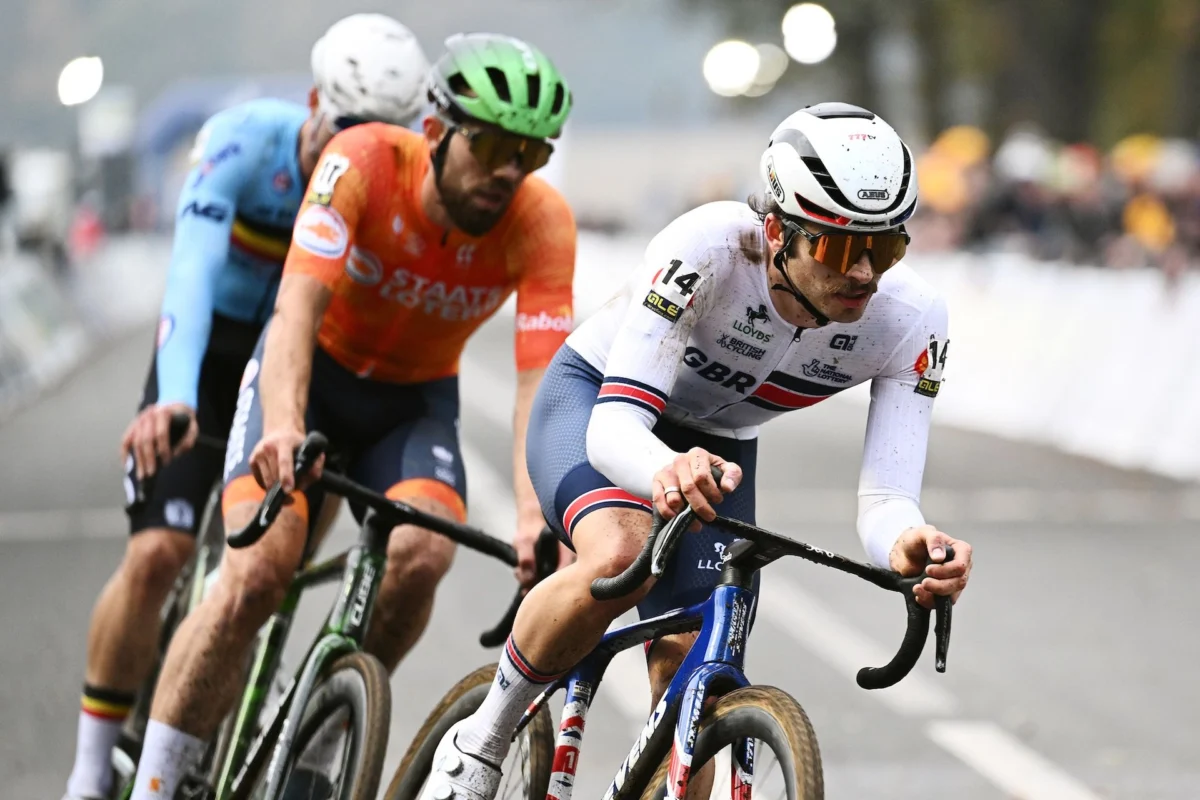
ZEDDAM, Netherlands — The ambition was clear, the form was building, but the execution of the opening meters ultimately dismantled Cameron Mason’s hopes of returning to the European elite men’s podium.
At the 2024 UEC European Cyclo-cross Championships in Zeddam, the British champion found himself immediately on the back foot following a sluggish start from the second row of the grid. While the race ultimately unfolded as a tactical masterclass for the continental powerhouse squads, Mason’s afternoon was defined by a race against time, traffic, and the brutal, narrow pathways of a course that punished hesitation.
Despite a tenacious, race-long pursuit that showcased his undeniable engine and technical prowess, the damage done in the opening 60 seconds proved insurmountable. Mason was forced to watch the race for the medals slip away up the road, turning what was anticipated to be a career-highlight battle into an arduous exercise in damage control.
Main Facts: The Anatomy of a Missed Opportunity
The elite men’s championship race at Zeddam carried immense prestige, drawing the finest winter specialists in the world to a notoriously demanding Dutch venue. For Mason, a rider who has consistently knocked on the door of international elite championships, the objective was simple: secure a spot on the podium.
However, the race was effectively shaped before the first technical corner.
- The Catalyst: Swiss specialist Kevin Kuhn rocketed away from the second row of the grid to claim the crucial holeshot, immediately dictating the pace at the front of the race.
- Mason’s Position: Starting alongside Kuhn on the second row, Mason suffered a momentary delay in acceleration and clipping in, plunging him deep into the pack.
- The Initial Deficit: As the field tore through the opening circuit, the British champion was languishing in 27th place, instantly separated from the powerhouse favorites who quickly formed the head of the race.
- The Course Factor: The Zeddam circuit—characterized by shifting sand, steep, leg-breaking power climbs, and tight, twisting single-track—offered notoriously few viable overtaking opportunities.
What followed was a courageous uphill battle. By the conclusion of the second lap, as the high-octane pace began to fracture the peloton and create significant gaps, Mason had clawed his way up to 23rd position. Yet, he still sat 17 seconds adrift of the front group—a chasm in modern, high-speed elite cyclo-cross where elite athletes separate themselves by watts and micro-seconds.
Chronology: Race Day Unfolded
To understand how Mason’s race slipped away, it is necessary to examine the minute-by-minute progression of a championship cyclo-cross race, where momentum is nearly impossible to regain once lost.
Pre-Race Optimism and Grid Placement
Entering the weekend, paddock chatter heavily favored the traditional heavyweights from Belgium and the Netherlands, but Mason’s recent performances suggested he was primed to disrupt the hegemony. Drawing a start on the second row was neither a distinct advantage nor a death sentence, provided a rider could cleanly execute their pedal stroke at the sound of the whistle.
Lap 1: The Bottleneck and the Holeshot
As the starter’s whistle blew, the grid compressed violently. Kevin Kuhn of Switzerland timed his start to perfection, surging past the front-row occupants to capture the holeshot. Behind him, the accordion effect took immediate hold.
While the riders on the front row and the right side of the track maintained unobstructed momentum, the bottleneck caught Mason. Struggling to find an immediate gap as the field funneled into the first narrow off-camber section, the British champion saw the elastic snap. By the time the pack crossed the line to complete the start-finish loop for the first time, Mason was buried deep in 27th place, staring at a wall of dozens of elite competitors.
Lap 2: The Chase Begins
Recognizing the existential threat to his podium chances, Mason immediately shifted into chase mode. On a traditional road or cross-country mountain bike circuit, a 17-second deficit over a long duration is manageable. In elite cyclo-cross—where the leaders drive the pace near or above threshold—clawing back seconds requires brutal accelerations out of every corner.
Mason successfully picked off four riders during the second circuit, advancing to 23rd position. However, the energy expended to make those passes on a course with limited passing lanes began to levy a heavy physiological tax. Each time he moved up, he was forced to brake or check his speed behind rivals navigating technical bottlenecks.
The Mid-Race Stalemate
As the race crossed the halfway mark, the front of the race had stabilized into a tactical yet blistering duel among the top contenders. Gaps solidified across the course. Mason continued to push a high, unrelenting cadence, but the elastic nature of his chase meant he was burning matches just to hold station relative to the leaders, whose advantage continued to stretch.
Supporting Data: The Physics of Modern Cyclo-cross
The statistics surrounding Mason’s race at Zeddam highlight the razor-thin margins that separate victory from anonymity in the modern era of the sport.
- Grid Disadvantage Translation: Data from modern RFID timing chips in elite cross races indicates that losing just five positions off the start line on a narrow Dutch course correlates with an average time loss of 8 to 12 seconds by the end of the first lap alone—even for WorldTour-caliber athletes.
- The Overtaking Penalty: On technical circuits like Zeddam, passing requires an athlete to expend roughly 115% to 130% of their Functional Threshold Power (FTP) for 10 to 15 seconds to clear a rider on a corner or sand section. Doing this repeatedly over the first three laps burns through finite anaerobic capacity.
- Historical Context: Mason, at 26 years old, is entering the prime years of his athletic career. His physical metrics—specifically his VO2 max and anaerobic recovery—rank among the best in the British peloton. Yet, modern cyclo-cross has evolved into a discipline where tactical positioning in the first 30 seconds dictates 80% of the final outcome.
Official Responses and Paddock Reactions
Speaking to cycling media following the conclusion of the grueling event, analysts and insiders reflected on the nature of Mason’s performance. While the final result did not yield the silverware the British camp had hoped for, the underlying effort drew widespread respect.
"Cameron didn’t lose this race on fitness; he lost it in the first hundred meters," noted one veteran race analyst on-site in Zeddam. "When you give a fifteen-second head start to riders of the caliber of [the race favorites] on a course this technical, you are fighting physics as much as you are fighting your competitors. He showed incredible grit not to drop his head, but the podium was gone before he cleared the second corner."
Paddock sources close to Mason’s team emphasized that while the result is a bitter pill to swallow, the data harvested from his power meter confirms that his underlying aerobic engine remains world-class. The primary takeaway for the coaching staff is clear: refining snap-start protocols and gate positioning will be the paramount focus ahead of the upcoming World Cup block.
Implications: What Zeddam Means for the Rest of the Season
The European Championships serve as the psychological and physical bellwether for the heart of the winter cyclo-cross campaign. For Cameron Mason, the events in Zeddam carry several significant implications moving forward:
1. The Urgency of Grids and UCI Points
In modern cyclo-cross, the front rows of the starting grid are heavily guarded by UCI ranking points. A poor performance or an early-race mishap can trigger a cascading effect, forcing riders to start further back in subsequent high-profile races. Mason’s immediate priority will be aggressively hunting UCI points in upcoming domestic and international fixtures to secure better front-row real estate for the World Championships.
2. Validation of Chase Form
While the podium was missed, the tenacity of Mason’s mid-race chase offers undeniable proof of his physical state. A rider lacking form would have drifted backward into the grupetto after such a disastrous start. Instead, Mason’s ability to stabilize his lap times and methodically pick off rivals indicates that his foundational fitness is precisely where it needs to be.
3. Tactical Evolution
The race in Zeddam underscored the reality that tactical racing in European cyclo-cross leaves zero margin for error. As the discipline becomes increasingly hyper-specialized, with road professionals frequently crossing over into winter racing, the explosive opening phase has become the definitive battleground. Mason and his support staff will undoubtedly return to the drawing board to analyze his start technique, equipment setup (specifically tire pressure and tread selection for the Dutch sand), and mental positioning ahead of the green lights of the next major international showdown.
Ultimately, Cameron Mason leaves Zeddam empty-handed in terms of medals, but the overarching narrative of his season remains unwritten. If he can translate the fierce determination of his chase laps into a clean getaway from the whistle, the podium step he so desperately sought in the Netherlands will soon be within his grasp.

 Laily UPN
 Sagoh
 Muslim

 Neng Nana
 Raul Delapena Setiawan
 Lina Hope