
 Lina Hope
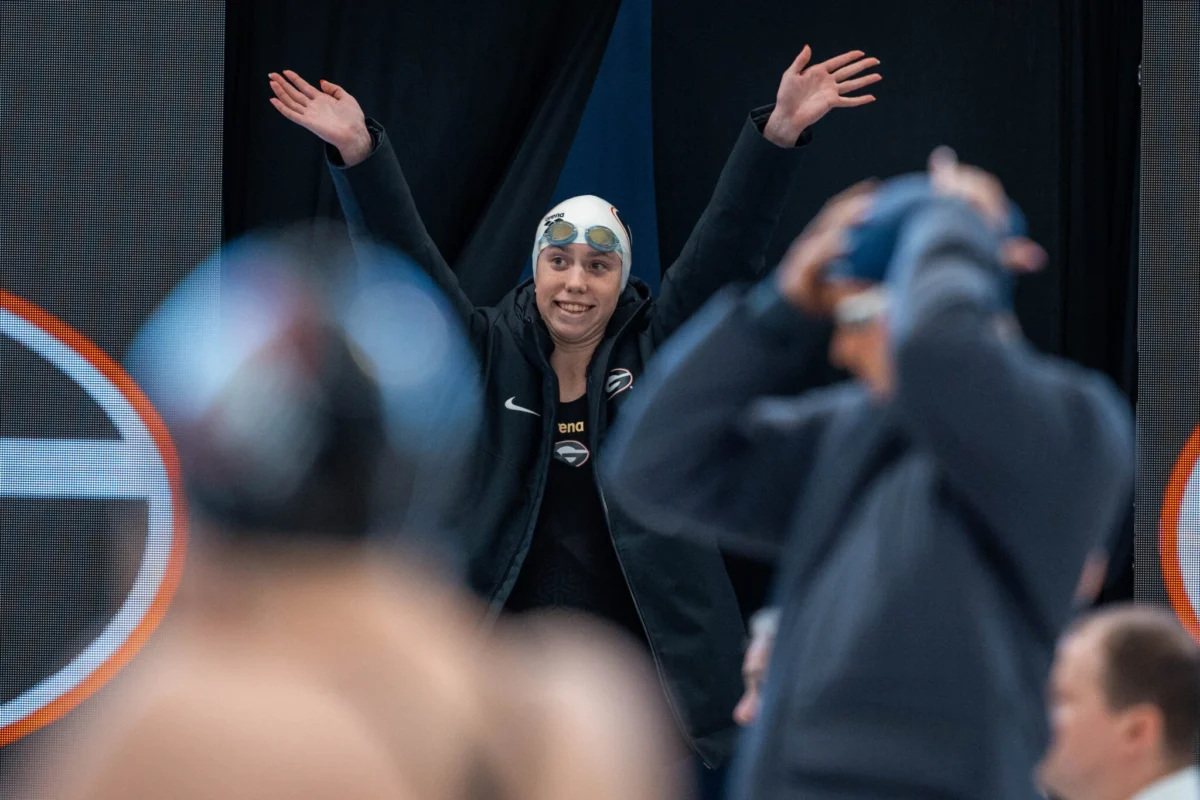
The 2026 Georgia Fall Invite has officially ignited, transforming the pool into a theater of history. As the third finals session concluded, the swimming world found itself witnessing a rare, epoch-defining performance. While the invite serves as a critical mid-season benchmark for top collegiate programs, the headline story belongs to Georgia’s Kennedi Dobson, whose blistering pace in the 500-yard freestyle has rewritten the NCAA record books and signaled a new era in distance swimming.
The Historic Breakthrough: Kennedi Dobson’s Sub-4:30 Masterclass
The marquee event of the evening was undoubtedly the women’s 500-yard freestyle. Expectations were high for Kennedi Dobson, who entered the meet already holding the SEC record with a 4:30.48 performance from the 6th CSL match in October. However, few anticipated the sheer clinical efficiency with which she would dismantle the historic 4:30 barrier.
Stopping the clock at 4:29.89, Dobson became the first NCAA swimmer to break the 4:30 threshold in eight years. To put the feat into context, she joins a legendary, albeit short, list of only seven women in history to ever eclipse this time. Among that group—which includes world-renowned stars like Summer McIntosh, Bella Sims, Katie Grimes, and Claire Weinstein—Dobson is only the third to achieve the mark within the confines of an official college meet.
The Anatomy of a Record-Breaking Race
The race was a masterclass in pacing and strategic fortitude. Dobson opened with a 25.00 split, locked in a tight battle with Florida’s Julie Brousseau (25.03). By the 100-yard mark, Brousseau had edged ahead, turning in 52.01 to Dobson’s 52.35. Brousseau continued to press her advantage through the 200-yard mark, holding a half-second lead as she clocked 54.75 on her second 100-yard segment.
The pivot point occurred at the 300-yard mark. Dobson began a calculated surge, splitting 54.54 over the third and fourth 50-yard segments. Her technical brilliance was on full display in the final 200 yards; she refused to yield, closing with back-to-back 100s of 54.19 and 53.93. By maintaining her tempo while the field began to feel the cumulative toll of the distance, Dobson erased her previous SEC record by six-tenths of a second.
Brousseau, though relegated to second, delivered a performance for the ages as well. Her 4:34.14 finish is a new lifetime best, shaving four-tenths off her 2025 SEC Championship time. Cal’s Camille Henveaux rounded out the podium with a solid 4:40.00, proving that the depth of the field is rising alongside the record-setters.
Chronology of the 2026 Georgia Fall Invite
The evening session was a high-octane display of collegiate talent, featuring a rigorous slate of events that tested both sprinters and endurance specialists.
- Women’s 500 Freestyle: Dobson’s historic swim headlined the session, followed by Brousseau and Henveaux.
- Men’s 500 Freestyle: The men’s distance event featured a dominant display from Georgia’s Tomas Koski, who capitalized on his momentum from the prelims to hold off a charging field, including LSU’s Nikola Simic.
- 200 Individual Medley: The IM events showcased tactical versatility. Grace Rabb established her dominance on the women’s side, maintaining a half-second lead over Cal’s Elle Scott. In the men’s category, Baylor Stanton replicated that gap, holding off Florida State’s Logan Robinson to secure the top seed and eventual victory.
- 50 Freestyle Sprints: The atmosphere reached a fever pitch during the 50-yard freestyles. LSU’s Michaela De Villiers made a statement in the women’s race, becoming the sole competitor to dip under the 22-second barrier with a 21.66 performance. On the men’s side, Lucca Battaglini touched in 19.04, narrowly edging Florida’s Devin Dilger (19.11) in a race where fractions of a second determined the podium.
- Relay Finales: The session concluded with the 400 medley relays, serving as a litmus test for team cohesion and depth as coaches assessed their potential championship lineups.
Supporting Data: By the Numbers
The caliber of competition at this year’s Georgia Fall Invite highlights the aggressive training cycles currently employed by top-tier SEC and Pac-12 programs.
| Athlete | Event | Time | Note |
|---|---|---|---|
| Kennedi Dobson | 500 Free | 4:29.89 | SEC Record / NCAA Milestone |
| Julie Brousseau | 500 Free | 4:34.14 | Lifetime Best |
| Michaela De Villiers | 50 Free | 21.66 | Sub-22 barrier broken |
| Lucca Battaglini | 50 Free | 19.04 | Margin of victory: 0.07s |
The data points toward a highly competitive 2026 NCAA Championship season. With swimmers like Battaglini and De Villiers leading the sprint charts, and the distance records falling, the trajectory for the remainder of the collegiate year suggests that the "A" finals at the upcoming national meet will be the fastest in recent memory.
Official Perspectives: Coaching and Strategy
While official press conferences follow the completion of the meet, early sentiments from the deck indicate that coaches are treating this invite as a "dress rehearsal" for March. The emphasis for Georgia, Cal, and LSU has been on the refinement of race-day execution—specifically the "descending" strategy used by Dobson.
"The goal wasn’t just to win; it was to control the tempo of the race regardless of what the person in the next lane was doing," noted one assistant coach following the session. "When you see an athlete like Kennedi hit those negative splits, it’s a reflection of months of aerobic conditioning paying off in a high-pressure environment."
For the Florida and Cal programs, the focus has been on the integration of freshmen and transfer athletes. The presence of five Cal swimmers in the men’s 50-free "A" final serves as a testament to the depth that programs are cultivating to secure the necessary points for team-scoring success later in the season.
Implications for the NCAA Landscape
The results of the Georgia Fall Invite carry significant weight for the upcoming NCAA Championship season.
1. The "Dobson Effect" on Distance Swimming:
By breaking the 4:30 barrier, Dobson has effectively reset the standard for the 500 freestyle. Her performance will force coaches across the country to re-evaluate their distance training regimens. If she continues this trajectory, she is the clear favorite to sweep the distance events at the national meet, potentially providing Georgia with a massive point cushion.
2. Sprint Depth and Relay Strategy:
The men’s 50-yard freestyle results highlight a tightening of the field. With Lucca Battaglini and Devin Dilger separated by less than a tenth of a second, the relay lineups for the 400 medley and 200 freestyle relays will likely be fluid throughout the spring. Teams with "B" relay depth—like Cal, which placed five in the A-final—will have a distinct advantage in the championship format.
3. Mid-Season Confidence:
For athletes like Julie Brousseau, achieving a lifetime best at a mid-season invite is a psychological victory. It validates the transition from off-season training to in-season tapering. As these athletes head into the winter training block, the confidence gained here will be the foundation for their final preparations.
As the Georgia Fall Invite continues, the swimming community remains fixed on the results. If the opening sessions are any indication, the remainder of the collegiate season promises to be a historic pursuit of speed, power, and record-breaking performances that will define the sport for years to come.

 Nila Kartika Wati
 Laily UPN
 Dwi Wanna
 Nana
 Ammar Sabilarrohman
 Asro