
 Nana
Nana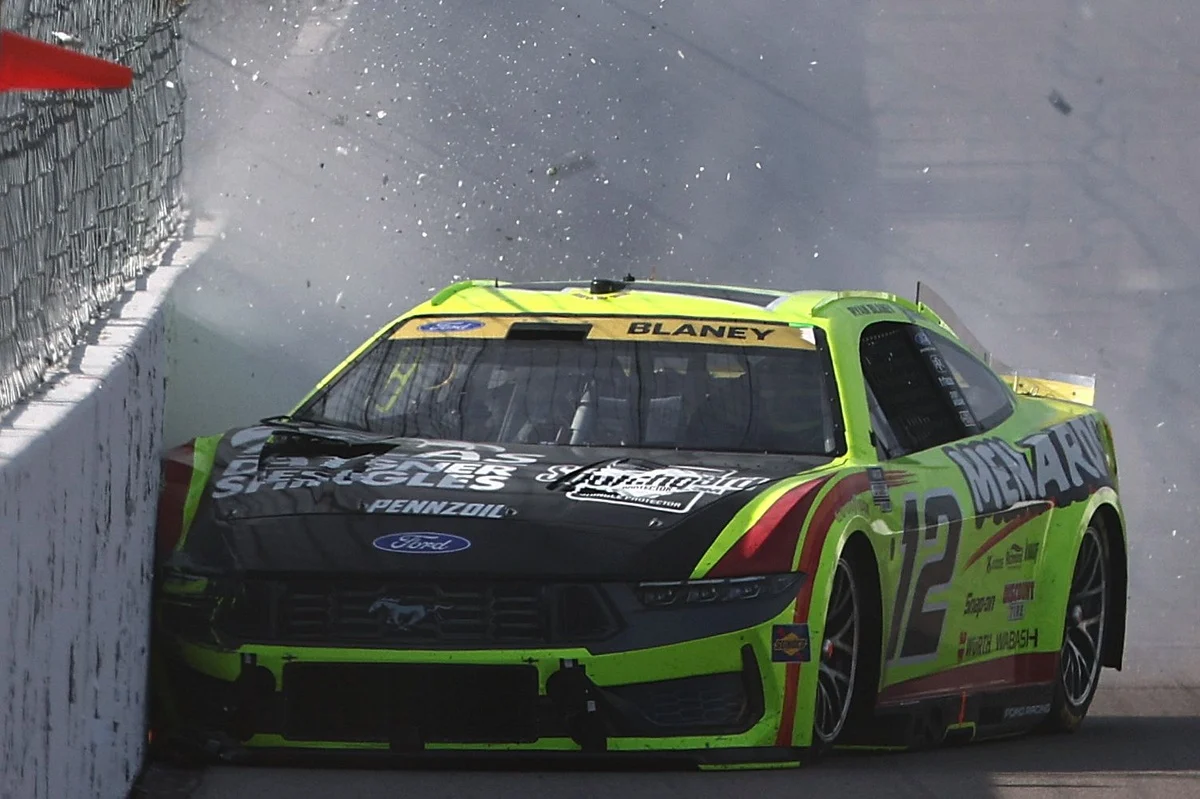
MADISON, Ill. — In the high-stakes theater of the NASCAR Cup Series playoffs, a championship campaign can unravel in the blink of an eye. For Team Penske’s Ryan Blaney, that nightmare scenario materialized on Lap 155 of the 240-lap event at World Wide Technology Raceway at Gateway.
Running comfortably inside the top ten and sitting within striking distance of the regular-season points lead, Blaney suffered a sudden, catastrophic brake failure on the front stretch. The mechanical failure sent his iconic Ford Mustang hurtling directly into the outside retaining wall, abruptly terminating what had been a highly promising afternoon.
The incident left Blaney credited with a 35th-place finish, making him the first among the 16 championship-eligible drivers to suffer a DNF (Did Not Finish) during this leg of the postseason. Yet, as the smoke cleared over the 1.25-mile oval, a silver lining emerged: chaos later rippled through the rest of the playoff field, potentially softening the blow to Blaney’s title aspirations.
Main Facts of the Incident
The crash occurred with 85 laps remaining in the scheduled distance, erasing a fast car that had already captured valuable stage points. Blaney was scored in the sixth position when the brakes completely failed as he approached Turn 1.
- Driver: Ryan Blaney, No. 12 Team Penske Ford Mustang
- Location: World Wide Technology Raceway (Gateway), Madison, Illinois
- Race Distance / Incident Lap: 240 laps total; incident occurred on Lap 155
- Result: 35th-place finish (first DNF among the 16 playoff drivers)
- Championship Impact: Entered the weekend near the top of the standings; the result drops him deep into the playoff danger zone, though rival attrition limited the immediate damage.
Despite the heavy impact, Blaney emerged from the infield care center uninjured, though visibly frustrated by a golden opportunity squandered by mechanical failure.
Chronology of a Disastrous Afternoon
To understand how Blaney’s race unraveled, it is necessary to examine the timeline of events that led up to the Lap 155 wreck.

Early Race Concerns
From the drop of the green flag, Blaney’s Ford showed strong speed, allowing him to carve his way toward the front and secure vital stage points in the opening segments. However, the driver noted that the car’s braking system had given him subtle hints of trouble early on.
"I had a little concern early in the race," Blaney admitted after being released from the infield medical center. "But then they kind of stabilized. They didn’t really get worse."
The Sudden Failure on Lap 155
For dozens of laps, the braking performance appeared stable, lulling the team into a false sense of security. That illusion shattered instantly on the front stretch as the field powered down the straightaway.
Unlike a slow degradation where a driver can pump the pedal to compensate, Blaney’s system experienced total structural collapse without warning.
"Gosh, I feel like they blew on the front stretch before I even touched the brake pedal," Blaney recalled. "They just crumbled apart and blew out. Honestly, it’s unfortunate, but fairly fortunate where they blew, and didn’t blow as I was kind of in the corner. But it’s a shame."
The Aftermath and Redirection
Following a mandatory evaluation and release from the infield care center, Blaney’s focus immediately shifted from shock to damage control. Recognizing the unforgiving nature of the playoff format, the reigning champion’s teammate and crew knew that dwelling on Gateway would only compound the points deficit heading into the next round.

Supporting Data and Technical Analysis
Brake failures in the Next Gen NASCAR Cup car are exceedingly rare, particularly at tracks like Gateway that demand heavy, sustained braking zones alternating with long straightaways. The configuration places immense thermal and mechanical stress on the rotors, pads, and calipers.
Following the race, media and technical analysts questioned whether the failure pointed to a systemic component issue or a team-specific setup choice regarding brake cooling and management.
Team-Related vs. Series-Wide Mandates
When Motorsport.com asked Blaney whether NASCAR should step in with technical mandates or structural rules to prevent similar failures across the grid, the Team Penske driver defended the current system of team autonomy.
"Oh, I don’t know," Blaney told Motorsport.com. "I mean, it’s all team related. We’ll have to look and see what we felt really good about. We haven’t had a failure in our company on the brakes here. So, we’ll just have to look at, you know, was there anything different? But no, I think just leaving that up to the teams is probably the best way to do it."
Blaney’s assessment underscores the complex engineering balancing act in modern stock car racing. Teams constantly push the boundaries of weight reduction, cooling duct configurations, and pad compounds to gain an edge in corner entry speed. When those boundaries are crossed, mechanical failure is often the price paid.
Official Responses and Driver Reactions
Speaking to reporters in the media bullpen after the medical release, Blaney elaborated on the physical sensations inside the cockpit prior to the crash and his outlook for the remainder of the championship hunt.

"Didn’t feel great about them the run before and probably just expired," Blaney said, reflecting on the final stint. "Yeah, just gotta keep going. Go to next week and try to have a good day. Yeah, it’s a shame. I thought we did a really good job today. I thought the car was good and had good stage points and was looking forward to the end of the race. So, just go race next week."
The driver emphasized that up until the failure, the execution from the No. 12 crew had been flawless. The strategy was working, the car’s handling was competitive, and the goal of capturing a deep playoff run remained entirely realistic.
Broader Implications for the Playoffs
The 10-week Chase for the NASCAR Cup championship is designed to punish mistakes, mechanical failures, and misfortune. A 35th-place finish is typically a crippling blow that can virtually eliminate a driver from championship contention unless they can secure a win in subsequent rounds.
However, the chaotic nature of the Gateway weekend acted as a great equalizer. As the afternoon progressed, several other high-profile playoff contenders encountered their own disasters, ranging from multi-car accidents on pit road to late-race wrecks in traffic.
Because the attrition was widespread among the top 16 drivers, the mathematical damage to Blaney’s point total may not be as catastrophic as a 35th-place finish usually implies. Nevertheless, the margin for error has evaporated. Team Penske will head to the next event needing a clean race, aggressive strategy, and maximum execution to regain lost ground and secure their path forward in the postseason.
For Ryan Blaney, the disaster at Gateway serves as a stark reminder of the fine line between championship glory and sudden elimination in the elite tier of American motorsports.

 Raul Delapena Setiawan
 Ali Ikhwan
 Laily UPN
 Lina Hope
 Evan Lee Salim
 Asro
Asro