
 Lina Hope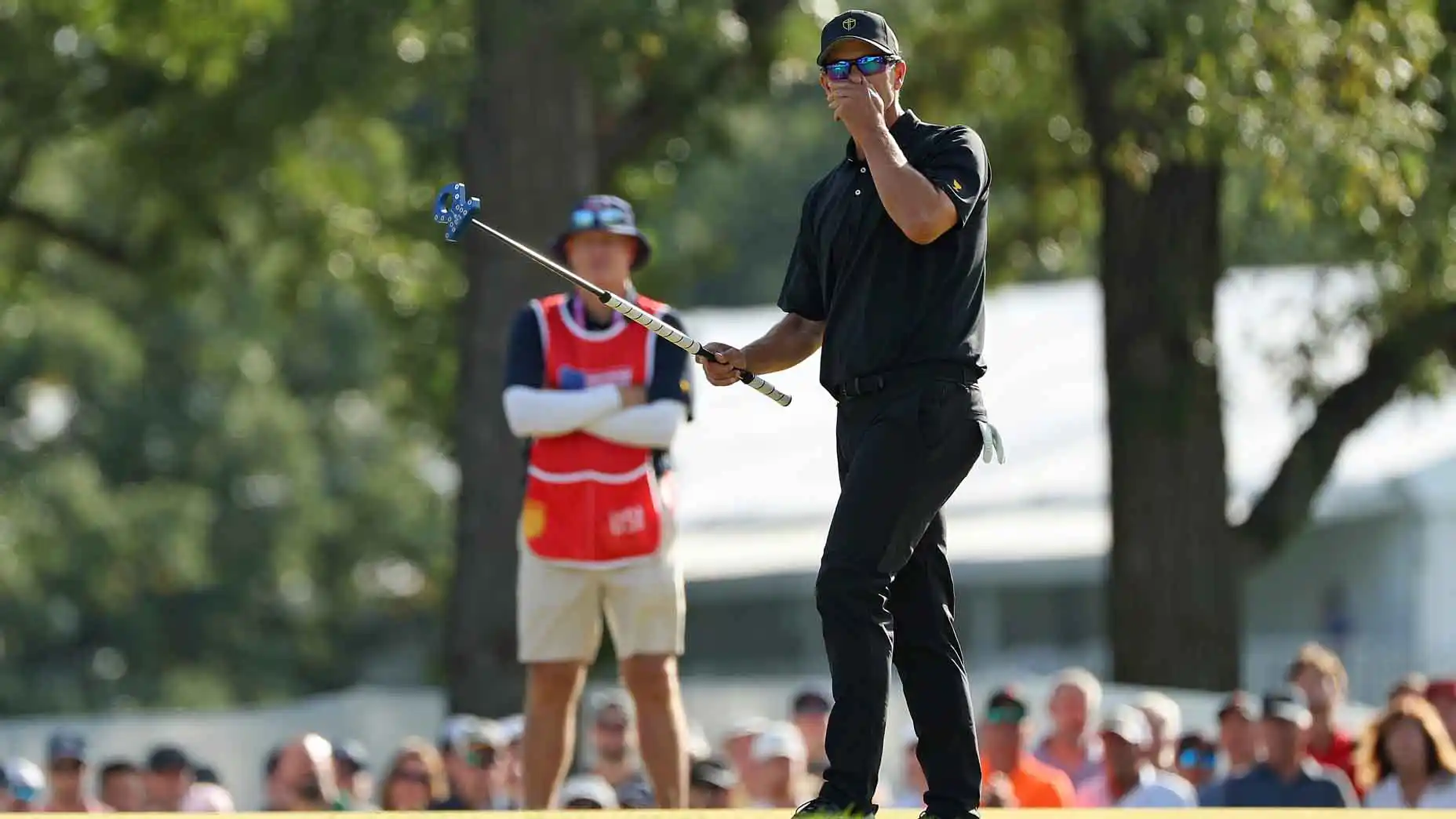
By Josh Schrock
September 28, 2026
At the 2024 Open Championship at Royal Troon, Adam Scott sat before a small cluster of reporters, his face wearing that familiar, boyish grin that has defined his public persona for over two decades. Beside him sat Justin Rose—another titan of the modern game—as both men reflected on a week where they had once again flirted with the summit of a major championship only to be turned away. When asked what continued to fuel their fires well into their mid-40s, Scott didn’t reach for a rehearsed corporate answer. He chuckled, looked down at his spikes, and offered a raw assessment.
"Always being a ‘Nearly Great’ of the game is spurring us on in our later years," Scott said.
It was a moment of profound vulnerability. For a man who has scaled the highest peaks—a Masters champion, a Players Championship winner, and a former World No. 1—the admission was striking. To the outside observer, Scott’s career is a masterclass in longevity and consistency. To Scott, however, it remains a work in progress, a collection of chapters that feels, in his own estimation, like a story left unfinished.
The Burden of Expectation: A Career Under the Microscope
Adam Scott’s self-assessment as an "underachiever" is perhaps the most fascinating paradox in professional golf. Entering the 2025 U.S. Open at Oakmont, he found himself once again in the hunt on Sunday. While the general public marveled at his ability to remain competitive at 44, Scott was internalizing a different narrative.
"I’ve put together a nice career," he mused at Oakmont, "but I think another major would really go a long way in fulfilling my own self, when it’s all said and done."
This sentiment captures the essence of the modern professional athlete’s existential crisis: the gap between objective success and subjective peace. When the dust settled at Oakmont and J.J. Spaun secured the victory, leaving Scott as a "tough-luck loser," the clock became the elephant in the room. Speaking with The Athletic’s Brendan Quinn shortly thereafter, Scott acknowledged the ticking biological and professional clock. "I feel like I can keep this up for another 18 months, for sure," he said. "Then, at that point, I’ll be 46. I think I can push myself for the next year and a half and then reassess."
Chronology of a White Whale: The Presidents Cup Struggle
While the elusive second major remains the primary headline of his later years, another quest has become arguably more personal for the Australian: the Presidents Cup.
Scott’s association with the event dates back to 2003, a year that ended in a stalemate between the International team and the United States. Since that moment, Scott has been a constant presence, a stalwart for a side that has tasted nothing but bitter defeat. The losses have come in various forms—the tactical collapses, the narrow margins, and the crushing weight of team expectation.
The 2019 loss in Australia was particularly devastating. The Internationals had surged to a 9-5 lead, tantalizingly close to a monumental upset on home soil, only to watch the Americans rally for a 16-14 victory. Scott’s individual defeat to Xander Schauffele in the Sunday singles remains, by his own admission, a scar that has never fully healed.
"I felt like I’d let the side down," Scott reflected in 2024. "That one slipped through our fingers. It was months and months and months of trying to figure out how it slipped away because it felt like that was going to be our time. It would have been an epic victory to win there. It’s something that I’m still looking for in my career."
Medinah 2026: The Final Frontier?
The narrative arc seemed perfectly set for the 2026 Presidents Cup at Medinah. The Internationals arrived in Chicago as heavy underdogs, yet buoyed by a newfound sense of cohesion. Scott, now the elder statesman of the team, spoke openly about his desperation to finally check this box.

"I want to win one desperately, and I don’t know how many more I can possibly play in," he told reporters at Medinah. "There was probably a period 10 years ago, in the middle of my career, where it was, ‘Oh, this is going to happen.’ But now there’s not many more, that’s for sure. I’ve been given another chance. It might be the last one."
The setup for a fairy-tale ending was almost too good to be true. After sweeping the Friday foursomes and successfully defending a surge from the Americans on Saturday, the International team entered Sunday with a three-point lead—a historic first for an away team on American soil. For a fleeting moment, it appeared the stars had aligned for Scott to finally secure the one team trophy that has eluded him for 23 years.
The Sunday Collapse and the Reality of Time
The cruelty of professional sports is that it rarely aligns with the script of a cinematic masterpiece. Sunday at Medinah saw the American squad, bolstered by a raucous home crowd and immense pressure, dismantle the International lead. The final score, a 17-13 victory for the U.S., mirrored the familiar heartbreak of decades past.
Scott’s own match against Patrick Cantlay became the microcosm of the event. With the Internationals teetering, Scott needed a momentum-shifting win. Instead, he watched as Cantlay drained a 57-foot birdie putt on the 16th hole, effectively closing the door on Scott’s rally and winning the match 2 and 1.
Official Responses and Future Outlook
In the immediate aftermath, sitting at the press dais, Scott’s demeanor was one of weary grace. He avoided the temptation to blame the conditions or the luck of the draw. Instead, he looked inward. He lauded the effort of his teammates, acknowledged his own failure to close the match, and faced the inevitable questions about his future.
When pressed on whether he would be a part of the 2028 team or potentially transition into a captaincy role for the Australian edition of the event, Scott remained non-committal, offering a smile that masked a deep, lingering uncertainty.
"I don’t know. It’s a long way away. Sounds like a lot of work," he said. "We’ll see if I can contribute to the team in any way, I’ll do whatever for this team."
Implications: The Legacy of the "Nearly Great"
Adam Scott’s journey is far from over. He remains 45th in the Official World Golf Ranking, his ball speed metrics remain elite, and his technical proficiency is still the envy of the PGA Tour. He still harbors the belief that he can add to his resume. However, the reality of professional golf is unforgiving.
The implications of the 2026 Presidents Cup result extend beyond the scoreboard. For Scott, it represents a realization that the window is not merely closing; it is becoming a sliver. The "white whale" of the Presidents Cup may well remain uncaught, and the pursuit of a second major continues to challenge his mental fortitude.
As Scott moves forward, he occupies a rare space in the pantheon of golf. He is a player who has arguably maximized his physical gifts, yet remains haunted by the margins of the game. His career will eventually be measured not just by the trophies he lifted, but by the ones he stood so close to, only to see them vanish into the twilight.
Ultimately, Adam Scott’s story is a reflection of the human condition in sports: the constant tension between what we have achieved and what we still believe we are owed by the game. Whether the final chapter brings the elusive triumph or simply the quiet dignity of a long, distinguished career, Scott remains a symbol of the relentless, often painful, pursuit of perfection. The sand in the hourglass is running low, but for as long as he tees it up, the possibility of a final, triumphant swing remains.

 Laily UPN
 Jia Lissa
 Nana Wu
 Siti Muinah
 Evan Lee Salim