
 Nana
Nana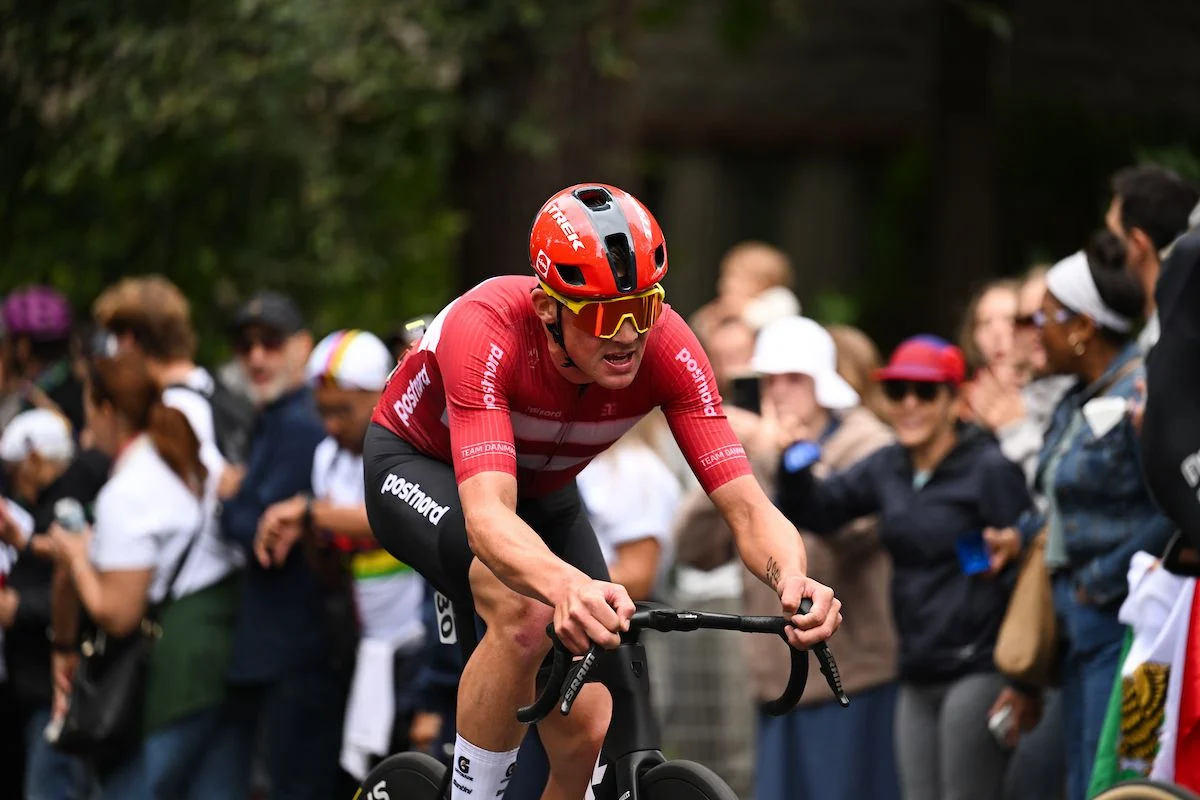
MONTREAL, CANADA — In one of the most grueling and tactically nuanced road races in recent memory, Denmark’s Mads Pedersen once again proved why he remains one of the most resilient and tenacious competitors in professional cycling.
Multiple times during the elite men’s road race at the UCI World Championships in Montreal, the 2019 World Champion appeared to be completely out of contention. As relentless attacks shredded the peloton on the brutal, punchy circuits of Mount Royal, Pedersen found himself distanced, forced to chase, and seemingly on the brink of capitulation. Yet, through a combination of unwavering discipline, veteran savvy, and a meticulously crafted tactical blueprint devised by Danish national coach Michael Mørkøv, Pedersen clawed his way back.
Staying strictly within his physiological limits, the Danish powerhouse relied on his legendary stamina to bridge the gap to the earlier attackers on the final lap. When the dust settled on the punishing Canadian circuit, Pedersen crossed the finish line in a hard-fought sixth place, just 14 seconds behind the newly crowned World Champion, Brandon McNulty of the United States.
Main Facts: A Masterclass in Defensive Racing and Tactical Execution
The men’s road race at the Montreal World Championships was a war of attrition. Characterized by relentless climbing, tactical sparring between powerhouse nations, and an unforgiving pace from the gun, the course quickly exposed any rider lacking absolute peak condition.
For Mads Pedersen, the primary objective was survival and patience. While pre-race favorites launched aggressive, long-range assaults, Pedersen and the Danish national team executed a strategy of calculated invisibility.
- The Result: Pedersen finished in sixth place, 14 seconds behind gold medalist Brandon McNulty (USA).
- The Strategy: Conceived by national coach Michael Mørkøv, the plan dictated that Pedersen must remain hidden from the cameras and the primary skirmishes until the absolute business end of the race.
- The Adversity: Pedersen was dropped or distanced from the front group on multiple occasions during the mid-race climbs, only to meticulously pace himself back to contention.
- The Execution: By refusing to panic when rivals surged ahead, Pedersen preserved his anaerobic matches, allowing him to launch a late-race resurgence that ultimately secured a top-six finish and a shot at the medals.
Chronology of the Race: From the Shadows to the Frontline
To understand the magnitude of Pedersen’s sixth-place finish, one must trace the undulating trajectory of the Montreal circuit, where the race was won and lost in increments of pain and tactical precision.
Phase One: The Quiet Accumulation (Laps 1–5)
From the opening kilometers, the pace was ferocious. National teams with depth—such as the United States, Belgium, and France—sought to make the race as hard as possible to isolate pure sprinters and heavy classics specialists.
True to Mørkøv’s pre-race directive, Mads Pedersen was nowhere to be seen at the front of the peloton. While aggressive riders tested the waters with early breakaways, Pedersen slotted comfortably into the belly of the bunch. He conserved energy, hydrated meticulously, and let other nations shoulder the burden of controlling the race. The Danish strategy relied entirely on weathering the early storm without burning precious matches.
Phase Two: The Mid-Race Cracks (Laps 6–9)
As the race entered its second half, the cumulative elevation gain began to take a severe toll. On the steepest ramps of the Mount Royal circuit, accelerations from elite climbers blew the race to pieces.
It was during this phase that Pedersen’s race seemed to unravel. Every time the road tilted upward, the elastic snapped. Observers and live commentators repeatedly counted him out as he was distanced from the elite selection. However, rather than digging into a destructive red zone in a desperate attempt to stay glued to the wheel of pure climbers, Pedersen made a calculated decision. He tapped out a steady, sustainable rhythm over the crests, trusting his unmatched descending skills and flat-road power to claw his way back to the group on the flatter sections.
Phase Three: The Final Lap Resurgence (Final Lap)
Entering the bell lap, the race was in total disarray. Breakaways dangled off the front, and the select group of chasers was fractured. Brandon McNulty had already made his decisive, race-winning move up the road, capitalizing on the tactical hesitation behind him.
This was the moment Mørkøv had prepared Pedersen for. With the earlier attackers tiring and the pace in the chasing group fluctuating, Pedersen unleashed his remaining reserves. Utilizing his exceptional stamina, he surged past demoralized rivals on the final leg of the circuit, bridging the gap to the chase group fighting for the minor podium steps.
He dug deep into his formidable physical reserves on the final straightaway, crossing the line in sixth place—a result that felt much more like a victory given how many times he had been distanced throughout the afternoon.
Supporting Data and Analysis: The Anatomy of Pedersen’s Resilience
Cycling at the World Championship level is as much a sport of data and energy management as it is of raw power. Pedersen’s performance in Montreal offers a fascinating case study in pacing strategy and physiological limits.
Power Distribution and Pacing
Sports scientists analyzing elite one-day races frequently point to the concept of "stochastic" racing—efforts defined by violent spikes in power output followed by brief recovery periods. For a rider of Pedersen’s build (robust, powerful, and exceptionally strong on rolling terrain), continuous acceleration on steep climbs is notoriously costly.
By refusing to match the accelerations of lighter climbers like McNulty or pure puncheurs, Pedersen avoided catastrophic glycogen depletion. Data from modern power meters indicates that riders who exceed their Functional Threshold Power (FTP) by more than 15-20% repeatedly on climbs face inevitable physiological failure in the final hour of a 250km+ race. Pedersen’s decision to limit his losses on the climbs and maximize his output on the flats and descents kept his physiological ledger balanced until the final kilometers.
Comparative Finish Metrics
- Winner: Brandon McNulty (USA) – Gold
- Time Gap: 14 seconds separating McNulty from the chase group containing Pedersen.
- Context: In a race where gaps between elite contenders often stretch into minutes due to the sheer length and difficulty of World Championship routes, a 14-second deficit highlights just how close Pedersen came to turning his survival act into a medal-winning coup.
Official Responses: Inside the Danish Camp
Following the race, the atmosphere within the Danish team bus was one of immense pride and validation. The tactical gamble orchestrated by national coach Michael Mørkøv had paid dividends.
Michael Mørkøv: "The Plan Was to Keep Him Hidden"
Mørkøv, whose legendary tactical mind and race intelligence were instrumental in guiding Pedersen to his famous rainbow jersey victory in Harrogate back in 2019, spoke candidly about the master plan for Montreal.
"We knew coming into this course that it would be a brutal test of attrition," Mørkøv explained to media after the race. "The profile favored lightweight climbers who could accelerate repeatedly on the steep sections. Mads is one of the best riders in the world, but we had to be realistic about his limits on this specific terrain.
The plan was simple on paper, but incredibly hard to execute: he shouldn’t be seen until the end. We told him to stay out of the wind, stay out of trouble, and let everyone else exhaust themselves in the early and middle laps. When you race against the best climbers in the world on a course like this, panic is your worst enemy. Mads executed the plan with incredible discipline. Every time he was distanced, he didn’t panic; he rode his own pace, and that is why he was still there fighting for a medal in the final lap."
Mads Pedersen: Reflecting on the Struggle
Pedersen, renowned for his candor and fierce competitive spirit, admitted that the race was one of the hardest he had ever contested.
"There were moments out there where I genuinely thought my race was over," Pedersen said. "The guys on the front were setting a brutal pace, and every time we hit the climb, I was right on the absolute limit. It hurts, and it’s frustrating when you feel like you’re constantly fighting just to hang on.
But Michael [Mørkøv] and the staff had a very clear plan, and I trusted it. We knew that if I could just survive the hardest parts without blowing up completely, the race would come back to me in the final. Sixth place isn’t gold, and of course, you always come to a World Championship wanting to win. But given how deep I had to dig just to stay in contention, I am proud of how I fought until the very last meter."
Implications: What Montreal Means for Pedersen’s Future
As the professional peloton looks toward the remainder of the season and prepares for upcoming autumn classics, Mads Pedersen’s performance in Montreal carries significant weight.
- Versatility and Maturity: The race highlighted Pedersen’s evolution from an explosive, instinct-driven sprinter and classics rider into a tactically mature athlete who can suffer, adapt, and manage multi-hour races with veteran poise.
- The Mørkøv Effect: The successful collaboration between Pedersen and Michael Mørkøv continues to yield elite results. Their mutual trust is a cornerstone of the Danish national team’s success, proving that tactical discipline can bridge the gap against superior climbers on unfavourable terrain.
- Classics Warning Shot: For his rivals in the upcoming autumn one-day races, Pedersen’s deep endurance base and fighting spirit serve as a stern warning. Even on a bad day, when he is seemingly dropped and out of the fight, writing off Mads Pedersen is a dangerous mistake.
In the end, Montreal did not yield a second rainbow jersey for the Dane, but it cemented his reputation as one of the most tenacious, intelligent, and unyielding competitors in the sport of professional cycling.

 Reynand Wu
 Laily UPN
 Neng Nana
 Nana Wu
 Lina Hope
 Sagoh
Sagoh
 Iffa Jayyana