
 Siti Muinah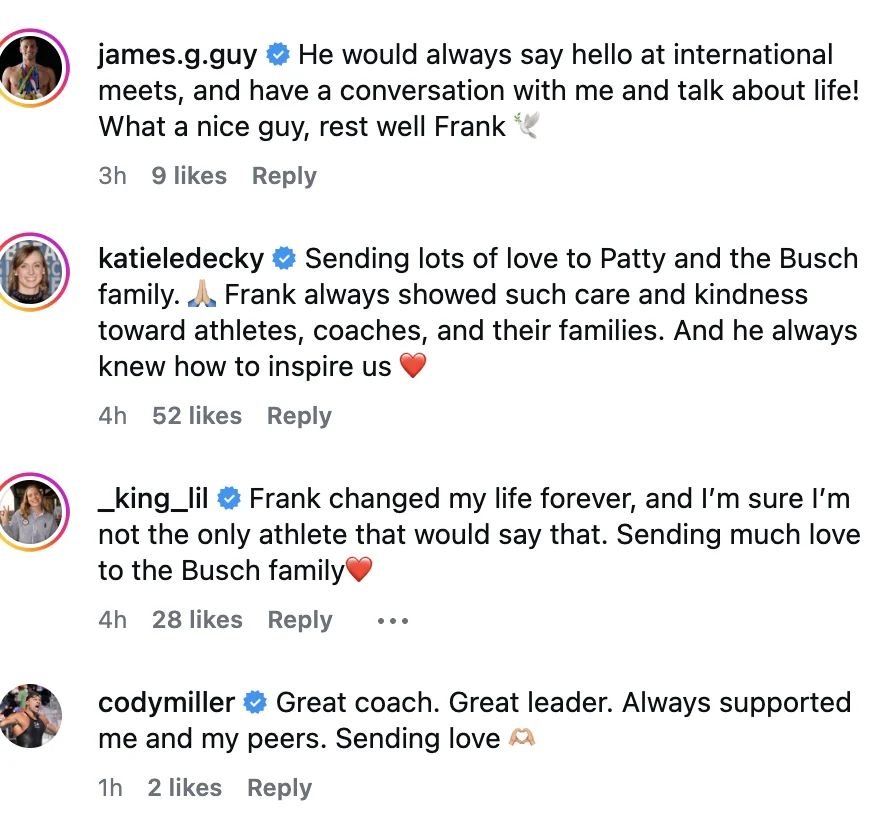
The global swimming community is in mourning following the sudden passing of Frank Busch, a visionary leader and legendary coach whose influence shaped the trajectory of American swimming for over half a century. Busch, 75, suffered a heart attack at the Phoenix Airport on Sunday while returning from a fishing trip in Idaho. His death marks the end of an era for a man who was not only a titan of collegiate and international coaching but a devoted mentor and "father figure" to generations of athletes.
A Legacy Built on More Than Medals
Frank Busch’s name is synonymous with excellence. Throughout his illustrious career, he served as a fixture on pool decks across the country, leaving behind a legacy that extends far beyond the trophies and records he accrued. From his formative years as a coach to his tenure at the helm of the University of Arizona and his groundbreaking work as the USA Swimming National Team Director, Busch possessed an uncanny ability to identify potential in individuals that they often did not see in themselves.
His philosophy was simple yet profound: he did not just coach swimming; he coached people. By fostering environments built on trust, integrity, and servant leadership, Busch created a culture of "family" that remains the hallmark of his career. Whether working with world-class Olympians or walk-on athletes, his commitment to his charges remained constant, cementing his reputation as one of the most respected figures in the sport’s history.
Chronology: A Career of Unprecedented Success
The Arizona Years (1989–2011)
Busch’s most enduring professional footprint was left at the University of Arizona, where he served as head coach for 22 transformative years. Under his guidance, the Wildcats program became a juggernaut in the NCAA landscape.
The pinnacle of his collegiate career arrived in 2008, when he led both the men’s and women’s teams to a historic sweep of the NCAA titles—a rare feat that solidified his status as a master tactician. During his two-decade tenure in Tucson, Busch oversaw 48 individual NCAA championships and 31 relay titles. His peers recognized this brilliance, awarding him NCAA Coach of the Year honors six times and naming him Pac-10 Coach of the Year 11 times.

Leadership at the National Level (2011–2017)
In 2011, Busch transitioned from the collegiate deck to the national stage, assuming the role of USA Swimming’s National Team Director. In this capacity, he was the architect of American success on the world’s biggest stages.
Under his leadership, the U.S. swim team delivered staggering results, securing 31 medals at the 2012 London Olympics and following it up with 33 medals at the 2016 Rio Games. His tenure was defined by a calm, steady hand, an ability to manage high-pressure environments, and a relentless focus on athlete well-being.
Supporting Data: The Impact of a Mentor
The breadth of Busch’s influence is best understood through the testimonies of those he mentored. Dave Rollins, head coach at Florida Gulf Coast University and a protégé of Busch, described him as "one of one."
"He had a knack for seeing things in people they did not know were there," Rollins told SwimSwam. "He always knew what to say when you needed it… He impacted thousands of lives in his time on this planet, and every person who interacted with him is better for it."
This sentiment is echoed by the many assistants and athletes who went on to become world-class coaches themselves. Roric Fink, associate head coach at SMU, credits Busch with his development not just as a professional, but as a person. "He treated me, as he did everyone, with love, respect, and the time needed to know he cared about you," Fink said.

Perhaps the most poignant tribute came from Seth Pepper, a 14-time All-American, who recounted how Busch supported him during a personal crisis. Despite being the National Team Director, Busch traveled to Pepper’s home simply to be there for him and his family. "That was my Olympic moment," Pepper reflected. "Frank showed me that the greatest thing we were building all those years was never a swimming career. It was a relationship."
Official Responses and Organizational Mourning
The outpouring of grief from organizations and prominent figures reflects the magnitude of the loss.
- USA Swimming: CEO Kevin Ring emphasized that Busch’s impact "reaches far beyond the medals, teams, and championships associated with his name." Ring noted that Busch dedicated his life to making the sport stronger and more inclusive for everyone involved.
- The University of Arizona: The institution where Busch built his reputation issued a heartfelt statement, noting that the "waves he made in this pool will be felt for generations to come."
- Coaching Peers: Legendary coaches like Bob Bowman, who credited Busch as a key influence in his career transition to Arizona State, expressed profound devastation. "Frank was a leader of the swimming coaching community," noted Richard Sybesma, former TCU head coach.
- Olympic Athletes: Stars including Katie Ledecky, Lilly King, and Cody Miller took to social media to pay their respects, highlighting the deep-seated respect Busch commanded across all generations of the sport.
The Human Element: Beyond the Pool Deck
While the sports world remembers him for his accolades, his family and friends remember him for his character. His son, Peter Busch, a news anchor, captured the essence of his father’s life in a touching public tribute. For those who knew him, Frank Busch was the "Father Frank" who would prioritize a lunch with a struggling former athlete over the administrative demands of an Olympic team.
His ability to balance professional high-stakes demands with a genuine, grounded empathy set a standard for what it means to be a "servant leader." He taught his athletes that while winning is a temporary achievement, the bonds formed through shared struggle and mutual respect are permanent.
Implications: A Lasting Legacy
The passing of Frank Busch creates a void that will be difficult to fill. However, his influence persists through the countless coaches, administrators, and athletes who now occupy the roles he helped create. The "Busch Tree" of coaches—individuals he personally mentored—is vast, ensuring that his methodology and, more importantly, his human-centric approach to development will continue to ripple through the sport for decades.

As the swimming community prepares to honor his memory, the focus remains on the life lessons he imparted. He proved that excellence is not mutually exclusive with kindness, and that the best way to develop a champion is to first develop a human being.
Frank Busch leaves behind a family, a vast network of friends, and a sport that is fundamentally better for his presence. As the tributes continue to pour in from around the world, one thing is clear: the man may be gone, but the culture of family and the standard of excellence he established will remain a permanent fixture in the history of swimming.
Bear Down, Coach. Your lane is clear, and your impact is eternal.

 Lina Hope
 Asep Darmawan
 Nana Wu


 Evan Lee Salim