Layla Zulfa
The road to the 2026 World Short Course Championships officially opened tonight at the FMC Natatorium in Westmont, Illinois, as the nation’s elite distance swimmers took to the blocks. The inaugural session of the U.S. Trials served as a focused, high-stakes introduction to the week of competition ahead, featuring only two events: the women’s 1500-meter freestyle and the men’s 800-meter freestyle.
While the condensed opening night lacked the traditional prelims-to-finals progression that will define the remainder of the meet, the quality of racing signaled a high bar for the U.S. contingent heading toward Beijing. With qualification standards set firmly, the evening proved that American distance swimming remains a dominant force on the global stage.
Chronology: A Night of Focused Determination
The evening began with the women’s 1500-meter freestyle, a race that, while lacking a full field, provided an opportunity for Minnesota senior Katie McCarthy to showcase her tactical discipline. With no other competitors in her heat, McCarthy was tasked with a solo duel against both the clock and the grueling demands of the 30-lap distance.
McCarthy’s performance was a masterclass in pacing. She navigated the first 500 meters in 5:24.31, maintaining a steady rhythm that allowed her to cross the 1000-meter mark at 10:49.99. While she encountered slight fluctuations in her splits early on—recording two 50-meter segments above 33 seconds—she found a second wind in the final third of the race. Descending her splits from the 1300-meter mark, she finished with a strong 30.80 closing sprint to touch the wall at 16:10.50.
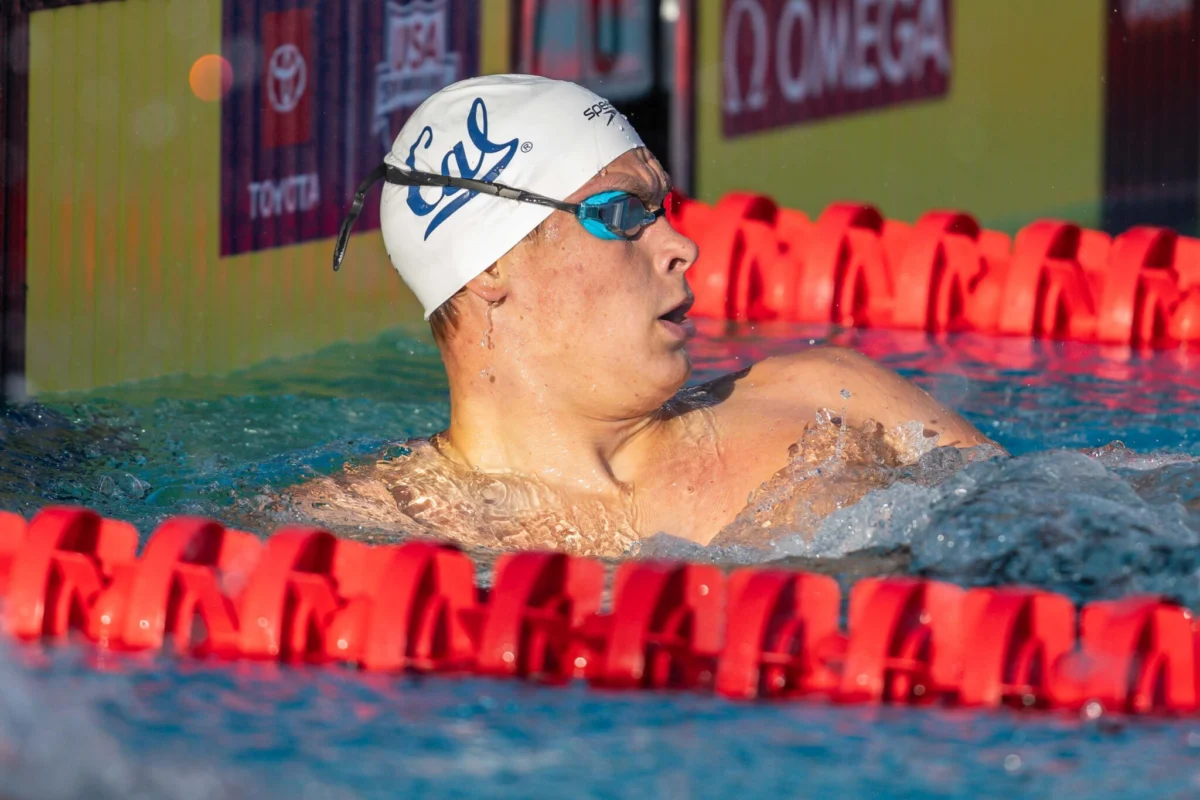
The men’s 800-meter freestyle followed, offering a more traditional competitive environment. California sophomore Ryan Erisman, entering as the top seed, wasted no time asserting his dominance. By the 200-meter mark, Erisman had already opened a 1.5-second lead over his closest rivals, Virginia Tech’s Jakub Poliacik and Minnesota’s Luke Brennan.
Erisman’s consistency was the defining feature of his race. He hit the halfway point in 3:47.23 and, with the exception of a single 350-meter turn, maintained sub-29-second splits for the duration of the event. His final 50 meters, clocked at a blistering 27.57, cemented a winning time of 7:34.84. Leonardo Barbieri Alcantara utilized a strong back-half strategy to secure second place with a time of 7:47.31, successfully holding off a charging pack to finish 12.47 seconds behind Erisman.
Supporting Data and Performance Metrics
The data emerging from Westmont suggests that the U.S. pipeline is currently producing world-class endurance talent.
Performance Analysis: Women’s 1500m Freestyle
Katie McCarthy’s 16:10.50 finish was not merely a win; it was a qualification benchmark. By dipping well under the “B” qualification time of 16:17.32, McCarthy secured her spot in the conversation for the world stage. According to reports from the FMC Natatorium, her time ranks as the 14th fastest in the world for the 2026 calendar year, a testament to her conditioning in the short-course format.
Performance Analysis: Men’s 800m Freestyle
Ryan Erisman’s performance was arguably the highlight of the evening. His time of 7:34.84 cleared the “A” qualification standard for the Beijing World Championships by an impressive 7.65 seconds. This performance is particularly noteworthy given that it was Erisman’s first official attempt at the 800-meter distance in a short-course meter pool.
To put his current form into perspective, Erisman’s 7:34.84 now ranks him as the fourth-fastest performer globally this season, surpassing Hungary’s Oliver Papai (7:35.58). Furthermore, Leonardo Barbieri Alcantara’s silver-medal swim of 7:47.31 ensures he remains firmly within the top 10 global rankings for the season, a position he solidified earlier this year at the José Finkel Trophy.
Official Perspectives and Technical Context
The technical nature of this trial—specifically the use of converted seed times—added a layer of uncertainty that kept the atmosphere in the Natatorium electric. Many of the entrants in the men’s 800-meter freestyle arrived with times derived from long-course performances, making tonight the first true test of their capabilities in the short-course format.
The distinction between historical records and current classifications remains a point of emphasis for officials. As noted in the event documentation, the world junior record landscape has seen significant shifts due to changes in age classifications. While Lani Pallister’s 2020 mark of 15:28.33 is often cited, it remains non-ratified in the current record books, leaving Katie Grimes as the official holder of the World Junior record. These administrative nuances highlight the rigorous standards to which these swimmers are held as they pursue international qualification.
Implications for the Road to Beijing
The opening night of the U.S. Short Course World Trials serves as a microcosm of the depth of the American swimming program. By focusing on the distance events, organizers have emphasized the importance of endurance in the modern competitive landscape.
1. Strengthening the International Roster
With Erisman and McCarthy successfully navigating their respective events, the U.S. team is beginning to take shape. The ability to clear "A" standards on the first night of competition reduces the psychological pressure on these athletes, allowing them to focus on tapering and final preparations rather than scrambling for qualifying times in later sessions.
2. The Rise of Collegiate Programs
The presence of swimmers from California, Minnesota, and Virginia Tech underscores the vital role the NCAA system plays in developing Olympic-caliber talent. The seamless transition from collegiate training to the international trial environment suggests that the collaboration between university coaching staffs and national team governing bodies is functioning at an elite level.
3. Setting the Pace for the Remainder of the Meet
As the trials shift to the standard preliminary and final format starting tomorrow, the momentum established by tonight’s winners will be critical. The decision to push finals to 6 p.m. local time is a strategic move to optimize recovery and peak performance for the athletes.
The early results in Westmont demonstrate that American swimmers are not merely participating; they are actively dictating the pace of the global season. As the meet progresses, the focus will shift to the sprint and middle-distance events, where the depth of the U.S. roster will face its most significant test. For now, however, the message from the FMC Natatorium is clear: the United States is ready to compete on the world stage, and the performance gap between domestic trials and international podiums is closing rapidly.
As fans look forward to the coming days, the performances of Erisman and McCarthy serve as a benchmark for the intensity expected throughout the remainder of the week. With qualification slots on the line, every stroke, flip turn, and underwater segment will carry the weight of national pride and individual aspiration. The 2026 World Short Course Championships in Beijing are still on the horizon, but for those who touched the wall tonight, the journey has already reached a historic turning point.

 Nila Kartika Wati
 Laily UPN

 Reynand Wu
 Neng Nana

 Lina Hope
 Suro Senen