
 Jia Lissa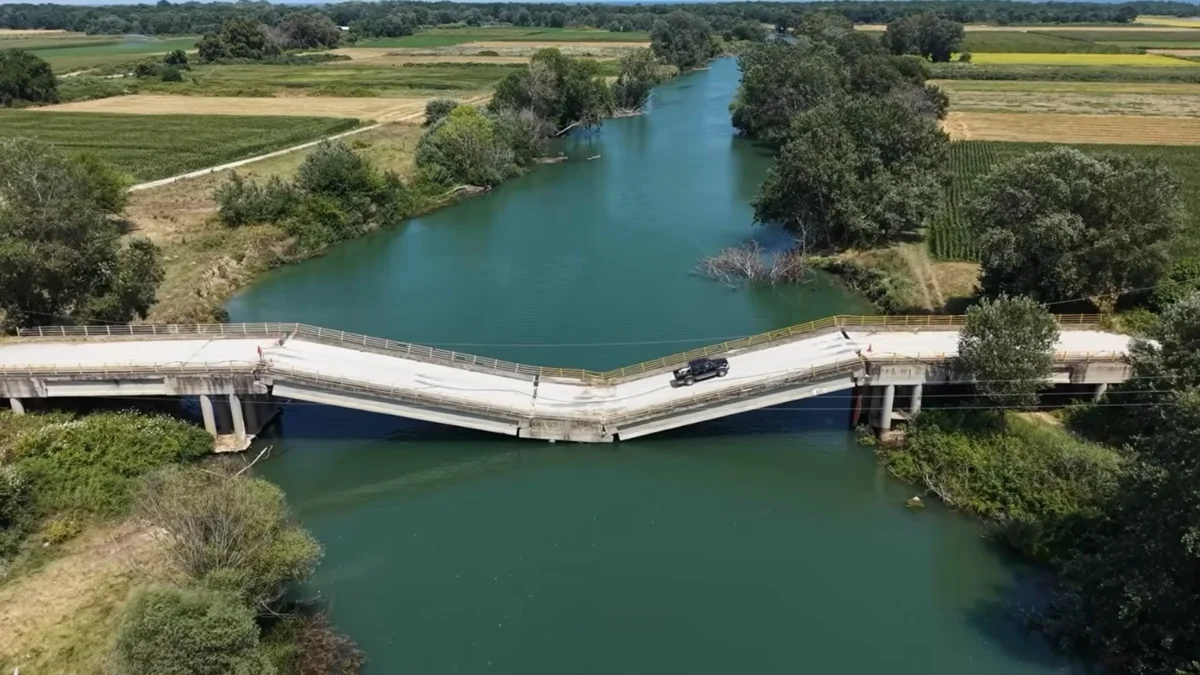
In the rural heart of Greece’s Larissa region, a harrowing routine plays out every morning. As the sun rises over the Pineios River, local farmers, commuters, and school transport vehicles navigate a structure that is, by any engineering standard, a death trap. The Palaiopyrgos Bridge, once a vital artery connecting the villages of Palaiopyrgos and Alexandrini, now sits precariously just inches above the water, its midsection buckled and submerged following the catastrophic impact of Storm Daniel in 2023.
Despite being officially declared out of service and marked as a hazard, the bridge has become the site of a daily, high-stakes gamble. For the residents of this region, the choice is not between safety and convenience; it is a desperate trade-off between economic survival and the looming threat of structural failure.
The Chronology of a Crisis: From Storm Daniel to Present Day
The structural integrity of the Palaiopyrgos Bridge was irrevocably altered in September 2023. Storm Daniel—a Mediterranean tropical-like cyclone that brought record-breaking rainfall to Greece—triggered massive flooding that decimated infrastructure across the Thessaly region. As the Pineios River swelled, its violent currents hammered the foundations of the bridge, causing the central span to buckle and sag.
In the immediate aftermath, the bridge was deemed unsafe for transit. Local authorities cordoned off the area, signaling to the public that the passage was closed. However, the closure proved to be a short-lived deterrent. Within days, as the initial shock of the storm subsided and the necessity of daily life returned, residents began to find ways around the barriers.
By late 2023, the “closed” sign had become a mere suggestion. Through the spring and summer of 2024, and continuing into the present, the bridge has functioned as an informal, unauthorized crossing. The asphalt, cracked and undulating where the concrete has failed, bears the fresh tire marks of vehicles crossing the threshold every hour.
The Economic Burden: Why the Detour Is Not an Option
The primary driver of this risky behavior is the staggering 19-mile detour required to bypass the damaged crossing. For the local agricultural community, this is not merely an inconvenience; it is an economic impossibility.
"What should we do? Should we go all the way around?" one local resident asked in a poignant interview with the Greek broadcaster Skai. "Where should we go? Nothing can be done. We play with death every day."
For a farmer attempting to transport perishable goods or move heavy machinery to fields on the opposite side of the river, the 19-mile journey along the national highway represents a significant cost in fuel, vehicle wear and tear, and, most importantly, time. In an era of rising inflation and shrinking profit margins for small-scale agriculture, many residents feel they have been left with no viable path forward. The bridge, broken as it is, represents the only bridge between the villages—literally and figuratively.
Official Responses and the Bureaucratic Bottleneck
The situation in Larissa has not gone unnoticed by the Hellenic Parliament. Lawmaker Velopoulos Kyriakos has taken a leading role in questioning the Ministry of Infrastructure and Transport regarding the delay in repairs. In a formal note submitted to the minister, Kyriakos highlighted the glaring disconnect between the state’s safety warnings and the reality on the ground.
However, the response from the government has been characterized by the slow pace of bureaucratic process. While plans for a replacement structure have been drafted and reportedly approved, the physical mobilization of construction crews has yet to materialize.
The delay is symptomatic of a wider crisis in Greek infrastructure management, where the scale of destruction left behind by climate-linked disasters has outpaced the government’s ability to secure funding and resources for reconstruction. For the people of Palaiopyrgos, the promise of a future bridge offers little comfort when the current one is crumbling beneath their wheels.
Structural Implications: A Disaster in the Making
The concerns surrounding the bridge are not limited to the immediate risk of a vehicle plunging into the Pineios River. Experts and local representatives have raised alarms about the environmental and hydrological consequences of leaving the buckled structure in place.
Kyriakos, in his appeal to the transport minister, emphasized the "dam effect." The submerged midsection of the bridge acts as an artificial obstruction to the natural flow of the river. During heavy rain, this creates a bottleneck. If another major storm were to occur—a growing probability given the increasing volatility of the regional climate—the bridge could effectively act as a dam.
"There is a visible risk that in a new Daniel-type storm, where there will be another overflow of the Pinios River, the bridge will act as a dam for the water heading towards the sea," Kyriakos noted. "This would result in it overflowing from the riverbeds and flooding the village."
If this scenario unfolds, the consequences would be catastrophic. A sudden release of dammed water, combined with the structural debris of the bridge itself, could lead to a secondary wave of destruction that would make the damage from 2023 look modest by comparison. The bridge is no longer just a failing piece of transit infrastructure; it is a potential catalyst for a humanitarian crisis.
Supporting Data: The Infrastructure Gap
The Palaiopyrgos Bridge situation serves as a microcosm of the challenges facing aging infrastructure in southern Europe. The structural load capacity of the bridge, even before the storm, was designed for a specific volume of traffic. Now, with the foundation compromised, the bridge is subject to "fatigue stress"—a condition where repeated loading and unloading cycles cause the material to weaken further, even if it hasn’t collapsed entirely yet.
Engineering reports from the region suggest that the concrete piers, likely undermined by scouring during the 2023 floods, are no longer firmly anchored in the riverbed. Every vehicle that crosses adds a vibration frequency that destabilizes the structure further. For the motorists, the "quickest route" is becoming exponentially more dangerous with every transit.
The Human Cost: A Community Left Behind
Ultimately, the story of the Palaiopyrgos Bridge is a human one. It reflects a deep-seated frustration among rural populations who feel that their essential needs are being ignored by centralized urban governments. When infrastructure fails, the burden of that failure falls disproportionately on those who rely on it for their daily livelihoods.
The residents are not ignorant of the danger. The phrase "we play with death every day" demonstrates a clear awareness of the risks. Instead, they are operating under a "survival bias"—a cognitive shortcut where the immediate, tangible benefits of saving 19 miles of driving outweigh the abstract, though severe, risk of structural failure.
Looking Forward: The Path to Resolution
As the government continues to weigh the logistical requirements of building a new bridge, the residents of Larissa are left in a state of suspended animation. The project, while approved, requires a coordinated effort between regional and national authorities to clear the debris, stabilize the riverbanks, and construct a modern crossing capable of withstanding the changing climate conditions of the region.
Until that happens, the bridge remains a haunting monument to the collision between human necessity and natural catastrophe. Whether the solution comes through the mobilization of emergency funding or a local protest to force government action, the status quo is clearly unsustainable.
For now, the tire tracks in the mud and the rhythmic thud of engines crossing the fractured concrete are the only sounds of progress in Palaiopyrgos—a grim reminder that for many, the risk of the unknown is far more acceptable than the certainty of a 19-mile detour. The people of the Pineios River valley remain, for better or worse, bound to a structure that is failing them, waiting for the day that a new bridge restores the connection they so desperately need.


 Siti Muinah
 Nana Wu
 Neng Nana

 Lina Hope

 Sagoh
Sagoh
 Iffa Jayyana