
 Neng Nana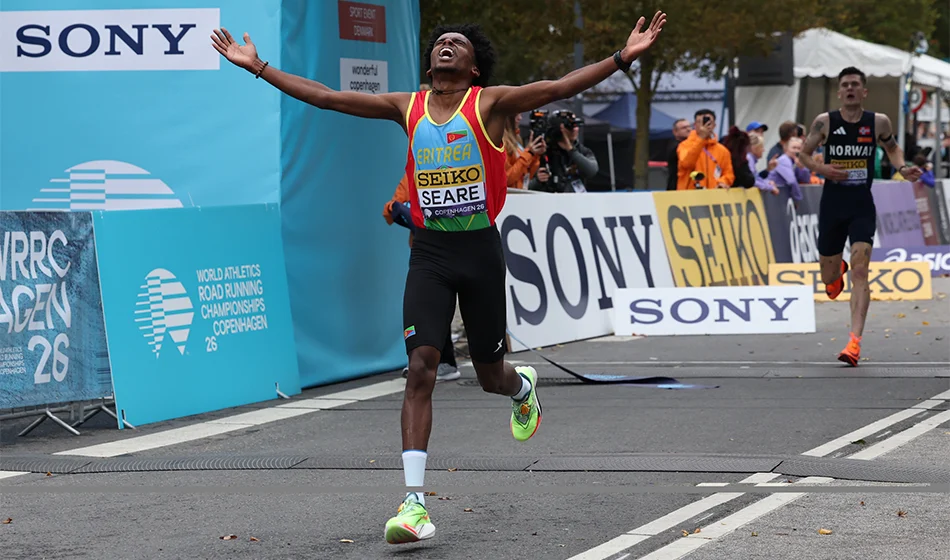
COPENHAGEN — In what is destined to be remembered as one of the most thrilling and improbable distance-running upsets of 2026, 21-year-old Eritrean talent Dawit Seare delivered a masterclass in tactical resilience at the World Road Running Championships. Hauling back the legendary Olympic champion Jakob Ingebrigtsen in the dying embers of the men’s 5km race, Seare smashed his national record to claim gold in 12:56.
While the day’s earlier mile events had already set a high standard for track-and-field excitement, the 5km races in the Danish capital exceeded all expectations. Amid tactical masterclasses, erratic pacing strategies, and dramatic home stretches, the championship delivered a seismic shift in the global distance-running hierarchy. In the women’s race, Likina Amebaw cemented a phenomenal fortnight by adding a World Road Running title to her recent Ultimate 5000m triumph in Budapest.
Main Facts: A Historic Upset on the Danish Asphalt
The headlines from Copenhagen belong unequivocally to Seare and Amebaw, whose victories showcased contrasting yet equally dominant forms of racecraft.
For Seare, the triumph represents a career-defining breakthrough. Arriving in Denmark as the reigning African 5000m champion—having captured gold earlier in the year in Accra—the young Eritrean was nonetheless considered an underdog against a stacked international field headlined by Norway’s Jakob Ingebrigtsen. Seare’s winning time of 12:56 not only secured the gold medal but established a blistering new national record. His compatriot, Saymon Amanuel, rounded out the podium with a bronze in 13:00, capping an extraordinary day for Eritrean distance running. Ingebrigtsen settled for silver, clocking a Norwegian record of 12:59.
In the women’s division, Amebaw shrugged off any concerns regarding a short turnaround from her exploits in Hungary just a week prior. Dictating terms from the outset, she tore the field apart in the second kilometer to cross the finish line in 14:41. Kenya’s Caroline Makandi Gitonga pushed her hard before settling for silver in 14:48, while Australia’s double Commonwealth champion Rose Davies produced a blistering late charge to claim bronze in an area record of 14:50.
Chronology of the Men’s Race: Chaos, Surges, and a Stunning Reprieve
The drama of the men’s 5km began long before the runners settled into their pacing rhythm. A ten-minute administrative and logistical delay kept the elite field waiting anxiously on the starting line, heightening the tension on the Copenhagen course.
Compounding the lack of official pacemakers, Frenchman Flavien Szot took it upon himself to force the issue from the starter’s gun. Acting essentially as an unofficial domestique for his teammate Jimmy Gressier, Szot set a blistering, relentless pace at the front. His commitment to the cause was so absolute that, upon hitting the 2km marker, he abruptly stopped his watch, stepped off the road, and withdrew from the competition.
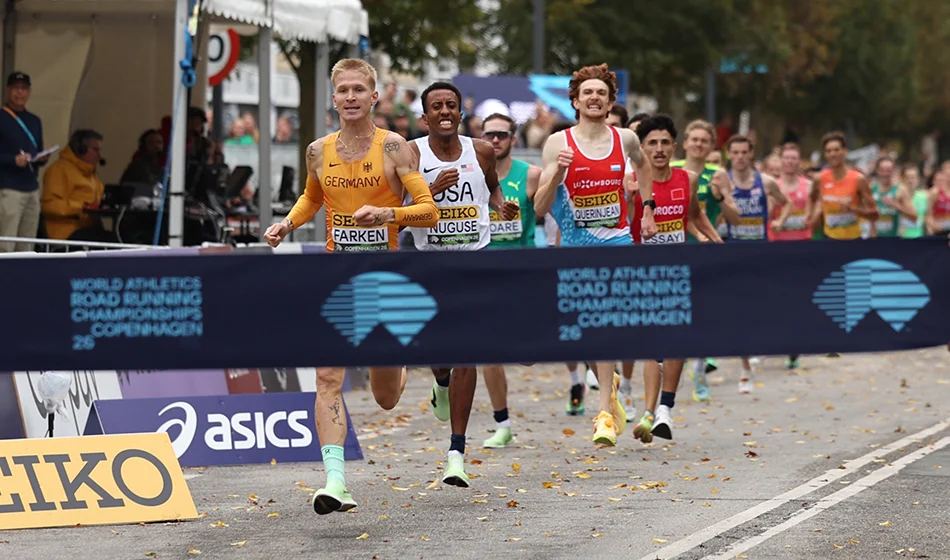
Gressier smoothly assumed leadership duties, guiding a compact lead pack of ten runners through the 3km mark. The race finally fractured violently with one kilometer remaining, when Ethiopia’s Mezgebu Sime launched a vicious surge. Only Seare possessed the raw acceleration to match the Ethiopian’s pace.
As Gressier began to pay the physical toll of his early-race pacing heroics, Ingebrigtsen—who had uncharacteristically missed the initial breakaway—began eating up the deficit with terrifying speed. Seare managed to shake off Sime entering the final straight, appearing to have victory in hand. However, Ingebrigtsen’s relentless hunting ground paid off. With roughly 200 meters remaining, the Norwegian drew level, seemingly executing a textbook tactical execution to coast past the tiring Eritrean into the lead.
What followed next stunned the athletics world. Refusing to accept defeat, Seare dug deep into his reserves, igniting a devastating counter-surge in the final meters. He surged past a stunned Ingebrigtsen, even finding the composure to look heavenward and point upward in jubilation before breaking the tape.
Chronology of the Women’s Race: Amebaw’s Unrelenting Front-Running
The women’s 5km unfolded with clinical precision courtesy of Likina Amebaw. Undeterred by her victory in the Ultimate Championship 5000m in Budapest just seven days prior, Amebaw immediately took control of the tempo.
By the second kilometer, her punishing pace had systematically dismantled the field. While Kenya’s Caroline Makandi Gitonga mounted a spirited challenge midway through the race, attempting to disrupt the Ethiopian’s rhythm, Amebaw remained unshakeable. With one kilometer left to run, she injected a second gear that Gitonga simply could not match, powering clear to take the tape in 14:41.
Gitonga held firm for silver, while Australia’s Rose Davies surged through the closing stages to capture bronze in an area-record 14:50. In the British domestic battle, Megan Keith dictated the pace for much of the race before being overhauled by teammate Hannah Nuttall, who finished a commendable 10th with a personal best of 15:08.
Supporting Data and Notable Performances
Beyond the podium finishers, the Copenhagen championships produced a flurry of personal bests, national records, and inspirational subplots across the international fields.
In the men’s race, Irish standout Darragh McElhinney delivered a phenomenal run to finish 16th, clocking an Irish national record of 13:22. David Mullarkey finished as the highest-placed Briton in 21st, registering a personal best of 13:31.
A particularly poignant narrative belonged to 20-year-old Aron Gebremariam. Having fled Eritrea as a refugee, Gebremariam has been based in Birmingham, England, training with Birchfield Harriers and collecting domestic English Schools and UK Inter-Counties titles. Competing under the banner of the Athlete Refugee Team in Copenhagen, he placed an impressive 26th with a time of 13:36.
Selected Final Standings:
Men’s 5km:
- Dawit Seare (ERI) – 12:56 (National Record)
- Jakob Ingebrigtsen (NOR) – 12:59 (Norwegian Record)
- Saymon Amanuel (ERI) – 13:00
- Ky Robinson (AUS) – 13:04
- Keneth Kiprop (UGA) – 13:04
Women’s 5km:
- Likina Amebaw (ETH) – 14:41
- Caroline Makandi Gitonga (KEN) – 14:48
- Rose Davies (AUS) – 14:50 (Area Record)
- Tayla Kavanagh (RSA) – 14:51
- Aleshign Baweke (ETH) – 14:53
Official Responses and Reflections
The contrasting emotions of the men’s race played out vividly in the post-race media zone.
An ecstatic Dawit Seare revealed the meticulous preparation that underpinned his shock victory. "I am very, very happy because I have been preparing very well for the last two months for this championship," Seare said. "I know Jakob is a very strong athlete. Especially in the last kilometre, it was difficult to compete with him, but at the end, I won, and I am very pleased about that. I will move to the US now and compete there, so keep an eye on me."
For Jakob Ingebrigtsen, silver marked a respectable continuation of his comeback season following Achilles surgery in February, which included a European 5000m title in Birmingham and a triumph in Budapest. However, the Norwegian was candid about his tactical miscalculations.
"I felt that it was so far to the finish line, and I hoped that the others would maybe freeze a little bit, and they did," reflected Ingebrigtsen. "I thought I had to fight with all I had, and I think that I was a little bit too early going into the sprint. When there was two kilometres left, I felt I had a moment and I was in a good position. But then the others speeded up and I thought, ‘Oh no.’ I must admit that my planning was a bit off."
Ingebrigtsen added: "I really felt it was heavy today, and the others were stronger and faster, and they pushed earlier than expected. When you don’t have endless power, you need to prioritize in order to increase your chances for making a good result. I did have the feeling from the very start today that this race would be extremely fast, so I’m very pleased to take the silver medal."
On the women’s side, Likina Amebaw dismissed notions that transitioning quickly from track to road would hinder her performance. "It was a very good race, and I’m really happy about my race. There was a little wind, but it was okay, and I managed to find some good spots on the course," Amebaw noted. "I’m coming straight from Budapest, but the shift from track to road was not really difficult as I have been training both at the same time. I knew I had to push from the very start, and it worked as planned."
Implications for the Sport
The 2026 World Road Running Championships in Copenhagen have rewritten the narrative surrounding middle-distance supremacy.
For Jakob Ingebrigtsen, the defeat serves as a sobering reminder that his aura of invincibility on the global stage faces an increasingly fearless and rapidly evolving generation of African runners. While his return from injury remains broadly successful, tactical vulnerabilities exposed on the road circuit will undoubtedly be analyzed ahead of upcoming global fixtures.
Conversely, Dawit Seare’s ascension—alongside the stellar depth displayed by Eritrean and Ethiopian distance runners—heralds a shifting guard. As Seare transitions to the United States circuit carrying a national record and a world title, the sport’s established superstars are officially on notice. The road and track landscapes are no longer just about household names; a new wave of tactical brilliance and fearless racing has arrived, and it runs right through Asmara and Addis Ababa.

 Lina Hope
 Muslim
 Layla Zulfa
 Nila Kartika Wati
 Asro
Asro
 Nana Wu
 Ali Ikhwan