
 Jia Lissa
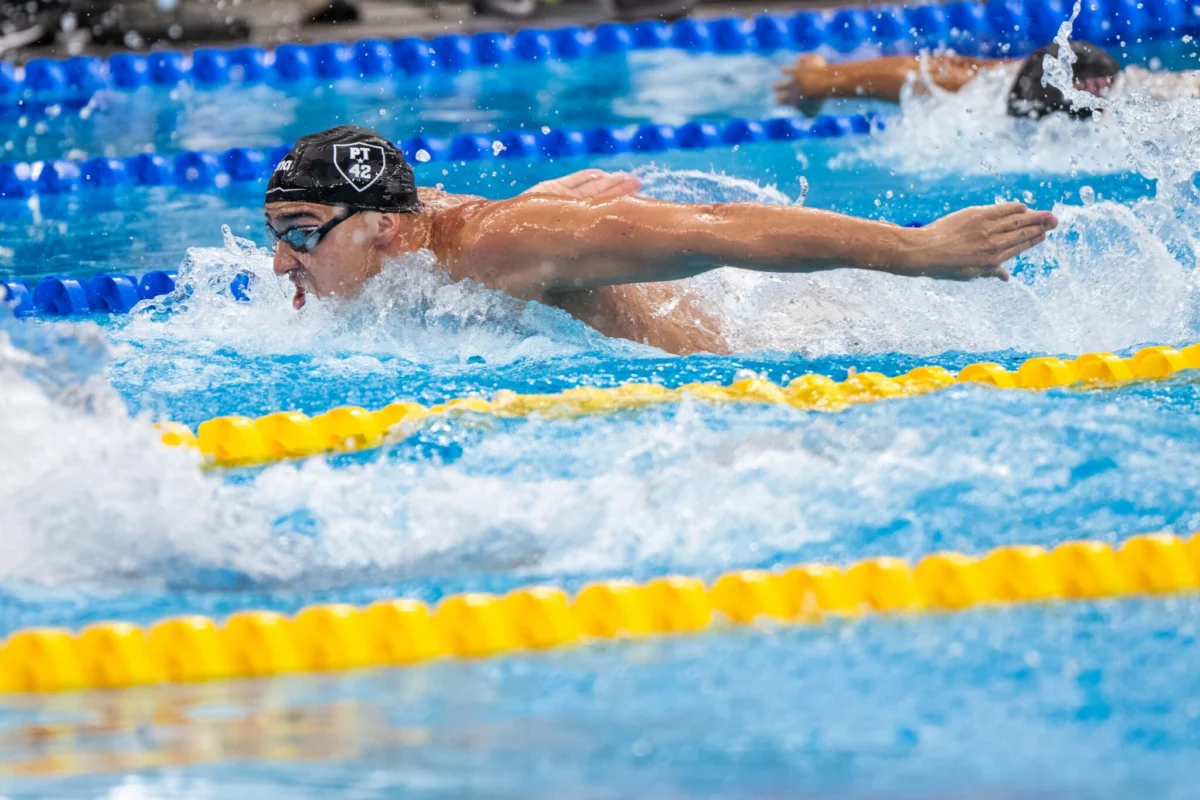
The atmosphere inside the natatorium reached a fever pitch as the 2026 U.S. Short Course World Championship Trials reached its dramatic conclusion. With the international roster for the upcoming Beijing World Championships hanging in the balance, the final night of competition served as a crucible for some of America’s most storied veterans and rising stars.
Entering the final session, the men’s roster was locked at 19 athletes, creating a bottleneck that left little room for error. The night promised not only individual glory but the mathematical tension of roster spots, priority rankings, and the final opportunity to represent the Stars and Stripes on the world stage.
The Morning Prelims: Setting the Stage for Drama
The final day of competition began with a flurry of record-breaking swims that signaled the caliber of the field. In the men’s 50-meter butterfly, Ilya Kharun delivered a statement performance, stopping the clock at 21.61 seconds. This effort not only secured the top seed for the evening but also etched his name into the record books as the new American and U.S. Open record holder. Behind him, a stacked field—including the legendary Caeleb Dressel and Tyler Ray, who also dipped under the previous American record—promised a final that would be one of the most explosive of the entire meet.
The middle-distance events offered a different kind of intensity. World record holder Luke Hobson dominated the men’s 200-meter freestyle preliminaries with a U.S. Open record of 1:40.51, creating a massive gap between himself and the rest of the field. Meanwhile, on the women’s side, the 100-meter freestyle presented a tactical gauntlet, with heavy hitters Kate Douglass and Gretchen Walsh positioned to fight for the top two spots, while Olympic veteran Simone Manuel looked to improve her standing on the priority list.
Chronology of a Final Night: Breakthroughs and Heartbreak
The Breaststroke Battles
The session opened with the men’s 200-meter breaststroke. Josh Bey, already a fixture on the Worlds roster, looked to cement his dominance. While AJ Pouch and Noah Cakir surged ahead during the middle of the race, Bey’s closing speed proved insurmountable. With a blistering 31.69 split over the final 50 meters, Bey touched in 2:02.23, holding off a charging Cakir.
In the women’s 50-meter breaststroke, the narrative was about roster validation. Skyler Smith, who led the prelims with a 29.83, found herself trailing Caroline Larsen at the 25-meter mark. However, Smith’s closing surge in the final ten meters saw her power to the wall in 29.65. The victory was more than just a gold medal; it was a confirmed ticket to Beijing. Piper Enge, already qualified in the 100-meter event, showed her versatility by taking second in 29.74, edging out Larsen by a mere three-hundredths of a second.
IM Mastery and Backstroke Intensity
The men’s 200-meter individual medley served as a pivotal moment for Destin Lasco and Maximus Williamson. Lasco, the top-ranked Priority 3 swimmer, led the field into the wall, further cementing his status. The competition for the final spots on the team was palpable, as Grant House and Williamson fought to keep their Beijing dreams alive against a rapidly shifting priority list.
In the women’s 400-meter IM, Alex Walsh stood in a league of her own. As the only swimmer to dip below the AQUA "A" cut in the prelims, she entered the final with a clear objective: winning the event to climb into the coveted Priority 2 position, a crucial step for securing her role in the U.S. delegation.
The backstroke events showcased the sheer depth of the U.S. squad. Luca Urlando set the pace in the 100-meter backstroke with a 50.16, though he was closely trailed by Owen McDonald. For McDonald, the final represented the absolute last chance to secure a spot on the team, bringing a heightened level of pressure to every turn and underwater transition.
Supporting Data: The Mathematical Reality
The structure of the 2026 Trials is defined by the "Priority System." Because the U.S. men’s roster was capped at 19 prior to the final night, the margin for movement was microscopic.
- Priority 2 vs. Priority 3: Athletes like Alex Walsh were focused on moving up the priority ladder to ensure their participation in relay events or specific high-leverage races in Beijing.
- The "One Spot" Rule: With only one new athlete allowed to be added to the men’s team at the start of the night, every race became a zero-sum game. Swimmers like Grant House and Maximus Williamson were not merely racing against the clock; they were racing against the shifting, complex algorithms of USA Swimming’s roster selection criteria.
Official Responses and Tactical Insights
Coaches throughout the week have emphasized the unique challenge of short-course racing compared to the long-course format used in the Olympic Games. "Short course is about efficiency," noted one team consultant. "The walls are the most important part of the race. If you miss a turn by even an inch, you lose the race. Today, we saw athletes who understood that the transition from the start to the breakout was the difference between a ticket to Beijing and a trip home."
The depth of the women’s 100-meter freestyle field—featuring stars like Douglass and Manuel—underscores the intensity of the U.S. internal selection process. Even for those already on the team, the pressure to secure a high-priority spot is immense, as it dictates the training load and event scheduling for the upcoming World Championships.
Implications for Beijing
The conclusion of these trials leaves the U.S. team with a distinct identity. The integration of veterans like Simone Manuel and Caeleb Dressel with breakout performers like Skyler Smith and Josh Bey creates a roster that balances seasoned tactical experience with the hunger of new blood.
For the swimmers who punched their tickets to Beijing, the next few weeks will be dedicated to fine-tuning their taper and adjusting their nutrition and recovery protocols to peak for the international stage. For those who missed the cut, the 2026 trials serve as a definitive marker of where they stand in the hierarchy of American swimming.
The implications of these trials extend beyond the immediate roster. By emphasizing short-course performance, USA Swimming has signaled a commitment to versatility. The ability to excel in 25-meter pools is a vital skill set for international competition, and the performances witnessed tonight suggest that the American squad is in a strong position to contend for multiple podium finishes in Beijing.
As the lights dimmed on the final night, the message was clear: the American swimming machine is operating at a historic level. With the team now finalized, the focus shifts to the global arena, where the world’s best will converge. The 2026 U.S. Short Course World Championship Trials proved that in the world of elite swimming, the difference between greatness and obscurity is often found in the final meters of the final race.
Summary of Key Results (Finals)
- Men’s 200 Breast: Josh Bey (1st), Noah Cakir (2nd), AJ Pouch (3rd).
- Women’s 50 Breast: Skyler Smith (1st), Piper Enge (2nd), Caroline Larsen (3rd).
- Men’s 50 Fly: Ilya Kharun (Record-breaking performance).
- Men’s 200 Free: Luke Hobson (Top seed/Record holder).
As the athletes depart for Beijing, the legacy of this meet will remain the remarkable resilience of the swimmers who pushed through the physical and mental barriers of the trials. The journey to the World Championships is only just beginning, and if tonight was any indication, the performance in China will be nothing short of historic.

 Raul Delapena Setiawan
 rifanmuazin

 Muslim
 Reynand Wu
 Iffa Jayyana
 Azzam Bilal Chamdy

 Asro