 Pevita Pearce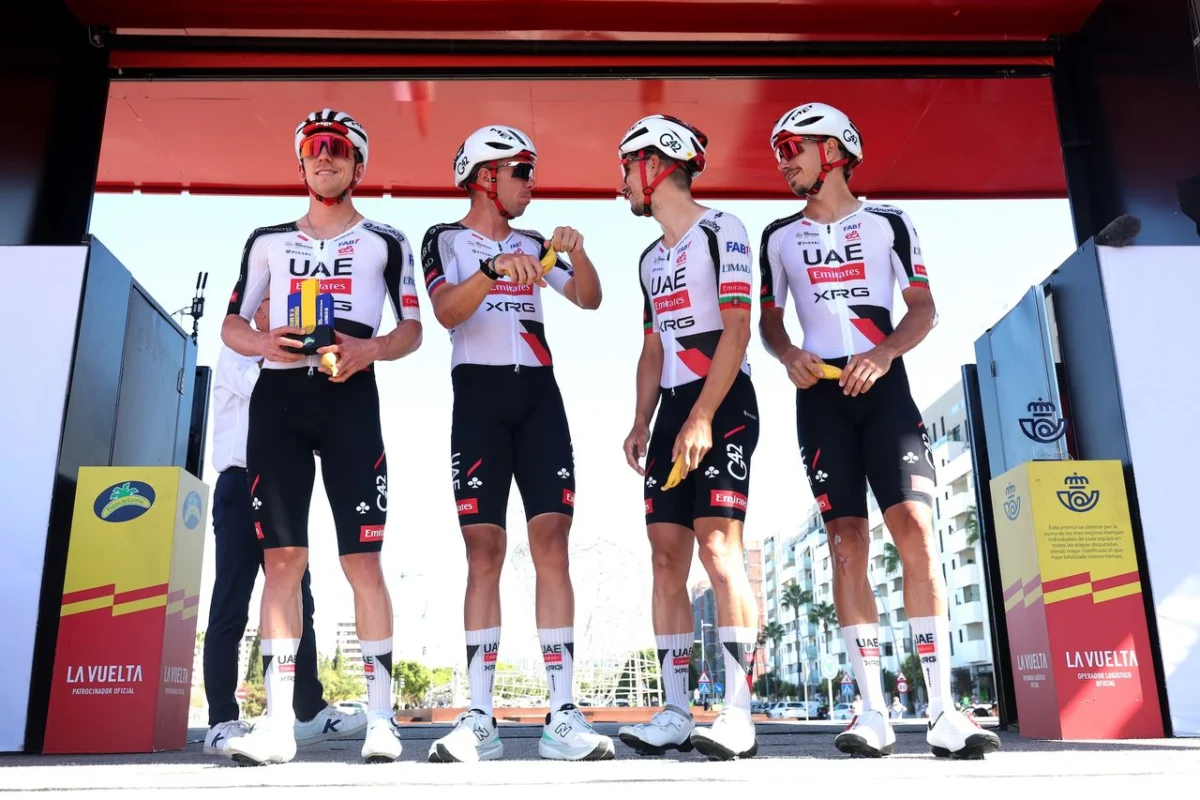
Main Facts: A Grand Tour Defined by Adversity and Grit
Less than two months after securing a historic and record-equalling fifth triumph at the Tour de France, UAE Team Emirates-XRG crossed the finish line of the Vuelta a España with their heads held high, though bearing the physical and mental scars of an extraordinary campaign.
While the team entered the final Spanish Grand Tour of the season riding a wave of unmatched momentum, the three-week race quickly transformed from a standard title defense into a battle of pure attrition. Plagued by circumstances largely beyond their control—ranging from sudden illness and catastrophic crashes to external disruptions—UAE Team Emirates-XRG endured what management and riders alike have candidly labeled one of their toughest Grand Tours in recent memory.
Yet, as the peloton gathered for the ceremonial closing kilometers in Granada ahead of Stage 21, the atmosphere around the UAE Team Emirates-XRG bus was one of quiet dignity and mutual respect. Tucked away in the calmest corner of the team paddock, the squad’s mobile headquarters welcomed a steady stream of well-wishers, family members, close friends, and a surprisingly heavy detachment of the Guardia Civil traffic police. Eager to share a moment with the riders and staff, the officers posed for photographs and exchanged warm regards with team management, highlighting the profound human connection that often blossoms amidst elite-level athletic suffering.
This was not the celebratory, champagne-soaked conclusion the squad had experienced in Nice at the Tour de France just weeks prior. Instead, it was a gritty, hard-fought survival of the fittest. The 2024 Vuelta a España demanded adaptability, exposing the vulnerability of even the most dominant cycling powerhouse in the world, while ultimately cementing their reputation for unyielding perseverance.
Chronology: From Early Promise to Unforeseen Turmoil
Week 1: High Ambitions and Immediate Momentum
The narrative of UAE Team Emirates-XRG at the Vuelta a España began with unmistakable optimism. Arriving in Lisbon for the grand Población start in Portugal, the team was buoyant. The tactical briefing was clear: control the race early, protect the designated leaders, and seize opportunities on the punchy Iberian ascents.
The opening stages offered a masterclass in controlled aggression. Riders executed pre-race strategies with precision, capturing early time bonuses and positioning themselves comfortably near the upper echelons of the general classification. The morale within the team bus was buoyant, mirroring the unstoppable aura they had cultivated throughout the season. Observers and pundits alike were already drafting the early chapters of another dominant UAE Grand Tour conquest.
Week 2: The Turning Point and Cascading Setbacks
As the race crossed the border from Portugal into Spain, the tectonic plates of the Vuelta shifted dramatically. What began as isolated misfortune quickly snowphalled into a systemic crisis. Unforeseen crashes in the peloton—some triggered by treacherous road conditions and others by mere racing volatility—claimed key domestiques and leaders alike.
The ripple effects of earlier season crashes, combined with fresh injuries sustained on the slick Spanish tarmac, began to handicap the roster. Riders who were meant to dictate the pace in the high mountains found themselves struggling simply to stay upright and maintain contact with the gruppetto. Furthermore, unseasonal weather patterns battered the peloton during the brutal mid-race mountain stages, exacerbating physical fatigue and inviting opportunistic viruses into the camp. Stomach bugs and respiratory issues swept through the paddock, and UAE Team Emirates-XRG was not spared.
Week 3: Survival Mode in the Southern Ranges
Entering the final week, the ambition to contest the red jersey (La Roja) gave way to a tactical pivot: survival and stage hunting. The team’s directeur sportifs convened late into the night, rewriting race books to protect whatever GC standing remained while freeing up resilient climbers to animate the breakaways.
The punishing climbs of Andalusia and the brutal ascent toward the high-altitude finales tested the psychological breaking point of every athlete left standing. For UAE Team Emirates-XRG, the final week was less about tactical supremacy and more about a refusal to quit. Each morning departure from the team bus required a monumental mental reset. Riders taped up road rash, swallowed anti-inflammatories, and pinned on their numbers knowing they would suffer. By the time the race reached Stage 21 in Granada, simply getting their remaining roster across the finish line felt equivalent to winning a trophy.
Supporting Data: The Numbers Behind the Struggle
To fully appreciate the magnitude of UAE Team Emirates-XRG’s ordeal at this year’s Vuelta, one must look beyond the emotional narrative and examine the quantifiable data of the race:
- The Contrast in Timeline: Just 54 days separated their triumphant parade on the Champs-Élysées (or its equivalent in Nice) and the gritty, defensive rear-guard action executed on the roads to Granada.
- Roster Attrition: Grand Tours are won and lost on depth. UAE Team Emirates-XRG suffered a higher-than-average percentage of time loss among key support climbers by the conclusion of Week 2, forcing tactical adjustments that compromised their usual chokehold on the race.
- Climatic and Topological Extremes: The Vuelta featured over 50 categorized climbs, several scaling altitudes exceeding 2,000 meters. Coupled with soaring Iberian temperatures that regularly breached 40°C (104°F) in the southern valleys, the physiological toll on riders recovering from prior season injuries was severe.
- The Pelotonal Ripple Effect: According to post-race medical bulletins, over 15% of the starting peloton withdrew before reaching Madrid or Granada due to a combination of crash-induced trauma and gastrointestinal illnesses—metrics that directly impacted UAE Team Emirates-XRG’s operational strategy.
Official Responses: Inside the Team Paddock
Despite the hardships, the public-facing posture of UAE Team Emirates-XRG remained resolute, characterized by a mix of profound realism and quiet pride.
Speaking from the shadow of the team bus prior to the rollout of Stage 21, team management reflected candidly on the grueling three weeks.
"We came here with the absolute highest ambitions, as we always do," said one senior team director. "When you wear this jersey, the expectation is to fight for the win every single day. But cycling is a living, breathing organism of a sport. Sometimes, the road writes a script you didn’t plan for. We didn’t get the result on paper that our pre-race dreams mapped out, but what I saw from these riders—the sheer refusal to lay down when things went wrong—is worth more than a trophy on some days."
Riders echoed these sentiments, emphasizing the solidarity that carried them through the darkest moments of the race. Several team members noted that the adversity faced in Spain served as a critical character-building crucible.
"In the Tour, everything flowed like clockwork. Here, every single kilometer felt like we were swimming upstream," admitted one of the team’s core road captains. "You learn a lot about your teammates when you’re suffering together in the rain or fighting a fever in a hotel room. We didn’t crack. We adapted, we supported each other, and we finished. That matters."
The unexpected camaraderie displayed by the local Guardia Civil traffic police—who took time out of their demanding security duties to share laughs, photos, and professional mutual respect with the riders and staff—provided a heartwarming counterpoint to the fierce competitive tension of the race. It served as a reminder that the broader cycling community recognizes and respects tenacity above all else.
Implications: What This Means for the Future of UAE Team Emirates-XRG
Every Grand Tour leaves an indelible footprint on a team’s tactical philosophy, and the 2024 Vuelta a España will undoubtedly influence UAE Team Emirates-XRG’s strategic roadmap for seasons to come.
1. Re-evaluating Grand Tour Depth and Periodization
The stark contrast between their dominant Tour de France performance and their survival-mode Vuelta campaign highlights the immense physiological and psychological toll of targeting multiple Grand Tours at an elite level. Moving forward, team physiologists and trainers will likely scrutinize recovery windows, transition periods, and the physical degradation riders experience when cycling back-to-back peak performances. Ensuring that secondary rosters possess equal resilience and depth will be paramount.
2. Mental Fortitude as a Competitive Advantage
While physical watts and aerodynamic efficiency dominate modern cycling discourse, races like this year’s Vuelta are ultimately decided in the mind. UAE Team Emirates-XRG’s ability to salvage a turbulent race without letting morale collapse proves that the team culture extends far beyond front-running tactics. The mental armor forged in the crucible of Spanish adversity will pay dividends when future leaders face sudden crises in upcoming seasons.
3. Strengthening Fan and Community Engagement
The poignant scenes outside the team bus in Granada—featuring local authorities, families, and fans rallying around a battered squad—demonstrate the enduring human appeal of professional cycling. As UAE Team Emirates-XRG continues to grow into a global sporting juggernaut, maintaining these grassroots, approachable connections remains vital to their public identity.
As the team departs the Iberian Peninsula and looks toward the off-season, they do so not with the bitter taste of failure, but with the quiet satisfaction of a unit tested by fire and unbowed by fate. The 2024 Vuelta a España may go down in their internal archives as one of their hardest tests, but it may ultimately be remembered as the race that proved their true greatness lay not just in winning, but in enduring.

 Asro
Asro
 Ali Ikhwan
 Basiran
 rifanmuazin
 Nila Kartika Wati
 Nana
Nana