
 Pevita Pearce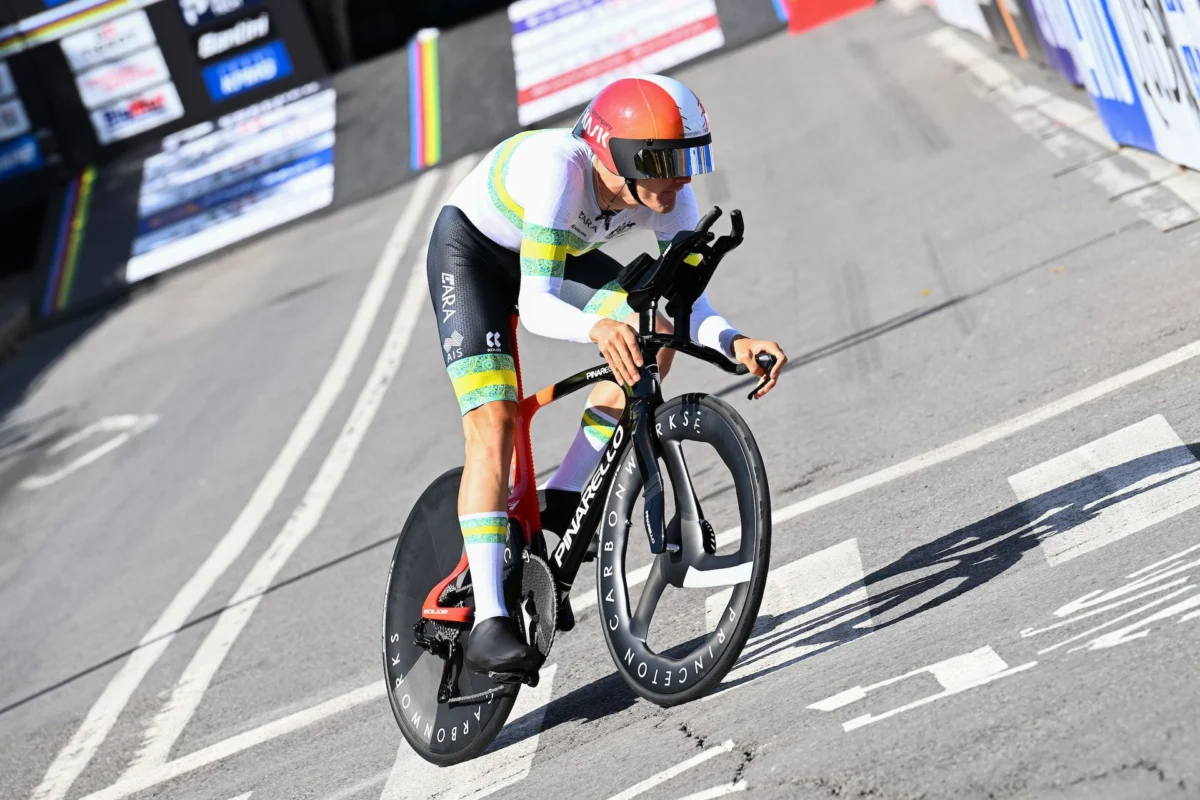
MONTREAL — The pursuit of a rainbow jersey demands an almost impossible alignment of physical supremacy, tactical precision, and mechanical perfection. On a crisp Monday afternoon in Montreal, Australian rising star Cameron Rogers possessed the first two in abundance. Unfortunately for the 21-year-old time trial specialist, fate intervened in the most agonizing way imaginable, turning what promised to be a career-defining performance at the UCI Road World Championships under-23 men’s time trial into a grueling exercise in damage control.
Entering the race as one of the premier outside favorites for a podium finish, Rogers was poised to make a profound statement on the global stage. Instead, a devastating mechanical failure just under 10 kilometers into the demanding 31.3-kilometer championship route derailed his ambitions, leaving him to battle the elements, the course, and an insurmountable gear ratio for the remainder of the race.
While cycling is inherently a sport of both triumph and tragedy, the manner of Rogers’ misfortune serves as a stark reminder of the razor-thin margins that separate glory from despair in elite modern sport.
Main Facts: The Anatomy of a Championship Disaster
The incident occurred during the opening third of the grueling 31.3-kilometer test against the clock through the streets and parklands of Montreal. Rogers, representing the Australian national team, had surged off the starting ramp with blistering pace, immediately establishing himself among the fastest riders through the early intermediate time checks.
However, disaster struck shortly before the 10-kilometer mark. Without warning, Rogers’ chain slipped off the front chainring, failing to engage properly back onto the drivetrain. In the high-stakes environment of a World Championship time trial, where riders use specialized single-chainring or tightly calibrated multi-chainring setups with electronic shifting optimized for sustained wattage, a dropped chain is not merely a brief inconvenience—it can be a catastrophic race-ender.
Compounding the problem, the mechanical forced Rogers into an untenable gear configuration for the remainder of the course. With his shifting capabilities compromised and unable to select a manageable cadence, the young Australian was forced to grind a massive, high-resistance gear for more than two-thirds of the race.
In modern time trialing, cadence and aerodynamic efficiency are inextricably linked. Forcing the legs to turn over a massive gear at a critically low revolutions-per-minute (RPM) rapidly depletes glycogen stores, spikes lactic acid accumulation in the quadriceps, and destroys the fluid, circular pedaling motion required to sustain high speeds over rolling terrain. Despite these nearly insurmountable physical and mechanical hurdles, Rogers gutted out the remaining distance, refusing to abandon his country or his dream, crossing the finish line deeply fatigued and shattered by what might have been.
Chronology of the Race: From Early Flight to Forced Survival
To fully understand the magnitude of Rogers’ heartbreak, one must trace the timeline of his Monday afternoon on the Montreal course—a narrative split sharply into two contrasting chapters: the dream and the struggle.
Phase One: The Fast Start (Kilometers 0 to 9.5)
From the moment he rolled down the start ramp, Rogers looked every bit the world-class athlete. Observers stationed along the early sectors noted his exceptional aerodynamic posture and powerful, rhythmic pedal stroke. Pacing strategies in a 31.3km time trial require immense discipline, yet Rogers appeared to be riding well within himself while simultaneously generating world-class speed.
"I was on a really good run," Rogers reflected in the aftermath, visibly dejected. "I felt super, super fast and had really good legs today."
Splits recorded at the opening time check confirmed his assessment. He was tracking among the absolute elite, cleanly inside the virtual podium projections and matching the ferocious pace set by the eventual heavy-hitters of the day. His preparation—months of altitude training, aerodynamic wind-tunnel testing, and meticulous pacing simulations—was paying immediate dividends.
Phase Two: The Catastrophe (Kilometer 10)
The turning point of the race occurred with cruel suddenness. Approaching a rolling section of the course, Rogers experienced the mechanical issue that would define his afternoon. As the chain dropped from the front chainring, momentum briefly stalled.
In elite time trials, support cars follow at a regulated distance behind the riders, but team mechanics are restricted by strict UCI regulations regarding intervention, gear changes, and drafting. By the time assistance could be managed or a makeshift fix applied, the damage to his rhythm—and his gearing options—was already done. The chain issue locked his setup into a gear unsuited for the undulating topography of the Montreal circuit, which features a punishing mix of false flats, punchy climbs, and technical descents.
Phase Three: The Grinding Battle (Kilometers 10 to 31.3)
For the remaining 21-plus kilometers, Rogers’ race transformed from a tactical exhibition of speed into a brutal endurance test. Riding in a "huge gear" meant that every time the road kicked upward, or every time he had to accelerate out of a tight corner, Rogers could not drop into a lighter gear to spin his legs.
Instead, he was forced to mash the pedals, driving his muscular system into the red zone far earlier than planned. Spectators watched in awe and sympathy as the young Australian fought visibly against his own machine, his cadence noticeably suppressed, his upper body swaying under the immense torque required to turn the cranks. Yet, despite the pain and the mathematical impossibility of contending for the gold medal under such constraints, Rogers pressed on, finishing the course out of sheer professional pride and dedication to the green and gold jersey.
Supporting Data: The Numbers Behind the Effort
While the official classification sheets will show a result far below Rogers’ true capabilities, a closer examination of his data highlights just how fast he was before misfortune struck:
- Total Race Distance: 31.3 kilometers (approximately 19.4 miles) over a technical, rolling circuit in Montreal.
- Point of Failure: Just under the 10-kilometer mark, meaning roughly 68% of the race was completed under severe mechanical handicap.
- Gear Ratio Crisis: Racing in a "huge gear" for two-thirds of a time trial drastically lowers cadence, forcing a shift from high-aerobic efficiency to pure muscular force, which accelerates physical exhaustion.
- Field Competitiveness: The UCI U23 Men’s Time Trial is widely regarded as one of the most fiercely contested categories in international cycling, where winning margins are often measured in mere seconds over a 30km effort.
In modern cycling, data is king. Power meters, heart rate monitors, and aerodynamic sensors stream real-time metrics back to team coaches. Up until the chain dropped, Rogers’ power-to-weight ratio output was tracking directly within the target zone required to fight for the world title. The mechanical failure effectively rendered those months of data analytics and meticulous preparation obsolete through sheer bad luck.
Official Responses: Grief, Resilience, and Stoicism
The cycling community was quick to rally around the young Australian following the race. In the mixed zone outside the finish area, Rogers struggled to conceal his disappointment, though he maintained his composure while speaking to reporters.
"It was just unfortunate with the gearing and the mechanical problem," Rogers said, his voice heavy with emotion. "The chain fell off the front chainring not even 10 kilometres in. I was on a really good run. I felt super super fast and had really good legs today – it’s just unfortunate."
Coaching staff and national federation representatives offered immediate support, emphasizing that sport at the elite level can be ruthlessly unforgiving. High-performance directors noted that while the result will not show up in the medal tally, the underlying performance during the first 10 kilometers proved that Rogers belongs among the absolute best time-trialists of his generation.
Fellow competitors and pundits across the cycling world echoed these sentiments, pointing out that mechanical failures in time trials—where riders operate in isolation against the clock without a replacement bike immediately at hand in every scenario—are among the most heartbreaking occurrences in the sport. There is no peloton to hide in, no teammate to swap a bike with instantly; it is rider versus machine versus course.
Implications: Moving Forward from Montreal
As the dust settles on the 2024 UCI Road World Championships in Montreal, the implications of Cameron Rogers’ mechanical mishap extend far beyond a single day of racing.
1. Validation of Potential
First and foremost, Rogers leaves Canada with undeniable proof of his engine. To set split times that match the world’s best under-23 riders in the opening third of a World Championship race confirms that his physical ceiling is exceptionally high. When the road pointed upward and the time checks rolled in early on, Rogers was matching pedal strokes with the titans of the discipline. This performance will cement his reputation within the international professional scouting community as a premier talent for the race against the clock.
2. Equipment Reliability and Protocol Review
Incidents of this nature inevitably trigger deep internal reviews within national federations and professional trade teams regarding equipment preparation. While mechanical failures are a statistical reality of mechanical sports, teams will scrutinize chain retention devices, front derailleur setups, and electronic shifting calibrations to ensure such a catastrophic failure is minimized in future championship events. In modern cycling, where marginal gains dictate outcomes, mechanical insurance policies—such as optimized chain catchers and rigorous pre-race stress-testing—are paramount.
3. Mental Fortitude and Future Horizons
For a young athlete, experiencing a major setback on the world stage can either break confidence or forge unbreakable resilience. Given Rogers’ post-race demeanor—acknowledging the heartbreak while squarely identifying his strong form—all signs point toward the latter. The resilience required to grind through 21 kilometers in a massive, punishing gear speaks volumes about his character.
As Rogers looks ahead to the upcoming seasons and future World Championships, the demons of Montreal will undoubtedly serve as powerful motivation. The rainbow jersey remains an ultimate ambition, and if his legs in the opening 10 kilometers of Monday’s race are any indicator, Cameron Rogers will return to the start ramp ready to reclaim what misfortune temporarily took away.

 Muslim
 Sagoh
Sagoh
 Iffa Jayyana
 Ali Ikhwan
 Jia Lissa
 Neng Nana
 Dwi Wanna