
 Nana Wu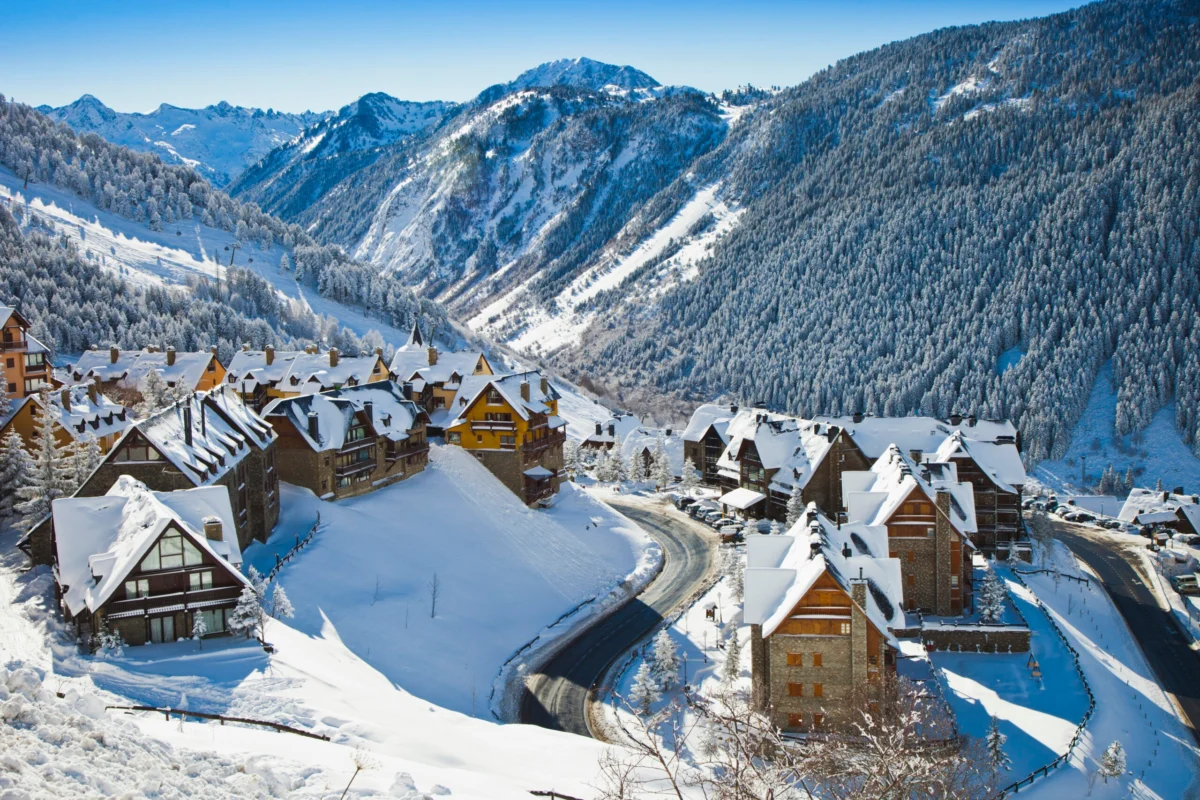
Updated September 15, 2026
When winter travelers set their sights on a European ski vacation, a familiar pantheon of alpine destinations immediately springs to mind. From the legendary steeps of Chamonix and the jet-set glamour of St. Anton to the dramatic verticals of Verbier, the car-free serenity of Zermatt, and the postcard-perfect limestone spires of the Dolomites, the European Alps command the global imagination.
Yet, stretching roughly 300 miles across the natural border separating France and Spain, the Pyrenees mountain range is routinely overlooked. For skiers seeking a profound departure from the homogenizing corporate polish of mega-resorts, this oversight is a distinct advantage.
The Pyrenees offer a dramatically different cadence to a European ski trip. Here, resorts are smaller, unpretentious, and fiercely independent. Lift lines are mercifully short—often nonexistent—and a $50 lift ticket remains a realistic baseline rather than a faded memory. It is a geographic anomaly where one can carve pristine powder through alpine bowls in the morning, savor authentic Catalan tapas by midday, and, depending on the season and proximity to the coast, surf the Atlantic breakers of the Basque Country the very next day. For serious ski tourers and backcountry enthusiasts, the range provides a rugged, sprawling canvas of untracked terrain.
Main Facts: The Anatomy of a Pyrenean Ski Trip
To understand skiing in the Pyrenees is to understand a landscape defined by dramatic contrasts. Running from the Mediterranean Sea on the east to the Bay of Biscay on the west, the range serves as a climatic and cultural bridge between Southern Europe and the high mountains.
Unlike the towering, glaciated monoliths of the Western Alps, the Pyrenees feature a more intimate scale, yet they boast peaks soaring past 11,000 feet—such as the Maladeta Massif and Monte Perdido. The snowpack is heavily influenced by both Atlantic storms sweeping in from the west and Mediterranean systems dropping moisture from the south. This dual maritime influence creates a unique meteorological footprint: north-facing French bowls frequently trap deep, cold powder cycles, while the sun-drenched Spanish slopes transition rapidly into stellar spring corn snow.
Logistically, the region offers surprising accessibility. Major international hubs like Barcelona provide direct flights from North America and major European capitals, allowing travelers to clear customs, rent a vehicle, and click into their bindings within a three-to-four-hour window.
Chronology: A Journey from Urban Catalonian Drizzle to Alpine Powder
The true character of a Pyrenean journey reveals itself in transit. The transition from Mediterranean warmth to high-altitude winter wonderland is not a gradual slope; it is a cinematic shift.
The Approach
The transformation begins on a drizzly morning, driving north from the architectural bustle of Barcelona. Instead of passing through the sterile, uniform highway tunnels of the Swiss Alps, the initial leg of the journey winds past wet onion fields, eucalyptus groves, and the muggy brown waters of the Llobregat River sliding past the windshield. A traveler sustains themselves on gas-station tortillas and bottled gazpacho. The atmosphere feels decidedly un-Alps—mild, earthy, and distinctly Mediterranean.
The Threshold
Then, the geography pivots. The route pierces the mountain barrier through a deep highway tunnel. Emerging on the other side feels like stepping through a portal into an entirely different continent.

On this particular March morning, two feet of fresh, heavy snow had blanketed the rolling hills of Cerdanya overnight, transforming the landscape into something remarkably reminiscent of Lake Tahoe. Pine trees bent under heavy white mantles, and pristine meadows stretched out toward distant granite peaks. The ski area was still miles away, yet the Pyrenees had already decisively made their case: this is a destination where expectation and reality collide in the most unexpected ways.
Supporting Data: Economics, Geography, and Culture
1. Imperfect, Uncrowded, and Authentically Retro
If the Alps represent a highly curated, industrial-scale tourism engine, the Pyrenees are an untended orchard whose fruit is left largely unpicked. The beauty of skiing here lies in its imperfect, unbothered character.
Skiers will encounter lift tickets attached with classic metal wickets, vintage rust-tinged T-bars, and cozy double-chairlifts that prioritize conversation over sheer speed. Local ski shops may bear signs reading cerrado (closed) in the middle of the afternoon for siesta, and resort websites often retain a charmingly rudimentary aesthetic built by web designers from a bygone era.
Beyond the slopes, the cultural hum is quiet. Instead of the booming bass lines of hyper-commercialized après-ski bars echoing across concrete plazas, lunch is consumed in sparkling mountain silence—what the locals call tranquilo. Outside of a handful of developed pockets, skiers share the high-alpine domain primarily with mountain goats and the occasional dedicated Catalan ski mountaineer.
2. Pricing from the 1990s
While major Alpine resorts have steadily inflated ticket prices to match luxury travel demands, mom-and-pop operations along the Franco-Spanish border have maintained remarkably stable economics.
To be fair, exceptions exist. High-profile, upscale destinations like Baqueira-Beret in the Val d’Aran cater to Catalonia’s well-heeled urbanites, with peak-season lift tickets pushing toward $90. Yet, a short drive away to community-focused hills like Piau-Engaly on the French side, or the Cauterets area near Monte Perdido, yields a full day of world-class skiing for around $50. In shoulder seasons, dynamic pricing structures at select treeline resorts can drop ticket costs even lower.
3. Mediterranean Gastronomy
Mountain food in the Alps is legendary, but weeks of heavy fondue, melted raclette cheese, and smoked sausages can leave travelers longing for culinary diversity. The Pyrenees solve this dilemma by anchoring ski culture firmly within Europe’s premier gastronomic zones.
The region merges hearty mountain traditions with refined Mediterranean flavors. Skiers can sample local delicacies such as Bigorre black pig ham or Basque Ossau-Iraty cheese, alongside Catalan staples like pan tumaca (crisp country bread rubbed with fresh tomato, garlic, and olive oil), fire-caramelized calçots dipped in rich romesco sauce, and traditional Toulouse bean cassoulets. Furthermore, San Sebastian—boasting one of the highest concentrations of Michelin-starred restaurants in the world—lies just a short drive from the western terminus of the range.
4. A Thriving Ski Touring and Mountaineering Culture
For backcountry skiers and splitboarders, the Pyrenees offer unmatched variety. The terrain shifts wildly from misty Atlantic foothills blanketed in beech forests to sun-baked canyons lined with wild olives and cork oaks.
Key zones showcase this topographical diversity:

- The Huesca Region: Home to the 11,155-foot Maladeta Massif and Monte Perdido, containing some of Spain’s final remaining high-altitude glaciers.
- Val d’Aran: Features dense, complex old-growth forests that rival the best tree-skiing zones in the French and Swiss Alps.
- Sierra del Cadí: Located within striking distance of Barcelona, this area features committing 50-degree couloirs that demand serious alpine mountaineering and avalanche assessment skills.
Official Responses and Perspectives
Local tourism authorities, mountain guides, and regional officials view the distinct profile of the Pyrenees not as a weakness to be corrected, but as a core asset to be protected.
"For decades, the prevailing narrative in European snow sports was that bigger is inherently better," explains Elena Vance, a regional mountain tourism coordinator based in Toulouse. "Municipalities and investors poured capital into interconnecting Alpine valleys, creating massive ski circuses. Our philosophy here has intentionally remained localized. We cater to visitors who value landscape integrity, cultural authenticity, and personal space over high-speed gondolas and luxury shopping villages."
Mountain guides operating within the Pyrenean backcountry emphasize safety and environmental stewardship over mass tourism development. Nacho Garrido-Lestache, a veteran guide working out of the Val d’Aran backcountry zones, notes that the relative lack of crowds transforms how visitors experience the mountain.
"In the Alps, you are often skiing within a heavily managed industrial park," Garrido-Lestache says. "In the Pyrenees, when you hire a guide to tour the Peñálla zone or the high routes of the Maladeta, you are stepping into a wild, breathing ecosystem. You can tour for hours without seeing another human track. That solitude is becoming an endangered commodity in modern mountain travel."
Implications: The Future of Pyrenean Tourism
As climate change alters snow reliability across lower- and mid-elevation European resorts, the geographic and topographical characteristics of the Pyrenees present both unique challenges and strategic implications for the future of winter tourism.
Because many Pyrenean resorts sit at lower base elevations than their high-altitude Alpine counterparts, operators are increasingly investing in sustainable snow-management practices, diverse year-round adventure tourism portfolios (such as mountain biking and hiking), and dynamic pricing models to smooth out seasonal fluctuations.
At the same time, the relative anonymity of the range shields it from the hyper-gentrification affecting other mountain communities. By preserving their mom-and-pop operational structures, local communities maintain economic resilience while avoiding the displacement of local residents often triggered by runaway mega-resort expansion.
Ultimately, the Pyrenees occupy a rare space in contemporary travel: a major European mountain range that still feels genuinely undiscovered. For skiers willing to trade the polished perfection and endless lift-ticket costs of the Alps for solitude, rich local culture, and a healthy dose of the unexpected, the French-Spanish borderlands offer an unforgettable alternative. Whether chasing north-facing powder in France or sun-baked corn snow in Spain, a journey into the Pyrenees unlocks a side of Europe that few skiers ever see.

 Nana Muazin
 Ali Ikhwan
 Layla Zulfa
 Nila Kartika Wati
 Asro
Asro

 Neng Nana