
 Ali Ikhwan
MADRID — As Formula 1 ventures into uncharted territory with its latest Grand Prix calendar addition around the IFEMA complex in Madrid, the paddock has been abuzz with intense technical debate. Prior to the opening practice sessions, apprehension echoed through the pit lane regarding whether the tight, unforgiving layout would earn a reputation as a literal "car killer"—a fear initially catalyzed by a chaotic and incident-packed Formula 3 testing block.
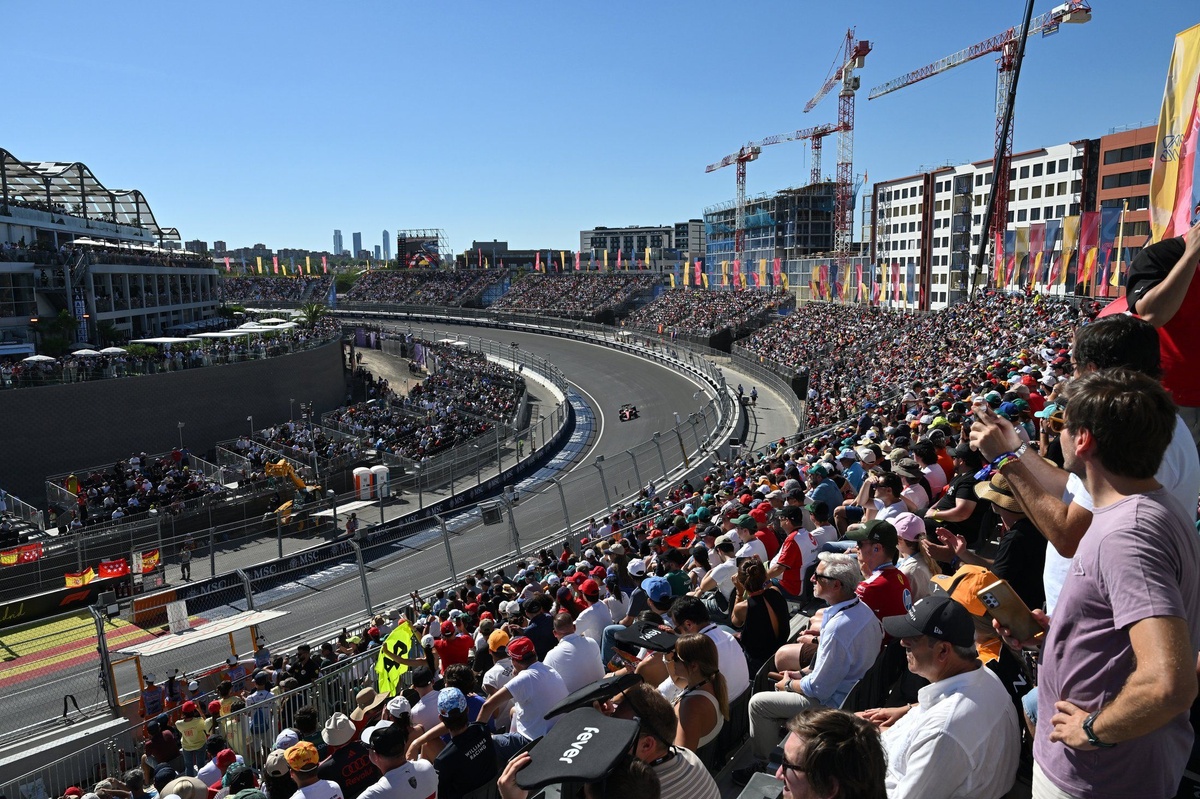
Yet, as the dust settles on the opening days of track action, the primary focal point of engineering obsession hasn’t just been the wall-lined concrete canyons of the Spanish capital. Instead, all eyes—and telemetry channels—have locked onto Turn 12, an aggressive, sweeping marvel christened "La Monumental."
Boasting a staggering 13.5 degrees of banking (translating to a sharp 24% incline), this section of the circuit has quickly established itself as the single most demanding challenge on the entire 24-race Formula 1 calendar, pushing modern rubber compounds to their absolute mechanical and thermal limits.
Main Facts: Deconstructing La Monumental
While Zandvoort’s iconic Arie Luyendyk corner boasts a steeper incline at 18 degrees, Pirelli’s engineering department has flagged Madrid’s Turn 12 as a significantly more punishing ordeal for tire integrity. The secret lies not in the instantaneous peak load, but in the brutal duration of sustained stress.
"Basically, the peak of the vertical energy is not higher than in other corners that we have on the calendar, like in Qatar, the banking in Zandvoort, et cetera," explains Pirelli’s Chief Engineer, Simone Berra. "It’s more about the time you are under load and the continuous load that you have."
Where a traditional high-load corner subjects tires to intense vertical and lateral G-forces for a fleeting two to three seconds, La Monumental extends that torture chamber experience. Drivers negotiate the massive banked turn under extreme, unyielding loads for roughly 5.5 seconds.
"So basically, instead of two or three seconds, you have 5.5 seconds under those loads," Berra highlights. "You have double the duty cycle in that area. That is the main thing to keep in mind and what we are considering in our calculations."
This prolonged exposure to immense gravitational forces forced Pirelli’s analytical teams to meticulously simulate structural degradation ahead of the event. Fortunately for the sport, real-world data gathered during Friday running has fallen lockstep with those theoretical models.
Chronology of the Weekend: From Early Fears to On-Track Reality
Thursday: Paddock Speculation and Driver Predictions
The narrative surrounding Madrid’s new layout began crystallizing well before the pit lane traffic lights flashed green. During Thursday media sessions, drivers weighed in on the unprecedented nature of Turn 12. Questions immediately arose over whether the sweeping banking could be negotiated entirely flat-out—a luxury drivers enjoy at Zandvoort’s final turn.
Red Bull Racing’s Max Verstappen offered a measured and perceptive take on Thursday afternoon, correctly anticipating the technical nuance required to master the corner.
"I think the banking is cool. It’s not going to be easy flat, I think. There’s a bit of skill involved, which I think is always good," Verstappen noted.
Friday: Free Practice and Telemetry Realities
As the cars took to the asphalt for Friday’s Free Practice 1 and Free Practice 2 sessions, Pirelli’s trackside engineers immediately initiated their rigorous data-harvesting protocols. By Friday evening, Berra was able to provide an encouraging status update to the media.
"At the moment it’s in line with our simulations," Berra confirmed on Friday night. "Obviously we are still checking all the loads and all the data. We have just checked three or four teams for now, but what we have seen so far is in line with what we expected."
The telemetry from FP2 quickly validated Verstappen’s pre-weekend prediction, exposing a sharp ideological split in how teams had programmed their pre-event simulator runs.
"It was interesting to see if the simulations from the teams were aligned in Turn 12, in La Monumental, because some teams were expecting to be grip limited," Berra revealed. "They expected that they had to lift from the throttle in this section, while other teams expected to be full throttle there."
When the rubber met the road, the pessimists—or rather, the realists—proved correct. Data analysis from the top-performing cars showed that traversing La Monumental at full throttle from entry to exit was an illusion.

"The reality is that the teams that simulated lifting were correct. Especially in the first part of the turn, they had to lift a bit, like 30 or 40% from the throttle. And then after two seconds, they could push again," Berra explained.
Subtle driving style variations quickly emerged among the front-runners. Both Scuderia Ferrari pilots tackled the entry aggressively, holding full throttle momentarily before biting the bullet and executing a significant lift. Conversely, rookie sensation Kimi Antonelli adopted a more cautious approach, feathering the throttle earlier upon entry to manage the car’s rotation. Once past the midpoint and sweeping downward toward the exit, however, the grid-wide consensus united: every driver smashed the throttle down to the floorboards as they bolted toward Turn 13.
Supporting Data and Tire Analysis Protocols
Despite the grueling 5.5-second duty cycle at La Monumental, Pirelli has delivered clean bills of health for the tire allocation thus far. Unlike previous nightmares encountered at circuits like Qatar—where sharp pyramid kerbs and relentless high-speed loads forced mandatory stint length restrictions and sudden safety interventions—Madrid’s surface and layout are behaving well within safe operational boundaries.
The risk of structural fatigue or catastrophic carcass failure remains a persistent ghost in modern F1, but Pirelli is leaving nothing to chance. Berra outlined the aggressive forensic accounting procedures taking place behind closed doors in the Pirelli engineering truck.
"At the moment there is nothing to be concerned about," Berra stated reassuringly. "Obviously we are still working and need to revise all the data. We will continue even tomorrow because we are sectioning the tyres, so we have to check all the constructions. This procedure is not yet finished."
The tire manufacturer’s quality control extends deep into the weekend schedule:
- Friday Evening: Initial batch extraction and structural scans.
- Saturday Morning: Sectioning and slicing fresh rubber compounds harvested directly from FP2 and FP3 running.
- Continuous Monitoring: Cross-referencing thermal degradation models with actual telemetry streams to guarantee safe operating windows for Sunday’s Grand Prix.
Because these rigorous physical examinations have revealed zero structural anomalies, regulatory interventions such as maximum stint lengths or mandatory three-stop mandates are firmly off the table.
Official Responses and Driver Perspectives
The psychological reception of Madrid’s circuit architecture has been overwhelmingly positive among the driver collective. While initial track walks and simulator correlations induced healthy skepticism regarding safety and wall proximity, the unique topography of La Monumental has been praised for rewarding genuine driver inputs.

The corner itself is a masterpiece of modern civil and motorsport engineering. It begins with a high entry point, plunges drivers downward into a compression phase, climbs once more toward the outer perimeter of the banking on the exit, and finally drops precipitously once again as the cars hustle toward Turn 13.
This complex undulation profile is precisely what neutralizes pure car performance and hands agency back to the driver. As Max Verstappen emphasized, the impossibility of taking the corner flat-out without fine motor control transforms Turn 12 into a legitimate testing ground for driver skill.
Teams that miscalculated their simulation models—assuming an easy, uninterrupted flat-out arc—found themselves scrambling on Friday evening to adjust their differential settings, ride heights, and power unit deployment maps. The ability to smoothly transition from a 30-to-40% lift on entry to full deployment in the second phase of the corner separates the podium contenders from the midfield stragglers.
Implications for the Remainder of the Weekend and Beyond
As the Spanish Grand Prix weekend marches toward qualifying and Sunday’s lights-out, the lessons learned around La Monumental carry profound implications for the rest of the championship calendar—and for future street circuits aiming to incorporate high-speed banking.
- Simulator Accuracy is King: The discrepancy between teams that simulated a flat-out corner versus those that accurately predicted the need to lift highlights how critical dynamic simulation models have become. Teams lacking robust simulation tools paid a heavy price in lost lap time and improper setup optimization during Friday practice.
- Tire Management Mastery: With Pirelli’s rigorous cut-and-analyze procedures confirming structural integrity, race strategists can breathe a sigh of relief. Standard multi-stop strategies will dictate the Grand Prix, though tire thermal degradation over that 5.5-second load cycle will heavily penalize any driver prone to excessive wheelspin or aggressive sliding on entry.
- A Blueprint for Modern Track Design: Madrid’s successful integration of La Monumental proves that high banking can be successfully engineered into tight urban and semi-permanent complexes. By avoiding the safety crises that once plagued events like Qatar, the IFEMA circuit has provided Formula 1 with a thrilling, challenging architectural feature that tests both machine durability and human bravery.
As engines fire up for Saturday’s crucial sessions, all eyes will remain glued to Turn 12. Whether the top teams can further optimize their throttle application through La Monumental will likely decide who claims pole position under the Madrid sun—and who is left paying the heavy price of rubber degradation on race day.

 Nana Muazin
 Siti Muinah
 rifanmuazin
 Dwi Wanna
 Raul Delapena Setiawan
 Laily UPN
 Ammar Sabilarrohman