
 Nila Kartika Wati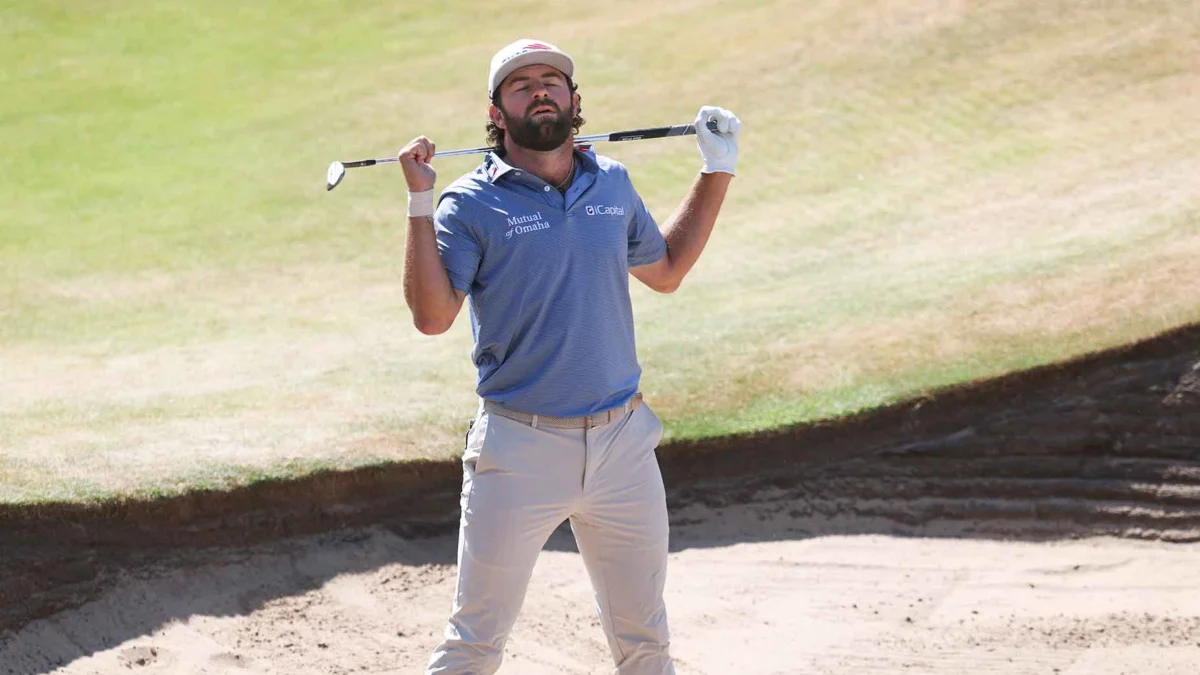
By Sean Zak
SOUTHPORT, England — There is a unique, suffocating stillness that descends upon a clubhouse when the leader in the house has finished his work. It is a purgatory of sorts, a place where professional athletes—men conditioned to control every variable of their performance—are suddenly rendered helpless.
On Sunday at the 2026 Open Championship, that man in the house was Cameron Young. Having posted a stellar 64 to reach nine-under for the tournament, Young sat in the temporary, sterile confines of the player clubhouse, watching his fate be decided by the whims of the wind and the nerve of his competitors. Beside him, his caddie, Kyle Sterbinsky, stood on the periphery of the driving range, bathed in the late-afternoon sun, staring at a distant leaderboard with the intensity of a man watching his life flash before his eyes.
The Architect of the Score
Cameron Young’s Sunday was a masterclass in controlled aggression. Entering the final round trailing the leaders, Young tore through the Southport links with a surgical precision that seemed destined for history. His 64 was the highlight of the week, a round that turned a respectable climb into a legitimate charge for the Claret Jug.
However, golf is a game of margins, and Young’s closing hole served as a poignant reminder of that reality. Needing a par to solidify his position, he pulled a 6-iron from a fairway bunker, attempting a shot that required both technical perfection and a bit of luck. The ball caught the face of the bunker, a cruel kiss of sand and turf that left him scrambling for a bogey. As he walked off the 18th, the frustration was palpable. He had done enough to be in the hunt, but he feared he had left the door wide open for the rest of the field.
A Chronology of Uncertainty
The hours following Young’s finish were a psychological marathon. To understand the tension, one must look at the timeline of a Sunday afternoon that felt like a lifetime.
- 4:36 p.m. (Local Time): Young finishes his round. At nine-under, he is the clubhouse leader, but the weight of the day is already heavy on his shoulders. He spends his time in the media center, answering 23 questions with a demeanor that suggests he is already resigned to his fate.
- 5:00 p.m. – 5:45 p.m.: The "numbness" sets in. Sterbinsky, watching from the player dining area, monitors the leaderboard as heavy hitters like Sam Burns and Si Woo Kim begin to falter. The realization hits: they are not just in contention; they are holding the lead.
- 5:44 p.m.: Ryan Fox finds trouble near a greenside bunker. For a fleeting moment, the dream of victory feels tangible for the Young camp.
- 6:10 p.m. – 6:20 p.m.: The "Cameron Cam" is in full effect. A broadcast crew has set up a dedicated camera on the clubhouse balcony. Young is seen shaking the creases out of a sweater, warming up, and checking the Open app with the rhythmic anxiety of a man who knows he is being watched by millions.
- 6:33 p.m.: The moment of truth. Ryan Fox stands over an 11-foot, seven-inch birdie putt. The air in the clubhouse is thick enough to cut with a knife.
Data and the Psychology of the Wait
While the human drama played out in the clubhouse, the digital world told a different story. As the afternoon progressed, advanced analytics models from DataGolf placed Young’s probability of victory as high as 67 percent. The math suggested that the 18th hole was a "nightmare factory" and that the field would likely buckle under the pressure of chasing a nine-under target.
Yet, numbers cannot account for the intangible grit of a golfer on a Sunday run. Young, who famously avoids social media and minimizes phone usage during tournaments, found himself tethered to his device as his only tether to the outside world. The phone became a pacifier, a source of weather updates and shot-tracking metrics that served only to heighten the suspense.
The scene in the clubhouse was a bizarre microcosm of modern professional golf. Scottie Scheffler’s father, carrying his ceremonial walking stick, wandered by. Justin Thomas’s father sat near Young, sharing a beer. David Young, a PGA professional himself, provided a steadying presence for his son, grounding him in the reality that even at the highest level of the game, some outcomes are simply out of one’s hands.

The Anatomy of a Heartbreak
The transition from hope to heartbreak is rarely sudden; it is a slow erosion of belief. As Sterbinsky watched the final groups play, he attempted to reach a state of zen—a "not too high, not too low" equilibrium. But as the crowd’s reaction on the 18th hole intensified, that equilibrium shattered.
When Ryan Fox stood over that final putt, the sound of the crowd—the "worst roar of their life," as Sterbinsky later described it—traveled across the links. It was not a roar of uncertainty. It was a roar of finality. Ten-under had been reached. The clubhouse lead, which had felt like a fortress for two hours, had been breached.
Implications: What We Learned at Southport
The events at the 2026 Open offer a fascinating look at the evolution of major championship golf. The reliance on "in-house" waiting rooms, the intrusion of omnipresent broadcast cameras, and the integration of real-time data analytics have changed the way players experience the climax of a tournament.
For Cameron Young, the loss is more than just a missed trophy; it is a testament to the volatility of the sport. He played the best round of his week, navigated the bunker blues of the 18th with as much grace as possible, and did everything right in the final hours. He was the man in the house, the protagonist of the afternoon, until he wasn’t.
The Human Element
The post-round reflection of a caddie like Kyle Sterbinsky reveals the emotional toll of professional golf. Having been with Young for 14 months, through victories at Doral and TPC Sawgrass and a final-pairing appearance at the Masters, Sterbinsky acknowledged that this felt fundamentally different. The proximity to the trophy—the feeling that it was "falling into their lap"—made the eventual loss sting with a sharpness that few other tournaments could provide.
Conclusion: The Quiet Walk Home
As the sun finally dipped below the horizon at Southport, the temporary structures that had housed the hopes of the world’s best golfers began to feel like just that: temporary. The "Cameron Cam" was dismantled, the broadcast crews packed their cables, and the leaderboard, once the focal point of the golfing world, stood dark and silent.
Cameron Young left the clubhouse with his team, facing the reality of a Monday flight and a long off-season of reflection. He had proven, once again, that he possesses the mettle to compete at the very pinnacle of the sport. He had navigated the nerves, the weather, and the relentless pressure of a major championship Sunday. But on this day, the game—and the cruel, beautiful math of the leaderboard—belonged to someone else.
In the end, the Open Championship remains the ultimate test of patience. Whether you are the one standing over the putt or the one watching it on a screen from two hundred yards away, the result is the same: the game moves on, the flags continue to flap in the seaside wind, and the wait for the next major begins anew. For Young and Sterbinsky, the lessons learned in that quiet, sun-drenched clubhouse will likely serve as the foundation for their next charge. Until then, they are left with the silence that follows a roar—the sound of a dream that was held, then lost, in the span of a few heartbeats.


 Lina Hope
 Iffa Jayyana
 Neng Nana
 Nana Wu
 Sagoh
Sagoh