
 Basiran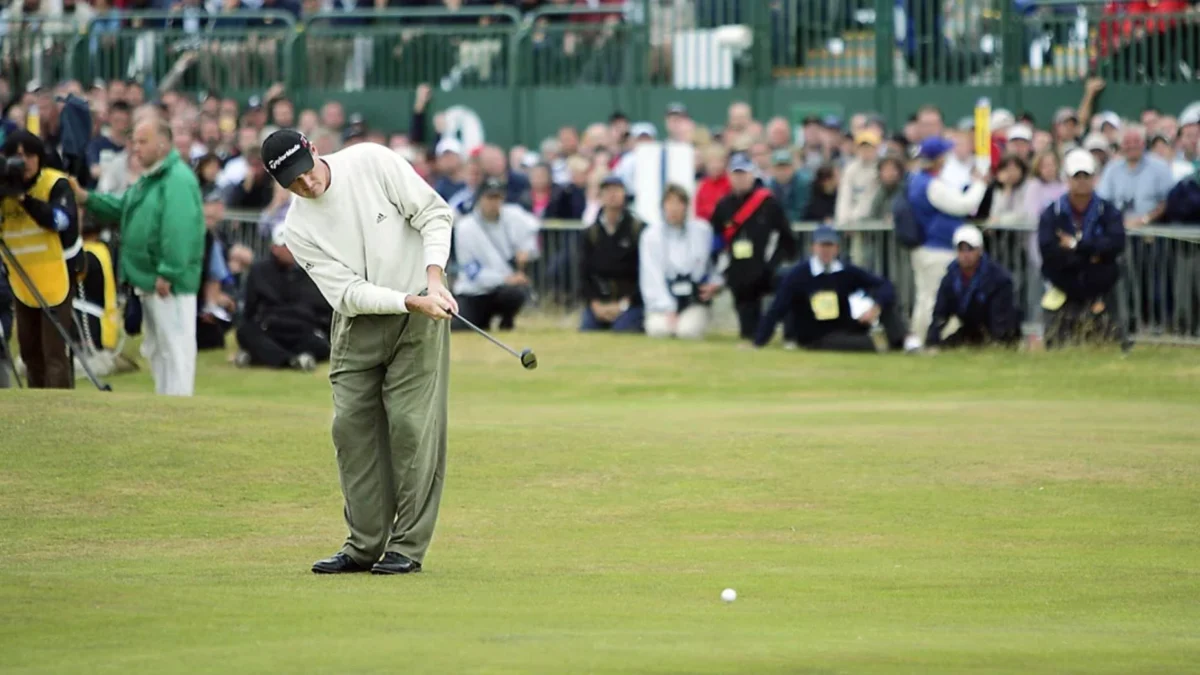
It has been over two decades since the 2004 Open Championship at Royal Troon, a tournament that remains etched in golf folklore not just for the drama of the final holes, but for the unorthodox weapon that secured the Claret Jug. Todd Hamilton, then an underdog journeyman, shocked the sporting world by outdueling Ernie Els in a four-hole playoff. Now 60 years old and largely retired from the competitive spotlight, Hamilton recently sat down with hosts Colt Knost and Drew Stoltz on the Subpar podcast to peel back the layers of a career-defining week that changed his life forever.
The Unlikely Champion: Main Facts of the 2004 Open
The 2004 Open Championship was meant to be a coronation for the game’s titans. Instead, it became a masterclass in tactical ingenuity. Todd Hamilton, a player who had spent years grinding on the Japan Golf Tour before finding his footing on the PGA Tour, arrived at the storied Royal Troon links in Scotland as an outsider.
The primary narrative of the week was not just Hamilton’s steady temperament, but his reliance on a specific, modified Sonartec hybrid club. While modern golfers carry hybrids as a standard part of their bag, Hamilton’s use of the club in 2004 was revolutionary. He utilized it not just for long approach shots, but as a "chip-slash-putt" tool from the tight, firm lies surrounding the greens—a technique that neutralized the difficult Scottish conditions.
Hamilton’s victory in the aggregate four-hole playoff against Ernie Els remains one of the most unexpected triumphs in major championship history. By sticking to his unconventional strategy, Hamilton secured the title of Champion Golfer of the Year, proving that in golf, the most effective equipment is the one that best suits the specific terrain underfoot.
A Chronology of a Masterpiece: The Road to Troon
To understand the magnitude of Hamilton’s win, one must look at the timeline of his preparation and execution during that pivotal week in July 2004.
Pre-Tournament: Finding the Secret Weapon
Hamilton noted during his Subpar appearance that he was never a fan of traditional 3-woods. In early 2004, he began experimenting with a 17-degree Sonartec hybrid that had been professionally bent down to 14 degrees. While technically a hybrid, the club functioned more like a utility wood. Hamilton noted that he had only begun using this specific club—and the accompanying "bump-and-run" technique—a few months prior to the Open.
The Tournament Week: Execution and Reliability
Throughout the four rounds at Royal Troon, Hamilton’s strategy remained consistent. He relied on the hybrid off the tee for accuracy and, more crucially, around the greens. Hamilton estimated he utilized the hybrid for short-game shots between 12 and 14 times throughout the week. His success rate was staggering: he successfully got up-and-down with the club on every occasion except for one, a missed 5-to-6-foot putt on the 10th hole during the final round.

The Playoff: The Defining Moment
The culmination of the tournament came down to a four-hole aggregate playoff. The pressure was immense, with Ernie Els—a global superstar—standing as the final hurdle. On the final hole of the playoff, Hamilton executed a perfect approach with his hybrid, sticking the ball to three feet. That shot set up a magnificent up-and-down save, effectively sealing the victory and cementing his legacy.
Supporting Data: The Mechanics of the "Hybrid Chip"
Why did this technique work so well for Hamilton, and why is it so rarely seen today? The answer lies in the physics of the course.
The Scottish Firmness Factor
Hamilton explained that his hybrid-chip technique is largely ineffective on American golf courses. "The grass [in the States] is kind of thatchy and grainy," Hamilton noted. "But the ground over there, the ground’s very firm, grass is cut down pretty tight. It’s basically a slower putting green."
In links golf, where the turf is firm and the grass is closely mown, a player does not necessarily need a wedge to get the ball airborne. By using the hybrid, Hamilton was able to treat his chip shots like long putts. The ball would track along the ground, mimicking the roll of a putt, which drastically reduced the margin for error compared to the "flick" of a wedge shot that could easily be thinned or fluffed.
Equipment Specifications
The Sonartec club used by Hamilton was a custom-bent piece of equipment. By taking a 17-degree head and bending it to 14 degrees, he created a hybrid with a lower profile and a more penetrating ball flight. This allowed him to hit the ball with enough force to navigate the firm fairways and apron areas without the ball ballooning into the wind—a common issue for players using higher-lofted woods or long irons.
Official Perspectives and Reflections
Looking back from the vantage point of 2026, Hamilton’s perspective is one of humble gratitude. Now living in Norman, Oklahoma, Hamilton has traded the stresses of the PGA Tour for the satisfaction of coaching the local high school golf team.
"I don’t play much golf anymore," Hamilton admitted during the podcast. His life has shifted from the pursuit of major championships to the development of the next generation. However, the memories of 2004 remain crystal clear. When prompted by hosts Colt Knost and Drew Stoltz about the specifics of his win, Hamilton was able to recall almost every shot of that week, emphasizing that the victory was a result of trusting a strategy that others in the field had dismissed.

His story serves as a reminder to the modern golfing community that innovation doesn’t always come from the most expensive technology, but from a player’s ability to analyze the environment and adapt their game accordingly.
Implications for the Modern Game
Hamilton’s win at Royal Troon had lasting implications for how manufacturers and players view the "hybrid" category. Following his victory, the popularity of hybrids exploded. While they are now a staple in almost every professional bag, Hamilton’s specific application—using them as a primary short-game tool—remains a niche, yet highly effective, strategy for links golf.
The Evolution of the "Utility" Club
Since 2004, the evolution of the hybrid has moved toward more forgiving, high-launch designs. Yet, the "low-launch" utility iron or hybrid that Hamilton championed is still sought after by players who play in windy, firm conditions. His victory proved that there is no "correct" way to play a shot, provided the result is favorable.
A Lesson for Future Generations
As Hamilton now mentors the next generation of high school golfers in Oklahoma, the lesson of 2004 remains central to his coaching philosophy. He teaches his students not just to hit the ball far, but to understand the terrain and use the tools in their bag to solve the specific problems presented by the course.
The 2004 Open Championship was not merely a victory for Todd Hamilton; it was a victory for the "thinking golfer." As we look toward future iterations of the Open Championship, the legend of the Sonartec hybrid serves as a permanent fixture in the history of the sport—a testament to the idea that sometimes, the most unconventional choice is the one that leads to glory.
For more in-depth interviews with golf’s most iconic figures, including further analysis of historical tournament strategies, subscribe to the Subpar podcast and stay tuned to GOLF.com.


 Lina Hope
 Iffa Jayyana
 Neng Nana
 Nana Wu

 Sagoh
Sagoh