
 Asro
By Darragh McDonald | November 18, 2026
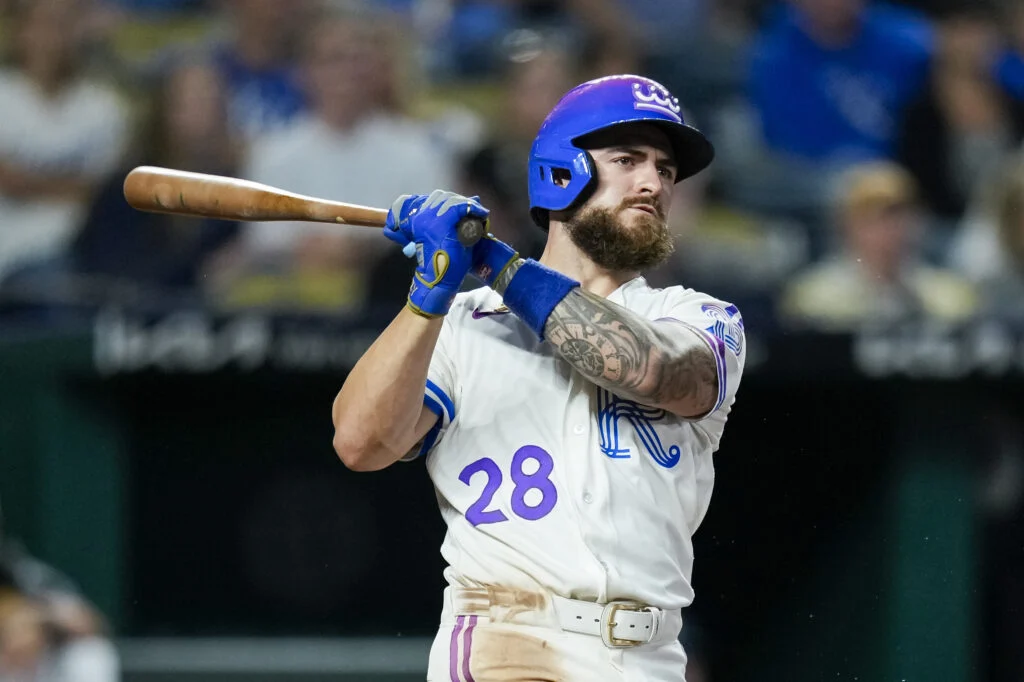
The Kansas City Royals have officially executed a significant roster overhaul, confirming a six-player trade with the Seattle Mariners that has sent shockwaves through the organization’s depth chart. The transaction, which saw the Royals acquire Maikel Garcia in a high-profile swap, required immediate administrative maneuvering to accommodate the incoming talent. Because the trade involved a three-for-three exchange where the Royals received three players currently on the 40-man roster while only sending two back in a similar capacity, the front office was forced to make a difficult personnel decision.
In order to clear the necessary space, the Royals have designated veteran outfielder Kyle Isbel for assignment. This move marks the end of a six-year tenure in Kansas City for the defensive stalwart, signaling a clear shift in organizational philosophy as the Royals look toward the 2027 season.
The Mechanics of the Move: Why Isbel?
The designation of Kyle Isbel is a direct consequence of the roster math necessitated by the acquisition of Maikel Garcia. In Major League Baseball, the 40-man roster serves as the primary gateway to the big leagues; when a team acquires a player already holding one of these coveted spots, they must create a vacancy.
While the trade was billed as a "three-for-three" swap, the specific statuses of the players involved left the Royals with a numbers crunch. By designating Isbel, the Royals have initiated a process that will likely result in his departure from the organization. Isbel, who will turn 30 in March, now enters a precarious period of uncertainty. Under MLB rules, the Royals have seven days to trade, release, or outright Isbel to the minor leagues. Given his service time and salary expectations, a trade or a subsequent non-tender appears to be the most probable outcome.
A Chronology of a Defensive Specialist
Kyle Isbel’s journey with the Royals has been defined by a consistent, if one-dimensional, contribution. Since his debut, he has been a fixture in the Kansas City outfield, particularly in center field.
- 2021-2023: Isbel established himself as a glove-first player. During these formative years, the coaching staff relied heavily on his range and instincts to anchor a youthful outfield.
- 2024: Isbel saw his most significant playing time, solidifying his role as the primary defensive option in center.
- 2026 Season: Isbel shared center field duties with Lane Thomas. While his defense remained elite, his offensive struggles became a focal point of team analysis.
- November 18, 2026: Following the Royals’ acquisition of Maikel Garcia, Isbel was officially designated for assignment to facilitate the roster expansion.
Throughout his tenure, Isbel has been a fan favorite for his highlight-reel catches and consistent effort, yet the cold reality of modern baseball—where offensive output is increasingly prioritized—ultimately led to his removal from the 40-man roster.
Statistical Breakdown: The Defense vs. The Bat
To understand why the Royals moved on from Isbel, one must look at the dichotomy between his glove and his bat. The metrics present a stark contrast that has defined his career to date.
The Defensive Mastery
Isbel’s reputation as one of the league’s premier defensive outfielders is well-supported by advanced metrics. In over 4,000 innings of professional outfield work, he has been a standout performer. His defensive accolades include:
- 34 Defensive Runs Saved (DRS): A testament to his ability to prevent runs through positioning and athleticism.
- 51 Outs Above Average (OAA): A figure that places him in the upper echelon of center fielders across the league.
- 40 Grade Fielding Run Value: A consistent benchmark of his positive impact on the field.
The Offensive Struggle
Conversely, Isbel’s offensive profile has stagnated. Over 1,832 career plate appearances, he has struggled to find a consistent rhythm. His career slash line of .235/.284/.357 leaves much to be desired for a starting outfielder. Perhaps most concerning for the front office is his lack of plate discipline; a 5.7% walk rate combined with a wRC+ of 75 indicates that he has been 25% worse than the league average hitter throughout his career. With only 29 home runs to his name in six seasons, the Royals’ inability to extract power or consistent on-base production from his spot in the lineup eventually became an untenable luxury.
Financial Implications and the Non-Tender Deadline
The timing of this move is not coincidental. With the league-wide non-tender deadline approaching this Friday, the Royals were forced to evaluate their financial commitments for the 2027 season.
Isbel was entering his final year of arbitration eligibility. After earning $1.75 million in 2025 and $2.7 million in 2026, he was projected by industry analysts—including MLBTR’s Matt Swartz—to command a salary of approximately $3.5 million for the 2027 campaign.
By removing him from the 40-man roster, the Royals have effectively signaled that they do not view him as a $3.5 million asset. If the team cannot find a trade partner by Friday, they will almost certainly non-tender him, making him an unrestricted free agent. This would allow the Royals to negotiate a potential return on a minor league deal, though Isbel would then have the freedom to explore the open market and gauge interest from the other 29 clubs.
The Ripple Effect: Who Takes Center Field?
The departure of Isbel creates a significant vacancy in the Royals’ defensive alignment. With Lane Thomas—the other half of the 2026 center field platoon—also entering free agency, the Royals are effectively staring at a blank slate in center field for the upcoming season.
Potential Internal Options
- John Rave & Tyler Tolbert: While both players received limited opportunities in the big leagues during the 2026 season, the organization has yet to see evidence that either is ready to handle the rigors of an everyday starting role.
- Carson Roccaforte: Roccaforte was added to the 40-man roster just one day prior to the trade, signaling that the organization views him as a prospect with high upside. However, his lack of Major League experience makes him a gamble for a team looking to compete in 2027.
The Free Agent Landscape
The Royals may be forced to enter the free agent market, which is currently populated by notable names such as Luis Robert Jr., Daulton Varsho, and Trent Grisham. Each of these players offers a different profile, with some providing power and others offering defensive versatility similar to what Isbel brought to the table. The front office must now decide whether to pursue a high-cost veteran or lean into the developmental phase with younger, untested talent like Roccaforte.
Implications for the Royals’ 2027 Outlook
This move is emblematic of a broader trend within the Royals organization: a ruthless focus on offensive efficiency. By trading for Maikel Garcia, the team is clearly betting on high-ceiling offensive players to carry the load, even if it means sacrificing established, elite-level defense in the outfield.
The front office is walking a fine line. By parting ways with Isbel, they have cleared salary and roster flexibility, but they have also removed a safety net that has served them well for half a decade. The upcoming weeks will be telling; if the Royals can secure a high-impact bat in free agency, the decision to designate Isbel will be viewed as a calculated, necessary risk. If, however, they struggle to fill the void in center field, the loss of Isbel’s defensive stability could become a recurring theme in the 2027 campaign.
For Kyle Isbel, the future remains wide open. He is a proven commodity with a defensive pedigree that almost every team in Major League Baseball covets. As he navigates this transition, the baseball world will be watching to see if a new team can unlock the offensive potential that has thus far eluded him, or if he is destined to remain the classic "glove-first" specialist in a league that is increasingly obsessed with run creation.
The Royals, meanwhile, must now pivot toward the winter meetings, armed with new roster flexibility and a glaring need to secure their defense before the first pitch of Spring Training is thrown.

 Pevita Pearce

 rifanmuazin

 Sagoh
 Muslim

 Suro Senen
 Layla Zulfa