
 Muslim
The Intersection of Two Footballing Minds
The landscape of international football is often defined by the migration of tactical philosophy, but few stories capture the shifting tides of the sport quite like the recent relationship between Mauricio Pochettino and Pep Guardiola. Their paths have crossed across decades, from their time as fierce rivals in Barcelona—Pochettino leading the underdog Espanyol and Guardiola commanding the juggernaut at the Camp Nou—to their tactical duels in the Premier League.
Yet, it was a quiet, unassuming afternoon at Yankee Stadium in September that has now become the focal point of a major coaching transition. As Guardiola served as an unofficial "hype man" for New York City FC, Pochettino sat alongside him, flanked by his trusted assistant Jesús Pérez and US Soccer CEO JT Batson. At the time, the optics suggested a meeting of two minds—one a legend currently on a sabbatical, the other the man tasked with guiding the United States toward the 2030 World Cup. Within three months, that image has transformed into the catalyst for a seismic shift in global coaching circles, as Pochettino departs for Manchester United and the US federation finds itself once again dreaming of the impossible: securing the services of Pep Guardiola.
A Chronology of a High-Stakes Departure
To understand the current volatility surrounding the US Men’s National Team (USMNT) coaching vacancy, one must look at the timeline of Pochettino’s brief but impactful tenure.
- August 2026: Mauricio Pochettino formally inks a four-year deal with US Soccer, signaling a massive coup for the federation and a promise to elevate the program ahead of the 2030 World Cup cycle.
- September 2026: During a scouting trip in New York, Pochettino is spotted with Pep Guardiola at a New York City FC match. The two share an intense, respectful dialogue that serves as the foundation for recent rumors.
- November 2026: Reports emerge that Pochettino is deploying staff to Manchester to prepare for an impending move to Manchester United.
- December 2026: Pochettino confirms his departure for the Premier League, describing the opportunity as a "reward" for his efforts in the United States. Simultaneously, US Soccer officials are linked to exploratory talks with Guardiola, who remains the federation’s "white whale."
The "Perfect Moment" for a New Direction
When asked during a press roundtable on Monday about his thoughts on Guardiola potentially stepping into his former role, Pochettino was characteristically blunt. Despite the professional rivalry, there is a deep, mutual admiration between the two.
"Take it," Pochettino said, when asked what advice he would give the Catalan coach regarding the USMNT job. "Why? Because it’s a perfect moment to arrive at the federation. Everything is on the right path, in the right direction. Of course, take it. You are going to find really good players, good people—the players can fit his style."
Pochettino’s endorsement is not merely a polite gesture; it is an assessment of the progress made during his tenure. He argued that the perception of the US job has fundamentally changed. Once viewed as a peripheral destination for coaches, the USMNT is now, according to Pochettino, a position of prestige. "The vision from Europe, I promise, is completely different after the World Cup," he explained. "If Manchester United, or Real Madrid, or Barcelona is coming for the US coach, it changes how others see the role."

Assessing Talent: Beyond the League’s Pedigree
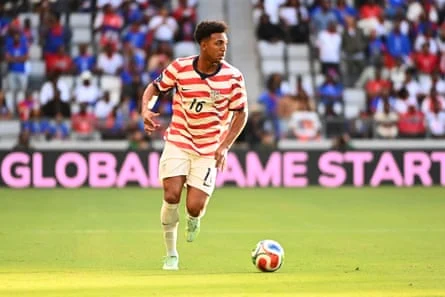
One of the core pillars of Pochettino’s philosophy—and a primary reason for his success—has been his refusal to view a player’s potential through the narrow lens of their club’s league ranking. He highlighted the meteoric rise of defender Alex Freeman and midfielder Sebastian Berhalter, both of whom earned their international stripes while playing in Major League Soccer before securing moves to Europe.
"You need to project the individual player," Pochettino noted. "Because he’s playing well, the level is no issue. That is the example, and I think that is so important. There is talent everywhere. We cannot make the mistake of measuring the level of the player simply because of the level of the league they compete in."
This meritocratic approach has been vital in broadening the USMNT player pool. By scouting based on form and tactical fit rather than market value or club status, Pochettino has successfully fostered a competitive environment that demands intensity from every player, regardless of whether they play in the Bundesliga or MLS.
The Daily Grind: Club vs. International Management
Pochettino’s transition back to the daily pressures of club football at Manchester United is driven by a genuine longing for the rhythm of the training ground. His time with the USMNT was his first foray into international management, and while he appreciated the time afforded for family and reflection, the administrative nature of the role—traveling to scout, managing long gaps between camps—ultimately left him yearning for the intensity of daily coaching.
"Guardiola asked me, ‘You don’t want to come back to the Premier League?’" Pochettino recalled. "I told him I was happy, but he knew. He asked, ‘Don’t you miss the daily grind?’ And he was right. I miss the press conferences, the daily training, the tactical preparation. It is the lifeblood of a manager."
For Pochettino, the Manchester United job represents a return to the "tra-tra-tra-tra-tra"—the constant, high-speed momentum of elite club management that he thrives upon. He views his time in the US as a "tough job" that has been accomplished, leaving the foundation for someone else to build upon while he embarks on his next challenge.
Implications for the Future of US Soccer
As the dust settles on Pochettino’s departure, the implications for the United States are profound. The program is at a crossroads. The "Pochettino era," while short, has arguably professionalized the national team’s approach to global standards. The question now is whether US Soccer can leverage this momentum to secure a manager of Guardiola’s stature.
Pochettino believes the "tough job" of establishing credibility is complete. He views the current state of the USMNT not as a project in ruins, but as a fertile ground for a high-level tactician to implement a cohesive identity. However, his refusal to prescribe "neat solutions" for American soccer reflects his broader, holistic view of the sport. He warned against the temptation to change one element in isolation, arguing that the American system requires a delicate, multi-faceted approach to growth.
"It’s a little bit of everything that you need to change," he said. "If you adjust one thing, you must adjust the others to maintain balance. We have spent two years laying the groundwork. If there is continuity, this is the beginning of a new era for soccer in the USA."
The Legacy of the "White Whale"
Whether Pep Guardiola is the one to provide that continuity remains the subject of intense speculation. For over a decade, his name has been whispered in the corridors of US Soccer as the ultimate ambition. Pochettino’s departure may have inadvertently opened the door for this dream to become a reality, or at least, for a serious dialogue to commence.
Ultimately, Pochettino leaves the United States with a sense of pride. He sees his time in the US not as a bridge to Manchester, but as a significant chapter in his career where he helped bridge the gap between American potential and global reality. "I don’t believe in coincidence," he concluded. "That has happened because something needed to happen. Now, the work is done, and it is time for the next stage."
As the football world watches to see if the "white whale" will finally be caught, the legacy of Pochettino’s brief tenure remains clear: the USMNT is no longer a project of trial and error, but a program that demands—and has demonstrated it can attract—the very best minds in the game.

 Layla Zulfa

 Basiran
 Suro Senen
 Asep Darmawan
 Nila Kartika Wati
 Ammar Sabilarrohman