
 Azzam Bilal Chamdy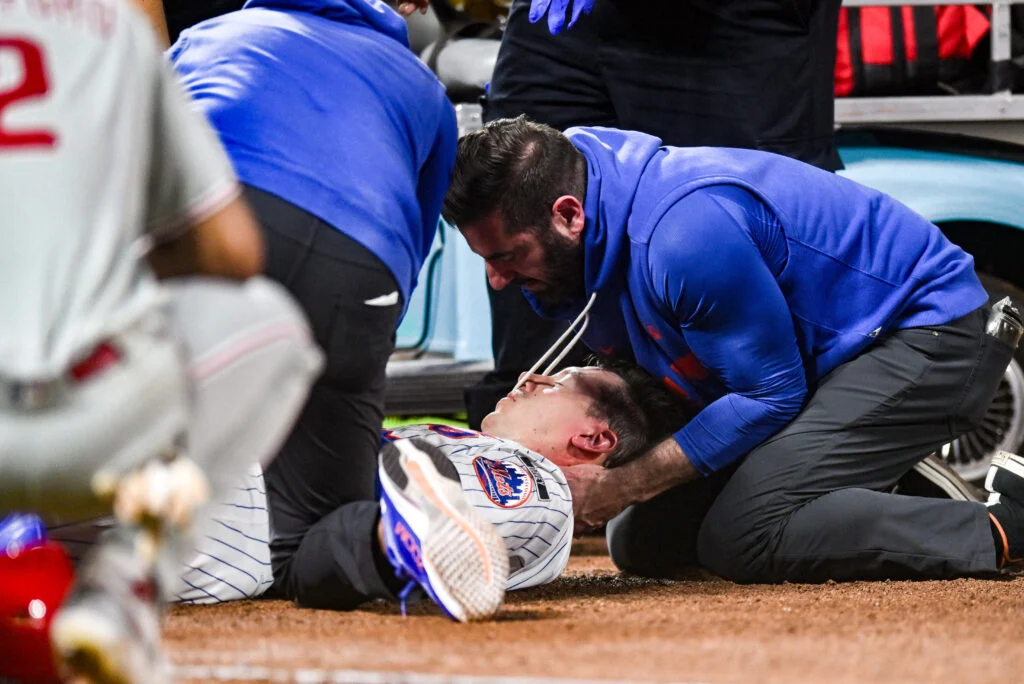
By Anthony Franco | September 18, 2026
The atmosphere at Citi Field shifted from the typical intensity of a late-season divisional clash between the New York Mets and the Philadelphia Phillies to a somber, breathless silence on the evening of September 17. During the top of the sixth inning, a routine defensive play devolved into one of the most harrowing scenes of the 2026 Major League Baseball season, as Mets first baseman Jared Young suffered a frightening head injury that left players, fans, and coaching staff visibly shaken.
While initial fears were centered on the possibility of a catastrophic injury, updated medical reports provide a sense of profound relief for the organization and Young’s family. As of September 18, the 31-year-old infielder has been officially placed on the concussion injured list, with the team expressing optimism regarding his long-term prognosis.
The Incident: A Routine Play Turned Dangerous
The injury occurred during the top of the sixth inning of what would eventually become a 3-0 victory for the Philadelphia Phillies. Phillies hitter Justin Crawford sent a slow-rolling ground ball just a few feet inside the first-base line.
In a moment of classic miscommunication that occurs dozens of times in a season, Young and Mets pitcher Nolan McLean converged on the ball simultaneously. Young, attempting to secure the out, sprinted to the first-base bag, stretching to maintain contact with the base while looking for the ball. Simultaneously, McLean raced toward the line to field the roller.
As the two converged, the timing proved disastrous. McLean’s leg collided violently with the side of Young’s head. The impact was immediate and jarring; Young appeared to be knocked unconscious before he even hit the dirt. The silence that fell over the stadium was palpable as medical personnel rushed from both dugouts to attend to the fallen infielder. For several agonizing minutes, the game was suspended while trainers stabilized Young.
The image of the 31-year-old being carted off the field will remain a defining, albeit somber, moment of the Mets’ 2026 campaign. However, in a brief moment of reassurance, Young managed to offer a thumbs-up to the concerned crowd at Citi Field as he was transported to a local hospital for emergency evaluation.
Chronology of the Medical Response
The timeline of the event highlights the efficiency of the Mets’ medical staff and the swift communication from the front office:
- September 17 (Top of the 6th): The collision occurs. Immediate medical attention is provided on the field. Young is removed via cart.
- September 17 (Postgame): Interim manager Andy Green addresses the media, confirming that Young has full use of his extremities—a massive relief to those fearing spinal or neurological damage. Green notes that while Young is experiencing "real concussion symptoms," initial CT scans have returned negative results.
- September 18 (Morning): The Mets release an official statement detailing that all secondary tests have yielded the "right kind of results."
- September 18 (Afternoon): The team officially places Young on the concussion injured list. To provide depth in the infield, the Mets announce the recall of Ronny Mauricio from the minor leagues.
Official Statements and Managerial Perspective
Interim manager Andy Green, who was tasked with guiding his team through the shock of the injury, spoke with a mixture of relief and lingering gravity during his postgame briefing.
"It feels at this point in time like we’ve avoided the scariest outcomes," Green told reporters on the night of the incident. "That was a terrifying moment on the baseball field. It took him a while to come to; it was a really scary collision."
By the following day, the tone had shifted from immediate crisis management to hopeful recovery. In a statement issued by the Mets, Green added: "As good as could be expected, or hoped for, given what we saw last night. All the tests that were ran, we got the right kind of results… Everything we have heard has been really optimistic from the recovery standpoint. I’m relieved, I think everybody is. All in all, about as good as we could have hoped for."
The organization’s transparency has been welcomed by fans, who have been monitoring the situation closely through social media updates and official club communications.
Statistical Context: The Season of Jared Young
The injury serves as a cruel bookend to what has been a breakout season for Jared Young. At 31 years old, Young has been one of the few bright spots in a challenging year for the Mets organization.
Before the injury, Young had slashed .266/.330/.429 with nine home runs across 342 plate appearances. These numbers represent the first sustained, successful opportunity for the journeyman infielder. A former 15th-round draft pick, Young’s path to the majors has been anything but linear. He has spent time with three different major league organizations and even ventured to Korea in 2024 to refine his skills—a gamble that clearly paid dividends in 2026.
His performance this year proved that he is capable of providing quality at-bats at the big-league level. While his season is undoubtedly over—a concussion recovery protocol requires a minimum stay on the injured list that would push his return to the final weekend of the season at best—his future remains bright.
Implications for the Mets’ Roster
With the 2026 season winding down, the Mets are now forced to navigate the final stretch without their primary first baseman. The recall of Ronny Mauricio is a significant development; Mauricio, a highly touted prospect, will likely be given a "look-see" opportunity to prove his worth as the team transitions into the offseason.
For Young, the implications are primarily health-focused. The standard recovery timeline for a significant concussion involves a multi-stage, symptom-free progression. Given that the injury occurred on September 17, the Mets are not rushing him back. The organization’s primary focus is ensuring that Young is symptom-free for an extended period before he begins any physical activity.
Assuming a full recovery, Young is positioned to enter Spring Training in 2027 with a genuine advantage. Having proven he can contribute as a left-handed bench bat—and perhaps more—he will likely be a favorite to secure a roster spot on Opening Day.
Moving Forward: Safety and Reflection
The incident has reignited discussions regarding field safety and the hazards inherent in split-second defensive decisions. While the collision between Young and McLean was a byproduct of hustle—both players were giving 100% effort to record an out—it serves as a sobering reminder of the physical toll professional baseball takes on its athletes.
As the Mets finish out their schedule, the focus in the clubhouse has clearly shifted toward supporting their teammate. The "scary collision," as Green described it, was a rallying point, but the priority remains clear: the health and well-being of the player come before any box score.
The Mets are expected to provide periodic updates on Young’s status throughout the remainder of the month. For now, the baseball community joins the New York Mets in breathing a collective sigh of relief that a terrifying moment did not result in a lifelong tragedy. Jared Young is on the mend, and for the New York faithful, that is the most important result of the 2026 season.

 Nila Kartika Wati
 Pevita Pearce
 rifanmuazin
 Laily UPN
 Nana
Nana
 Asro
Asro
 Muslim