
 Siti Muinah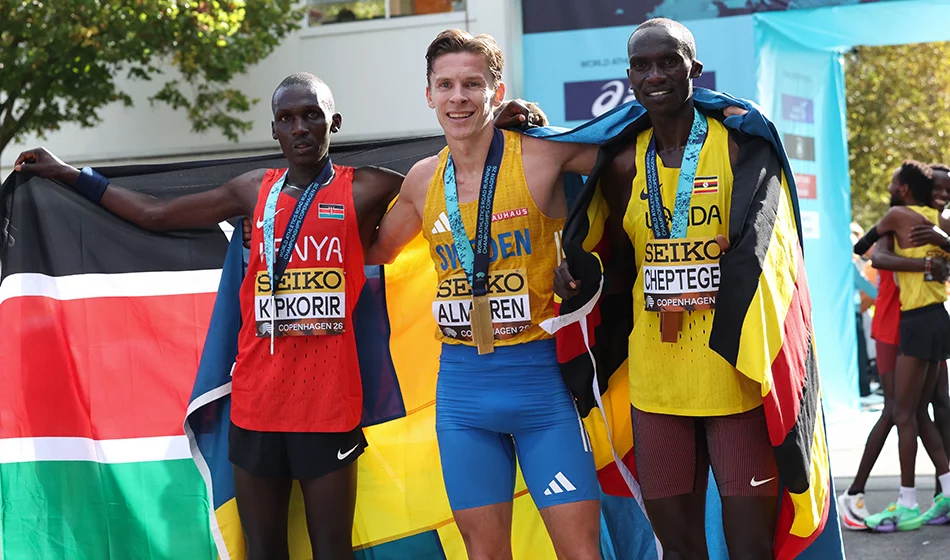
STOCKHOLM — In the crisp, cool air of Copenhagen, Andreas Almgren did not merely win a race; he stepped directly into the pages of Scandinavian sporting folklore. Powered by a devastating finishing kick and a mind trained to interpret complex data streams, the Swede carved his name into the history books by capturing the world half-marathon title in a sensational European record time of 58 minutes and 6 seconds.
For followers of Swedish athletics, the imagery was inescapable. Decades ago, legendary compatriots Arne Andersson and Gunder Hägg captivated the sporting world by trading world mile records back and forth on cinder tracks. In Copenhagen, Almgren cut a similarly solitary, relentless figure on the asphalt—a lone Swede driving the nation’s rich endurance legacy to an unprecedented modern peak.
Yet, this triumph was far more than a single day’s glory. It represented the culmination of a decade-long metamorphosis, a meticulous analytical approach to self-coaching, and the bridging of two distinct running worlds: the explosive speed of the middle distances and the brutal, unforgiving endurance required on the roads. With a glittering 12-month resume now firmly in his back pocket, Almgren’s gaze is already locked onto his next gargantuan challenge: a high-stakes marathon debut on the streets of New York.
Main Facts: A Historic Run in Copenhagen
The headlining statistic from Almgren’s masterclass in the Danish capital is staggering: 58:06.
With this performance, Almgren shattered the European half-marathon record for the second time in less than a year, building upon the 58:41 he clocked in Valencia the previous October. The victory secured his first world half-marathon title, cementing an extraordinary transition from a 400m and 800m track specialist into one of the most formidable road racers on the planet.
The race itself was a tactical chess match that ultimately broke open in the final kilometers. Kenya’s Nicholas Kipkorir pushed the pace aggressively, attempting to crack the Swede’s resolve from the front. Instead, Almgren remained unshakeable, utilizing the economical mechanics and raw over-speed of his track background to wait for the opportune moment before launching a decisive surge with a few hundred meters remaining.
Chronology: The Making of an Endurance Maestro
To understand the magnitude of Almgren’s current dominance, one must trace a career path defined as much by agonizing setbacks as it is by meteoric breakthroughs.
Early Promise on the Track (2014)
Born in Sollentuna and raised with a passion for both football and athletics, Almgren initially made waves as a middle-distance runner. At the 2014 World Under-20 Championships in Eugene, Oregon, he claimed a bronze medal in the 800m with a time of 1:45.65. Remarkably, that time still stands as the Swedish U20 record a decade later. Growing up, his athletic idol was the legendary Danish-Kenyan 800m icon Wilson Kipketer, whose poster adorned his wall—a subtle foreshadowing of a career that would eventually peak in neighboring Denmark.
The Valley of Injuries and Fourth-Place Heartbreak
Almgren’s path to the top was far from linear. Plagued by a series of persistent injuries and physical setbacks that would have derailed a less resolute athlete, he experienced a frustrating string of near-misses on the international stage. Time and again, he found himself finishing heartbreakingly fourth at the European Championships, forced to watch the podium from the outside looking in.
The Turning Point and Global Podiums (2024–2025)
Patience finally bore fruit as Almgren transitioned upward in distance. The turning point arrived with a bronze medal at the World Championships, followed by his breakthrough gold at the European Championships in Birmingham earlier this year, and a world bronze over 10,000m in Tokyo.
His 12-month tear has been nothing short of historic:
- January: European 10km record of 26:45 in Valencia.
- June: European 5000m record of 12:44.27 in Stockholm.
- October: Previous European half-marathon record of 58:41 in Valencia.
- Present: World half-marathon title and a new European record of 58:06 in Copenhagen.
Supporting Data: The Data Scientist’s Mindset
What separates Almgren from many of his peers is not just his physiological ceiling, but his intellectual engagement with the sport. Alongside his grueling training regimens, Almgren studied at the prestigious KTH Royal Institute of Technology in Stockholm and continues to work professionally as a data scientist consultant.
This analytical background permeates every facet of his training, which he largely self-coaches using a meticulously structured, numbers-led methodology.
Training Blocks and Threshold Work
Almgren operates in rigid, six-week training blocks designed to build baseline fitness before introducing sharper race-pace stimuli. During peak phases, he logs up to 170km to 200km per week.
- Threshold Backbone: The core of his aerobic engine is built on threshold running, typically executed at roughly 2:40/km pace with heart rates maintained between 167 and 178 bpm. Lactate testing is used regularly to establish baseline values and ensure optimal recovery.
- Key Sessions: Detailed tracking via COROS watches—whose metrics he relies heavily upon—reveals brutal sharpening sessions. Recent highlights include 3 x 3km repeats with three minutes of recovery, run at escalating splits of 8:00, 7:52, and 7:43. Another staple session features 10 x 1km repeats with one-minute recoveries, averaging a blistering 2:34/km at 162 bpm.
By comparing speed, heart rate, perceived exertion, and blood lactate side-by-side from block to block, Almgren treats his physical body with the same precision an engineer applies to software architecture.
Official Responses: In Almgren’s Own Words
Reflecting on his journey from a promising 400m runner to a world-conquering endurance athlete, Almgren’s emotions were palpable.
"This gold medal means so much to me," Almgren said in the aftermath of his victory in Copenhagen. "I have had a few problems in my career. A lot of fourth places at the Europeans. Then finally I got a bronze medal at the World Championships last year. And then my first gold medal in Birmingham earlier this year, and now to become the world champion in the half marathon means a lot to me."
Discussing the tactical dynamics of the race, he noted the psychological comfort his track background provides:
"I felt extremely strong at the last few kilometres. I did not only have one or two gears left, I had three or four. I felt like my opponents could try whatever they wanted, but I was not going to let this gold medal go."
On the ease of translating middle-distance speed to road racing, he added:
"It is actually very nice to come as a track runner to the half marathon, because I know I have a lot of over-speed in me. Ten years ago, we joked that maybe one day I will run a 5000m race. Now I am world champion in the half marathon and I am going to have my marathon debut in New York in about a month."
Implications: The Road to New York and Beyond
The immediate horizon holds a daunting new frontier. With barely time to let his historic performance in Copenhagen sink in, Almgren’s focus has already shifted across the Atlantic.
Altitude and the Big Apple
Following his victory, Almgren was immediately scheduled to travel to Arizona for a rigorous altitude-training block. From there, he will head straight to New York City to taper for his highly anticipated marathon debut.
While confident in his fitness, the marathon distance remains an uncharted wilderness.
"Running a marathon is something completely different," he admitted candidly. "I do not know how my body will react after 35 kilometres, but I am very excited to try it. In New York, I am going to try to be somewhere in the front; hopefully, I can make it all the way to Central Park and fight for the win. But you have to be humble."
Mental Shutdown and Future Horizons
Once the dust settles on the New York City Marathon, Almgren plans to close the book on a relentless, year-long racing campaign that began back in January. A well-deserved vacation awaits him in Stockholm—though much of it will be spent unpacking and organizing his newly purchased apartment rather than pounding the pavement.
Looking further down the road, the ambitions only grow larger. Though he insists he has not yet mapped out the specifics, the global stage in Beijing looms as a natural long-term target for a runner who has continually defied expectations.
For now, Andreas Almgren stands as a testament to the power of patience, scientific precision, and the refusal to let early setbacks define a career. From a young boy staring up at a poster of Wilson Kipketer to a data scientist rewriting European and world running record books, the Swede’s remarkable journey is only just entering its most thrilling chapter.

 Nila Kartika Wati
 Azzam Bilal Chamdy
 Ali Ikhwan
 Jia Lissa
 Neng Nana
 Iffa Jayyana
 Dwi Wanna
 Evan Lee Salim