
 rifanmuazin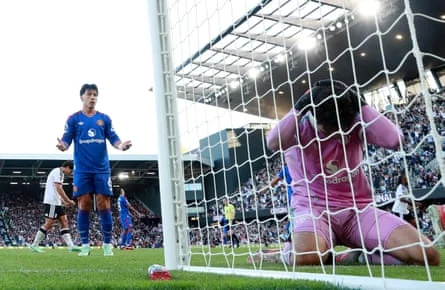
To paraphrase a legendary Manchester United manager, Michael Carrick knew the storm was coming. After a second half of the previous season that bordered on the immaculate, the current campaign has been defined by a series of turbulent, ill-fated afternoons. The atmosphere at Old Trafford has grown increasingly fraught, and as the team traveled south to London to face a struggling Fulham side, the sense of impending doom was palpable. For Carrick, the 90 minutes at Craven Cottage were not merely about points; they were about survival.
The Context: A Hat-Trick of Despair Avoided
The pressure on Carrick had reached a fever pitch. Coming off the back of a bruising derby defeat to Manchester City and a midweek Carabao Cup exit at the hands of Brighton—both suffered within the familiar, yet currently unforgiving, confines of Old Trafford—United were teetering on the edge of a disastrous three-game losing streak. These results followed an erratic start to the season that began with a sobering loss to Hull, leaving the United manager to navigate an environment characterized by extreme anxiety and tactical uncertainty.
A defeat to Fulham, who entered the match anchored to the foot of the Premier League table, would have been, by any objective metric, unthinkable. Yet, as the game progressed, the unthinkable began to look like a mathematical probability.
A Chronology of Chaos: The Own Goal and the Reprieve
The match began with a frantic, end-to-end energy that favored the hosts. Fulham, under the guidance of Álvaro Arbeloa, displayed a newfound tactical discipline, particularly in the center of the park. By pairing Sander Berge and Shea Charles, Arbeloa effectively clogged the midfield, forcing United into a predictable, sideways passing game that lacked the verticality required to break down a determined low block.
The breakthrough, or rather the breakdown, arrived in the second half. It was a moment of dark, slapstick comedy that will likely feature on blooper reels for years to come. A defensive lapse by United allowed Fulham to mount an attack that culminated in a strike on goal. Senne Lammens, the United goalkeeper, failed to deal with the initial threat, parrying the ball into a precarious position. Lisandro Martínez, perhaps suffering from a momentary lapse in spatial awareness, attempted to clear the ball but instead jabbed it into his own net. Lammens, caught in a state of indecision between a back-pass and a loose ball, could only watch as the ball trickled into the corner.
For much of the second half, it appeared that this comedy of errors would be the defining image of the match. United’s players looked sluggish, their movements laboured and their creative spark dimmed by a lack of composure in the final third.
However, football has a habit of rewarding persistence. With time ticking away and Fulham beginning to sit deep, inviting pressure they were ill-equipped to handle, United found their opening. Matheus Cunha, arguably the brightest spark in a dull attacking display, collected the ball on the edge of the penalty area. With little support, he opted to test Bernd Leno. The shot, curling toward the near corner, seemed destined for the goalkeeper’s gloves. Instead, a fortuitous deflection off David Affengruber redirected the ball, sending it spinning into the opposite corner of the net. It was not pretty, and it was certainly not planned, but for Carrick, it was a lifeline.
Tactical Breakdown: Square Pegs and Round Holes
The tactical setup for both sides highlighted the disparity in their current states of development. Arbeloa’s Fulham is undeniably a work in progress, but the manager’s commitment to "round pegs in round holes" is beginning to bear fruit. By shifting Alex Iwobi to the left wing and empowering Oscar Bobb to tuck inside, Arbeloa created a fluid, unpredictable attacking structure that caused United’s defensive transition significant problems. Josh King, operating in the number 10 role, was a constant thorn in the side of the United backline, frequently finding the seams between Maguire and the fullbacks.

For Carrick, the personnel issues were once again the primary narrative. With Benjamin Sesko sidelined due to a recurrence of a shin injury, United were stripped of their only recognized, pure number 9. This forced Carrick to rely on the "false 9" experiment, utilizing Cunha in a hybrid role while Bruno Fernandes hovered in close support. While the box-midfield configuration of Youri Tielemans and Kobbie Mainoo was designed to provide stability, it often left the team devoid of a target man to aim for when the game became stretched.
Supporting Data and Key Moments
The statistics from the match paint a picture of a game that could have swung in either direction:
- First Half Woodwork: United hit the frame of the goal twice in the opening 45 minutes—once through a Fernandes flick and again via a deflected Cunha effort.
- Fulham’s Wasted Opportunities: Gonzalo García’s failure to convert two high-quality chances before the interval was a significant source of frustration for the home support.
- The Discipline Gap: Fulham’s intensity was evident in their pressing, but it occasionally spilled over into recklessness, exemplified by Josh King’s yellow card for a blatant dive in the 45th minute.
- Goalkeeping Contrasts: While Lammens was culpable for the own goal, Leno was forced into multiple high-level saves, particularly in the dying minutes as United desperately sought an equalizer.
Official Responses and Post-Match Analysis
In the aftermath, the relief in the visitors’ dressing room was tangible. Michael Carrick, speaking to the press, was quick to deflect criticism regarding his side’s fitness levels, despite accusations that the team looked "leggy" after the hour mark.
"We are managing a difficult period," Carrick noted. "When the results aren’t going your way, every pass feels heavier and every decision more scrutinized. We showed the character to keep going until the final whistle, which is the bare minimum required at this club."
Conversely, Álvaro Arbeloa was left to rue what he described as a "cruel lesson" in Premier League ruthlessness. "We controlled the tempo for large stretches," the Fulham manager lamented. "We forced them into mistakes. To concede in that manner—a deflection after working so hard—is the nature of the league. We are building, but we need to learn how to kill off games when we have the opponent on the ropes."
Implications: A Fragile Foundation
While the draw at Craven Cottage prevents an immediate total collapse, the implications for Manchester United remain ominous. The "fault-lines," as observers have termed them, remain deeply entrenched. The dependence on individual moments of magic—like Cunha’s late equalizer—is not a sustainable long-term strategy for a team with title aspirations.
For Fulham, the performance provides a blueprint for the future. They have demonstrated that they can hold their own against the league’s traditional heavyweights, provided they maintain the defensive structure Arbeloa has implemented.
As the dust settles, the question for United is whether this point represents a turning point or merely a stay of execution. Carrick has earned another week of work, but the "ill winds" he sensed before the match have not dissipated. They have merely been held at bay by a spinning ball and a lucky deflection. The storm, it seems, is still very much on the horizon.

 Ali Ikhwan
 Raul Delapena Setiawan
 Jia Lissa
 Neng Nana
 Iffa Jayyana
 Dwi Wanna
 Evan Lee Salim