
 Ali Ikhwan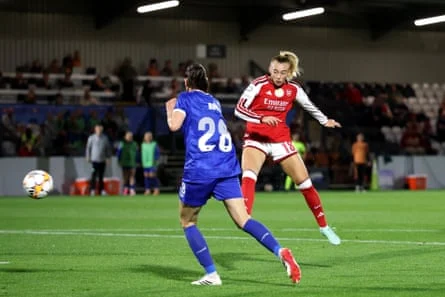
By Sports Correspondent
At Meadow Park on a crisp Tuesday night, the sound that greeted the final whistle was not one of jubilation, but of profound, collective exhalation. When Mariona Caldentey coolly slotted home a 93rd-minute penalty to secure a 1-0 victory over HB Køge, the North Bank erupted—not with the swagger of a team that had conquered Europe, but with the visceral relief of a side that had stared down the barrel of a humiliating stalemate.
While the three points in their Women’s Champions League (WCL) opener are vital for the league phase standings, the performance left the Arsenal faithful with more questions than answers. For a squad dripping with world-class attacking talent, the Gunners are currently trapped in a cycle of profligacy that threatens to derail their season before the autumn leaves have fully fallen.
The Chronology of a Frustrated Evening
The match was framed by the looming shadow of Sunday’s high-stakes clash at Stamford Bridge. Manager Renée Slegers, clearly mindful of squad management, made eight changes to the starting XI that salvaged a dramatic late draw against Manchester United just three days prior. Only Leah Williamson, Steph Catley, and Stina Blackstenius were retained, signaling a desire to inject fresh legs and hunger into a side currently suffering from a documented mental block in front of goal.
From the opening exchanges, the intent was clear. Arsenal dominated possession, pushing their defensive line so high that, for long stretches, the team functioned with little more than a single center-back covering the transition. Early warnings were sent to the Danish visitors: Chloe Kelly tested goalkeeper Alberte Vingum with a sharp drive, followed shortly by a stinging effort from Frida Maanum.
The breakthrough appeared to arrive in the 13th minute. Caitlin Foord kept a move alive, finding Taylor Hinds, who laid the ball off for Kyra Cooney-Cross. The Australian midfielder’s delicate flick was met by a clinical volley from Kelly. However, the celebrations were short-lived. A lengthy VAR review determined that Stina Blackstenius had strayed into an offside position, effectively obscuring Vingum’s line of sight. It was the first of many moments where fortune—and clinical precision—deserted the hosts.
As the half-time whistle approached, the mood at Meadow Park shifted from expectation to agitation. HB Køge, the A-Liga leaders, proved to be far more than mere fodder. Their defensive organization was disciplined and, at times, desperate, while their manager, Kristian Mørch Rasmussen, seemed to relish the role of the antagonist. His post-whistle antics—stumbling over a railing before shushing the home crowd—added a layer of theatre to a match that was becoming increasingly defined by Arsenal’s inability to break the deadlock.

The second half saw the introduction of Alessia Russo, Mariona Caldentey, and Lisa Baum, but the narrative remained unchanged. Arsenal probed, pressed, and dominated, but the "forcefield" around the Køge goal remained impenetrable. It wasn’t until Yukina Sakabe’s clumsy challenge on Selina Cerci in the dying embers of stoppage time that the deadlock was finally broken, allowing Caldentey to salvage a win that felt earned by persistence, if not by style.
Statistical Breakdown: A Tale of Two Teams
The numbers paint a stark picture of Arsenal’s current dilemma. The Gunners finished the match with 21 attempts on goal, compared to just four from their Danish counterparts. Yet, the efficiency ratio was staggering: Arsenal registered only two shots on target throughout the entire 90 minutes.
This lack of accuracy is becoming a hallmark of their start to the season. Having secured only five points from their first three Women’s Super League (WSL) fixtures—following back-to-back draws against Crystal Palace and Manchester United—the underlying metrics suggest a team creating high-quality opportunities but lacking the "killer instinct" required at the elite level.
In contrast, HB Køge’s defensive setup—anchored by the 21-year-old Vingum—exemplified the resilience needed to survive against top-tier opposition. Their path to the league phase, which included a 4-1 thrashing of Riga and a hard-fought aggregate win over PSV Eindhoven, proved they were not a side to be taken lightly. By restricting Arsenal to long-range efforts and desperate, scrambled attempts, they successfully dragged the Gunners into a tactical mud-fight.
The "Arsenal Problem": Mentality and Tactical Drift
Exactly what is stifling Arsenal’s attacking output remains a topic of intense debate among pundits and supporters alike. Is it a tactical issue, a lack of chemistry, or a psychological hurdle?
Renée Slegers’ visible frustration on the touchline—her puffed cheeks and constant, vocal demands for more intensity—suggests that the coaching staff is acutely aware of the stagnation. "Pressure!" she bellowed throughout the night, urging her players to harrying the opposition defense. Yet, the intensity often led to rushed decisions rather than calculated strikes.
The problem seems two-fold:

- The Tactical Overload: By committing so many players forward, Arsenal leaves itself vulnerable to counter-attacks, which forces the midfield to play with caution, effectively slowing down the transition speed needed to catch defenses out of shape.
- The Psychological Barrier: The "near misses" and disallowed goals are compounding. There is a palpable tension in the stadium whenever a forward reaches the penalty area, a feeling that the players are overthinking their finishes rather than relying on instinct.
Beyond the Pitch: The Streaming Controversy
While the football on the pitch was tedious for the home fans, those watching via Disney+ were met with an entirely different brand of frustration. The broadcast was marred by a series of technical and editorial oddities, including inexplicable ad breaks occurring while the ball was in play and a bizarre focus on a "studio dog."
For a competition as prestigious as the Women’s Champions League, the broadcast quality became a lightning rod for criticism. Fans took to social media to vent their annoyance at the fragmented viewing experience, which only served to heighten the frustration of watching a star-studded Arsenal side struggle to convert 21 shots into more than a single, late-penalty goal.
The Road Ahead: Implications for the Gunners
The victory over HB Køge ensures that Arsenal begins their Champions League campaign with points on the board, but the manner of the win offers little comfort ahead of a daunting trip to Stamford Bridge.
The reality is that Arsenal cannot afford to be this wasteful against Chelsea. If they carry this "mentality block" into the weekend, they risk a defeat that could set the tone for a long, difficult season. The squad is undeniably talented, but talent without efficiency is a hollow currency in modern football.
As the players left the pitch, the relief was palpable, but the questions remain. Are they capable of finding their rhythm, or is this "profligacy" the new normal? For Slegers, the next few days will be spent not just on tactical adjustments, but on the psychological conditioning of a group that clearly knows how to win, but has forgotten how to be clinical.
The Champions League is a ruthless competition. On Tuesday night, Arsenal survived because of a 93rd-minute mistake by their opponents. They cannot expect such benevolence from the European giants waiting for them in the coming weeks. The "Arsenal problem" is no longer a minor talking point; it is a full-blown crisis of confidence that requires an immediate, ruthless solution.

 Raul Delapena Setiawan
 Jia Lissa
 Iffa Jayyana

 Neng Nana

 Dwi Wanna