
 Reynand Wu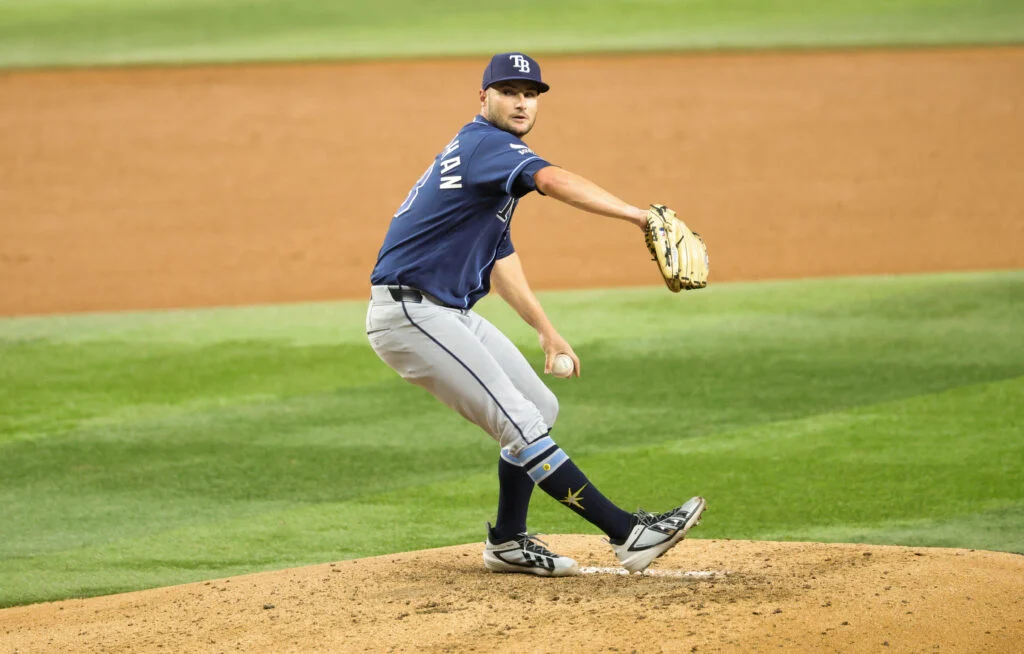
By AJ Eustace | September 20, 2026
The Tampa Bay Rays, currently the class of the American League and a heavy favorite for the top seed in the postseason bracket, have received a sobering update regarding one of their most talented arms. Shane McClanahan, the 29-year-old southpaw who has battled injury adversity for the better part of two seasons, will not return to the mound for the remainder of the 2026 regular season.
The announcement, first reported by Marc Topkin of the Tampa Bay Times, clarifies the status of the left-hander who has been sidelined since September 4th due to left forearm tightness. As the Rays prepare for an October postseason run, the absence of a healthy McClanahan forces manager Kevin Cash and his coaching staff to navigate the most critical time of the year with a rotation that is undeniably deep, yet missing one of its most lethal components.
The Chronology of a Frustrating Setback
The 2026 campaign was supposed to be the "comeback" year for McClanahan, who had been absent from professional play for the duration of the 2024 and 2025 seasons while recovering from Tommy John surgery and subsequent nerve complications.
His journey this year has been one of stop-and-start progress:
- Early Season: After a grueling rehabilitation process, McClanahan rejoined the big-league rotation, showing flashes of his former All-Star self.
- First IL Stint: The pitcher faced an early obstacle with mid-back tightness, forcing a temporary departure from the rotation.
- The September Flare-up: After regaining his rhythm, McClanahan reported forearm tightness on September 4th. Given his medical history, the Rays’ front office exercised extreme caution, immediately placing him on the 15-day injured list.
- The Current Status: As of September 20th, McClanahan is limited strictly to playing catch. While manager Kevin Cash noted that the lefty had "a good day" of throwing on Friday, the lack of a progression toward bullpen sessions or live batting practice serves as the primary indicator that he is not near a competitive return.
Analyzing the 2026 Production
To understand the weight of this loss, one must look at what McClanahan provided when he was available. Despite making only 118 innings of work, the southpaw posted a respectable 3.36 ERA.
His profile this season has been that of a pitcher evolving to manage his physical limitations. While his strikeout rate dipped to 21.8%—a noticeable decline from his high-velocity years—he remained highly effective by leaning on efficiency. His 8.0% walk rate and a 44.2% ground ball rate demonstrate a pitcher who has transitioned from a pure "power" profile to one that relies on command and inducing soft contact. With 2.4 fWAR accrued in limited time, he remained the team’s third-most valuable starter, serving as a vital stabilizing force in a rotation that faced several uncertainties throughout the summer.
The Rays’ Strategy: Navigating the First-Round Bye
The Rays’ current standing as the American League’s likely top seed provides a unique strategic advantage: a first-round bye in the postseason. By bypassing the Wild Card Series, Tampa Bay does not play its first game until the Division Series (ALDS) on October 3rd.
While this break provides a window for player recovery, the medical staff’s assessment of McClanahan suggests that even the extra time is unlikely to be sufficient. If the Rays are forced to move forward without him for the ALDS, they must rely on the rotation depth that has allowed them to dominate the regular season.
Evaluating the Postseason Rotation Depth
With McClanahan sidelined, the burden of the rotation falls squarely on the shoulders of Drew Rasmussen. Having established himself as the team’s undisputed ace, Rasmussen’s 4.7 fWAR season has been the heartbeat of the pitching staff. He will almost certainly take the ball for Game 1 of the ALDS.
Behind him, the Rays possess a diverse, if slightly reconfigured, rotation:
- Nick Martinez: A veteran presence who has stabilized the middle of the rotation, Martinez has been arguably the most reliable arm behind Rasmussen.
- Freddy Peralta: Acquired to bolster the staff, Peralta provides the high-strikeout potential that the rotation lacks with McClanahan out.
- The "Wildcard" Fifth Spot: This is the most critical question mark for the Rays. The team must choose between Griffin Jax, who has transitioned successfully from a high-leverage relief role to a starting capacity, and Ian Seymour. Seymour has provided solid innings as a bulk-relief option, but he lacks the pedigree of a seasoned postseason starter.
Implications for the Championship Series
If the Rays successfully navigate the ALDS, there is a glimmer of hope for a late-postseason return for McClanahan. However, management must be realistic. Should he return for the Championship Series, he would be doing so without the benefit of minor league rehab appearances or a month of competitive innings.
Kevin Cash’s approach will likely be to use McClanahan as a "weapon" rather than a traditional starter. If he is available, he could slot into a series-shortening role, allowing the Rays to push Jax or Seymour back into the bullpen, where their roles as multi-inning specialists could prove invaluable.
Official Responses and Tactical Outlook
Manager Kevin Cash remains characteristically optimistic but grounded in reality. When speaking to reporters, Cash emphasized the importance of the team’s "next man up" philosophy, a mantra that has defined the Tampa Bay organization for over a decade. By refusing to commit to a firm return date, the front office is protecting the player from the pressure of a deadline while maintaining flexibility in their roster construction.
The loss of a starter of McClanahan’s caliber is never ideal, but the Rays’ statistical success is built on the collective rather than the individual. With a potent offense and a bullpen that remains one of the deepest in baseball, Tampa Bay is well-equipped to handle the absence. However, as the competition stiffens in October, the margin for error shrinks. The performance of Rasmussen and the resilience of the supporting rotation will be the primary factors in determining whether the Rays can overcome this hurdle and secure a World Series title.
For now, the focus shifts to the final two weeks of the season—a period that will serve as an extended audition for the remaining pitchers vying to prove they can handle the high-pressure environments of October baseball. While the name "McClanahan" may be missing from the starting rotation sheet for the ALDS, the Rays remain, by all metrics, a team built to win under any circumstances.

 Iffa Jayyana
 Evan Lee Salim
 Ali Ikhwan
 Jia Lissa
 Neng Nana
 Dwi Wanna