
 Lina Hope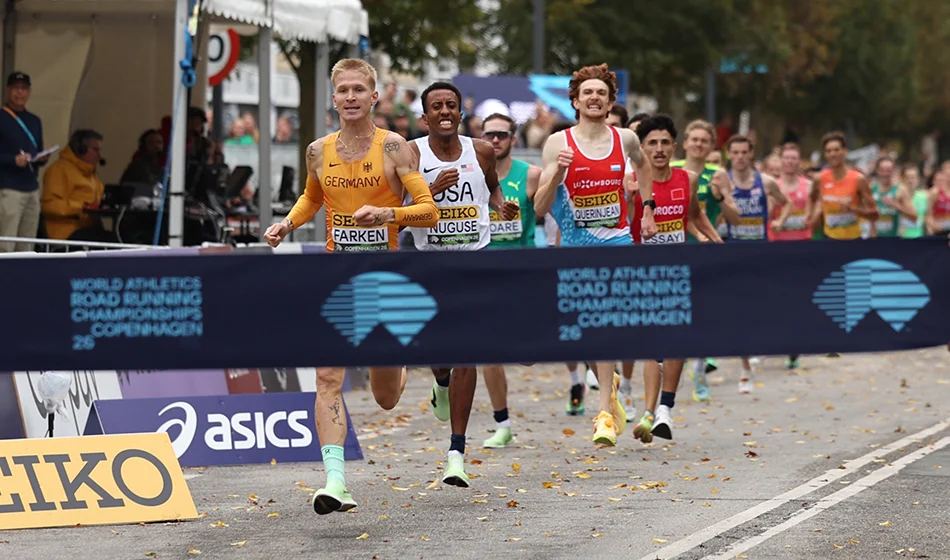
COPENHAGEN — The opening morning of the World Road Running Championships in the Danish capital delivered a masterclass in tactical patience, uncompromising grit, and late-race surges. Stripped of the hyper-commercial razzmatazz and high-production light shows that characterized London’s Athlos meeting just 24 hours prior, Saturday morning in Copenhagen offered a purist’s paradise. It was a throwback to the grit of old-fashioned road racing, where positioning, wind management, and raw anaerobic acceleration in the final straight decided the world titles.
By the time the dust settled on the city’s meticulously measured road mile course, two athletes had etched their names into the sport’s history books. France’s Agathe Guillemot and Germany’s Robert Farken executed carbon-copy tactical blueprints, waiting until the dying 150 meters to hunt down front-running favorites and sprint to gold medals. Both winners clocked world-leading times for the year on ratified road mile courses, setting a blistering standard for the remainder of the weekend’s championship events.
Main Facts: A Blueprint of Late Surges
The narrative of Saturday morning’s mile races can be summarized in two distinct acts, both dictated by front-running ambition that ultimately unraveled under late pressure.
In the women’s championship, Ethiopia’s Freweyni Hailu assumed control from the gun, relentlessly driving the pace from the halfway mark and stretching a 48-strong elite field. Yet, France’s Agathe Guillemot anchored herself to Hailu’s shoulder, biding her time before unleashing a devastating 150-meter kick that secured the world title in 4:22.74. Hailu was forced to settle for silver—a painful echo of her runner-up finish at the inaugural World Road Running Championships in Riga, Latvia, three years prior. Kenya’s Mirriam Cherop rounded out the podium in 4:25.71.
The men’s race offered an almost identical mirror image. American star Yared Nuguse went to the front early, pushing a punishing tempo that dared the 58-man field to come and get him. Most were content to sit a stride behind, seeking aerodynamic shelter. Among them was Germany’s Robert Farken. Having spent the preceding four days sharing an Airbnb and training tracks with Nuguse in Boulder, Colorado, Farken knew precisely what to expect. As the race funneled into the final 150 meters, Farken moved with clinical precision, overhauling the American to take gold in a world-leading 3:51.80. Nuguse held on gamely for silver in a season’s best 3:52.33, while Luxembourg’s Ruben Querinjean shocked the field to capture bronze in a national record of 3:52.77.
Chronology of the Races
The Women’s Mile: Guillemot’s Tactical Triumph
From the outset, the women’s elite wave was characterized by intentional, strung-out pacing. Hailu, renowned for her front-end strength, took responsibility for breaking the wind and pushing the envelope. By the midway point, her persistent surge had successfully whittled the lead pack down, appearing to put distance between herself and the chasing contenders.
However, Guillemot was quietly orchestrating a masterclass in energy conservation. Having endured a turbulent, physically demanding summer season marked by underwhelming track results—including a fourth-place finish in a tactical 1500m at the European Championships in Birmingham, a sixth in Brussels, and an eighth in Budapest—the Frenchwoman felt entirely revitalized on the tarmac.
"I felt great during the race. In the first part, I did not like to do extra effort. Just to follow the girl. There was no wind," Guillemot recalled.
As the course looped toward the final straightaway with roughly 150 meters remaining, Guillemot shifted gears. Channeling the pre-race advice of her coach, she leaned into her national identity: "When you are French, you keep pushing and pushing and pushing." She drew level with Hailu, surged past her with startling acceleration, and crossed the finish line with a radiant smile, punctuating her victory by folding her arms in a definitive statement of dominance.
Behind them, Ireland’s Sarah Healy navigated the traffic to finish 13th in 4:32.98, just ahead of Britain’s Katie Snowden, who crossed in 16th with a 4:33.44 performance. Snowden, reflecting on her grueling calendar, noted the physical toll of a packed international schedule: "When I’m on my fourth championships of the year, it’s just about a long time to kind of keep going and try and hold form."
The Men’s Mile: Farken Capitalizes on Roommate’s Pace
The men’s mile played out with chilling predictability for those privy to the athletes’ pre-race preparations. Yared Nuguse, motivated by a season that hadn’t entirely gone according to script, lit the fuse early. He commanded the front of the 58-man pack, setting a punishing tempo that tested the elastic limits of the field.
Farken, meanwhile, was riding in Nuguse’s slipstream, executing a race plan born from their recent domestic training block in Boulder under coaches Dathan Ritzenhein and Kelsey Quinn.
"I kind of knew what was going to happen: I trained with Yared and we shared the same AirBnB for the last four days," Farken explained. "His racing hasn’t really gone after plan, so he really has the fire burning in him today and he wanted to take it in hard. So I was very prepared for that today and I knew I needed a spot close to him and see if I could find some shelter from the wind a few places back."
As the runners swung into the home straight, Farken utilized that saved energy. Just as Guillemot had done minutes earlier, the German launched his decisive bid with 150 meters left on the clock. He swept past Nuguse, holding off a desperate, grit-laden counter-charge from the American to secure the world crown.
Further back, the race for minor placings produced fireworks. Luxembourg’s Ruben Querinjean powered to a national record of 3:52.77 for bronze, while Australia’s Oliver Hoare scorched to an area record of 3:53.65 in sixth. Jake Heyward led the British contingent once more, taking 11th in a personal best of 3:55.76.
Supporting Data and Official Results
The statistics from the Copenhagen road mile reaffirm the supreme quality of the fields assembled for the World Road Running Championships.
Women’s Mile Results
- Agathe Guillemot (FRA) – 4:22.74 (WL)
- Freweyni Hailu (ETH) – 4:24.35
- Mirriam Cherop (KEN) – 4:25.71
- Annemarie Nissen (DEN) – 4:26.78
- Naomi Korir (KEN) – 4:29.15
- Adelle Tracey (JAM) – 4:29.30
- Linden Hall (AUS) – 4:29.36
- Lucia Stafford (CAN) – 4:29.51
- Gabriela Debues-Stafford (CAN) – 4:30.59
- Addison Wiley (USA) – 4:31.02
(Selected others: 13. Sarah Healy (IRL) 4:32.98; 16. Katie Snowden (GBR) 4:33.44; 27. Sarah Calvert (GBR) 4:48.98)
Men’s Mile Results
- Robert Farken (GER) – 3:51.80 (WL)
- Yared Nuguse (USA) – 3:52.33 (SB)
- Ruben Querinjean (LUX) – 3:52.77 (NR)
- Anass Essayi (MAR) – 3:53.28
- Flavien Szot (FRA) – 3:53.44
- Oliver Hoare (AUS) – 3:53.65 (AR)
- Pietro Arese (ITA) – 3:54.37
- Vincent Ciattei (USA) – 3:54.62
- Jude Thomas (AUS) – 3:54.92
- Tshepo Tshite (RSA) – 3:55.66
(Selected others: 11. Jake Heyward (GBR) 3:55.76)
Official Responses and Athlete Reactions
The emotional spectrum in the mixed zone ranged from euphoric disbelief to exhausted introspection.
Agathe Guillemot struggled to process her new status as a global gold medalist. "Can you repeat? World Champion you say, oh my God," she laughed when speaking to reporters. Looking back on a grueling campaign, she added: "It has been a very long season with a lot of races. And a lot of trouble. My body felt good during the season. But it has not been easy. I learned a lot. It was not a perfect season, but it had a perfect end. Plan for 2027 is training, training, training." With her sights already set on the future, Guillemot hinted at a return to her winter roots, stating, "I love running. I love cross country. Indoor, outdoor. So maybe I will do European Cross Country in December."
Robert Farken’s victory carried an extra layer of personal significance, arriving on the absolute threshold of a milestone birthday. "This was my final race of the season, 100 per cent," Farken noted. "It is my last day in the 20s too, as I have my birthday tomorrow. I don’t need anything else for my birthday for sure." He was also quick to praise the collaborative training environment fostered in Boulder: "It’s very overwhelming to come away with a world gold medal. And it’s very special to do that with Yared—it just shows how good the work that Dathan and Kelsey do with us… and it gets me fired up for the future."
For the British athletes, the sentiment was a mixture of pride in making the senior ranks and frustration with late-season fatigue. Sarah Calvert, reflecting on her first senior Great Britain vest after finishing 27th in 4:48.98, shared her mixed emotions: "I’m very disappointed. I did not feel myself out there. I’ve had a bit of a tough past month or so, but I am so happy to just be here, trying to embrace it all and take in all the atmosphere. This is my first GB senior vest, so I’m happy to be here, but I wanted a lot more, and hopefully now I can reset and get stronger for next year."
Implications for the Sport
The high-octane drama of the Copenhagen road miles highlights the rapidly growing prestige and viability of road racing within the global athletics calendar. While traditional track events remain the crown jewel of Olympic cycles, specialized road championships are successfully carving out a unique identity. They offer athletes alternative pathways to global glory, financial incentives, and fan engagement that track meets often fail to replicate.
For Guillemot, the gold medal completely rewrites the narrative of her 2026 campaign. Having hovered on the fringes of medals during the summer championship circuit, her breakthrough on the roads validates her tactical evolution and sets her up as a multi-surface threat heading toward the 2027 track and cross-country seasons.
Similarly, Farken’s tactical masterclass—and Querinjean’s national record for Luxembourg—demonstrates that middle-distance depth on the roads is expanding rapidly. As international federations continue to invest in road disciplines, athletes are adapting their training to master the unique variables of tarmac racing: cornering, wind-sheltering, and unforgiving, surge-heavy pacing.
As attention pivots to the subsequent events of the weekend—including the much-anticipated 5km showdowns and Sunday’s grueling half-marathons—the Copenhagen World Road Running Championships have already delivered an unforgettable masterclass in tactical intelligence and championship execution.

 Neng Nana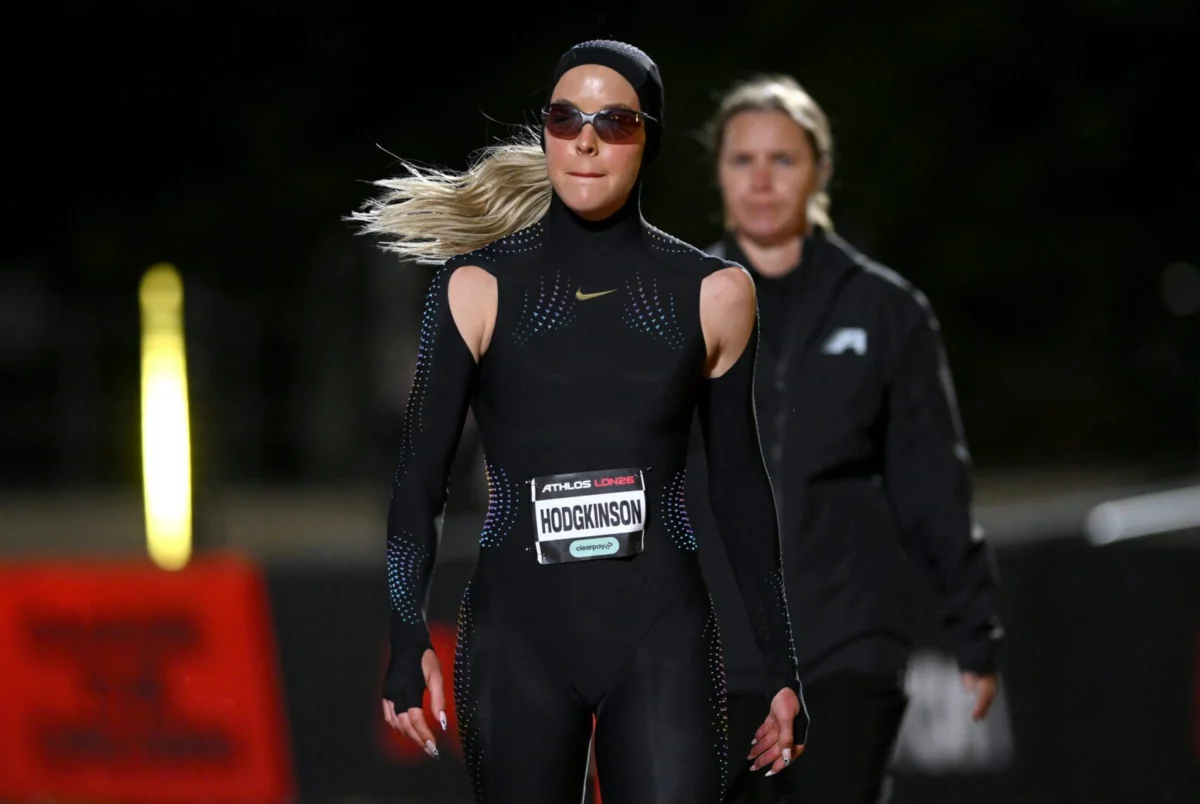
 Muslim
 Layla Zulfa
 Nila Kartika Wati
 Asro
Asro
 Nana Wu
 Ali Ikhwan