
 Azzam Bilal Chamdy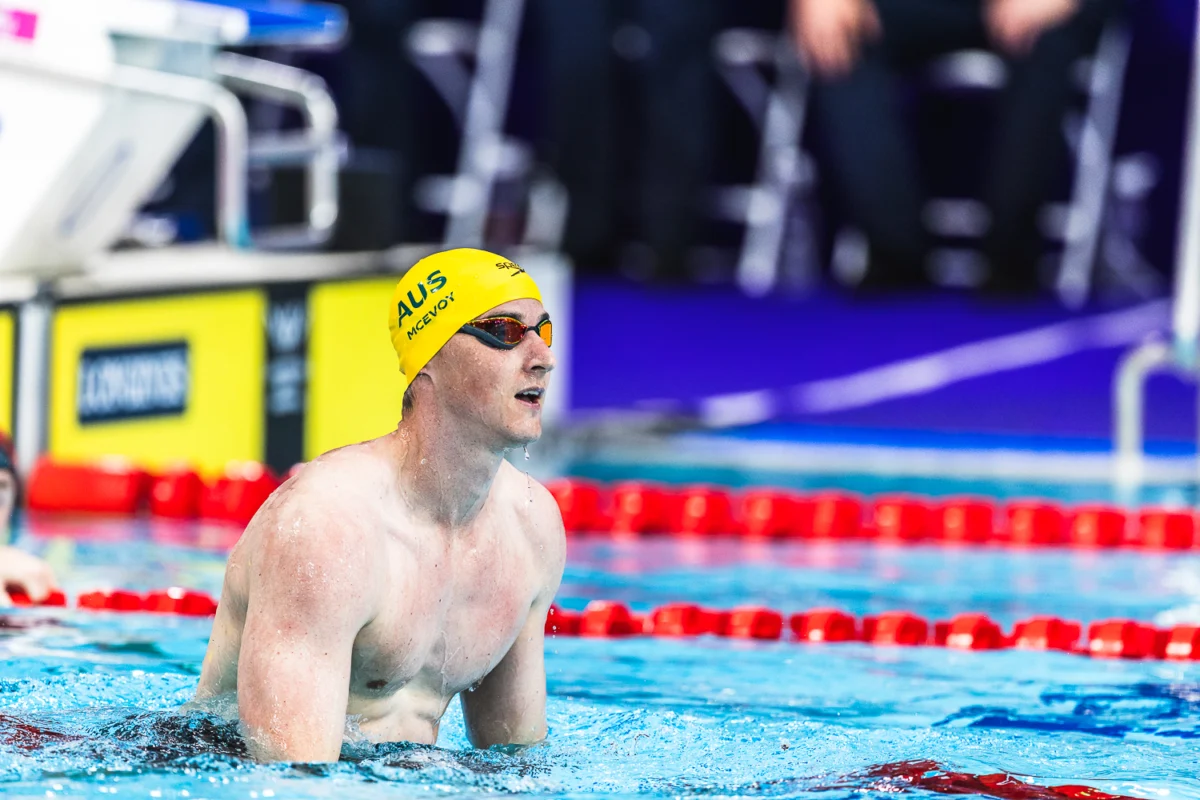
The landscape of international swimming is bracing for a significant shift as world record holder Cameron McEvoy prepares to re-enter the 100-meter freestyle arena. In a strategic move that signals a departure from his recent focus on pure sprinting, the Australian powerhouse has confirmed he will be testing his capabilities in the 100-meter freestyle at the upcoming Silk Road World Cup Tour. This announcement, which follows his recent public declaration of a return to specialized 100m training, marks a calculated effort to secure a spot on the Australian team for the upcoming Short Course World Championships.
The Core Objective: A Path to Budapest
For McEvoy, the decision to prioritize the 100m freestyle is not merely a test of form; it is a tactical mission to qualify for the 4x100m freestyle relay squad at the Short Course World Championships. While McEvoy has cemented his legacy as the king of the long course 50m freestyle—holding the world record with a blistering 20.88—his recent training regime suggests a desire to contribute more versatility to the Australian national team.
By committing to the Silk Road World Cup Tour, which features three stops across Eurasia, McEvoy is positioning himself to meet the rigorous selection criteria set forth by Swimming Australia. Although he will be notably absent from the Australian Short Course National Championships scheduled for late September, he remains a prime candidate for a "discretionary pick" by the National Head Coach. This pathway is specifically designed for athletes with proven medal potential, a category in which the world record holder naturally resides.
Chronology of a Career Pivot
To understand the significance of this move, one must look at the evolution of McEvoy’s career. For the better part of the last decade, McEvoy’s short course personal bests have remained frozen in time. His 50m freestyle SCM record of 20.75 dates back to 2015, while his 100m freestyle best of 46.19 and his 50m butterfly mark of 23.73 were both established in 2016.
For years, the swimming community has watched McEvoy navigate the delicate balance between long course dominance and the unique technical demands of the short course pool. The juxtaposition of his records is particularly revealing: his 50m freestyle short course personal best is only a tenth of a second faster than his long course world record. When he set that 20.75 mark in 2015, his long course equivalent was a 21.97. This massive gap illustrates just how much room for improvement exists if McEvoy applies his current, more refined long-course mechanics to the shorter 25-meter pool environment.
The current timeline for his return is aggressive. With the first stop of the World Cup Tour conflicting directly with the Australian National Championships (September 29 – October 2), McEvoy is bypassing the traditional domestic qualification route entirely in favor of an international stage. This indicates a high level of confidence from both the athlete and the national coaching staff.
Supporting Data: Analyzing the Performance Gap
The technical implications of McEvoy’s return to the 100m distance are profound. In short course swimming, the 100m event is defined by wall transitions, underwater dolphin kicks, and the ability to maintain speed through multiple turns. As a swimmer who has mastered the long course 50m, McEvoy possesses the raw top-end speed required to be competitive; the challenge lies in sustaining that velocity through the mid-pool turns.
Statistically, his 46.19 personal best from 2016 is a solid foundation, but the modern era of the 100m freestyle has seen a significant downward trend in winning times. To be a true contender on the world stage, McEvoy will likely need to shave several tenths of a second off that decade-old mark. His recent training focus on the 100m distance—which he has discussed publicly on several platforms—suggests that he is already observing improvements in his aerobic capacity and his ability to hold his stroke rate under the fatigue of a second lap.
Furthermore, the new World Aquatics "wild-card" system provides a safety net that did not exist in previous years. Under the new regulations, as long as a swimmer competes in at least two of the three World Cup stops and finishes in the top three of their individual events with a time under the AQUA "A" standard, they can qualify for the World Championships independently of their country’s quota. With a maximum of three wild-card spots per nation—which do not count toward the standard team size limit—McEvoy has a distinct, secondary route to the championships should the discretionary selection committee decide to prioritize younger, up-and-coming talent for the standard roster slots.
Official Responses and Selection Criteria
The Swimming Australia Selection Criteria is clear regarding the "discretionary basis" for team selection. The policy states that the National Head Coach has the authority to select athletes based on "medal potential in Individual Olympic Events, or for non-Olympic Individual Events." Given McEvoy’s status as an Olympic gold medalist and a current world record holder, it would be highly unusual for the federation to overlook him, provided he demonstrates a baseline of fitness during the World Cup.
The federation’s approach reflects a broader trend in international swimming: the shift toward a "medal-first" philosophy. By allowing for discretionary picks, Swimming Australia ensures that veteran stars who may have scheduling conflicts or injury concerns are not automatically discarded, provided they can prove their relevance in the lead-up to major international meets.
Strategic Implications: The Road to 2026
What does this mean for the Australian team at the Short Course World Championships? It suggests that the team is looking to reinforce its relay strength. The 4x100m freestyle relay has historically been a point of pride for the Australian program, and the addition of a focused, motivated McEvoy would provide an immediate boost to their depth.
Beyond the relay, the implications for the individual 100m freestyle are equally exciting. If McEvoy can successfully transition his long-course speed to the short course format, he immediately becomes a threat for the podium. The World Cup tour will serve as the perfect laboratory for this experiment. By racing the 50m free, 100m free, and 50m fly, he is forcing himself to work on both his explosive power and his endurance under pressure.
The move also highlights the changing nature of the sport’s calendar. With the rise of the World Cup circuit as a viable, high-stakes qualification pathway, elite swimmers are finding more flexibility in how they approach their training cycles. No longer are they strictly tethered to domestic trials; instead, they can utilize international competition to sharpen their skills and meet the standards required to compete at the pinnacle of the sport.
As the Silk Road World Cup Tour approaches, the eyes of the swimming world will be firmly fixed on McEvoy’s times. Whether he is simply testing the waters for a future transition or making a serious bid for a medal in a new short-course distance, his participation is a win for the sport. It brings a level of prestige to the World Cup events and ensures that the Short Course World Championships will feature one of the most decorated sprinters of the modern era.
In conclusion, Cameron McEvoy’s return to the 100m freestyle is a calculated risk, but one that is backed by extensive experience and a clear understanding of the new qualification pathways. By prioritizing the World Cup over the national stage, he is demonstrating a modern, professional approach to athletic excellence—one that values international results and strategic preparation above tradition. If his performance on the Silk Road matches his ambitions, the world should prepare for a renewed, more versatile version of the Australian sprint king in the months to come.


 Nana Wu

 Pevita Pearce
 rifanmuazin
 Laily UPN
 Nana
Nana
 Asro
Asro
 Muslim