
 Nana
By [Your Name/Journalistic Staff]
The Wuppertal swimming complex became the epicenter of German aquatic excellence this Thursday, November 12, as the 2026 German Short Course Championships officially commenced. With the prestigious World Short Course Championships looming on the horizon next month, the stakes in Wuppertal are significantly heightened. For the nation’s top-tier athletes, this meet serves not merely as a pursuit of national titles, but as a critical crucible for international qualification and a barometer for current physiological readiness.
As the starter’s pistol echoed through the venue, the tone was set for a weekend defined by precision, tactical mastery, and the desperate hunger for podium spots. The opening day of competition provided a compelling narrative of veteran dominance, rising stars staking their claims, and a clear message that German swimming is firmly entrenched in a period of high-performance evolution.
The Landscape: High Stakes in Wuppertal
The atmosphere in Wuppertal is charged with the typical intensity that accompanies a pre-World Championship selection event. Athletes are not just racing against their peers in the pool; they are racing against the clock and the stringent selection criteria established by the German Swimming Federation (DSV).
For many, these championships represent the culmination of months of intense micro-cycle training designed to peak exactly during this window. The objective is twofold: secure a ticket to the upcoming global championships and establish a psychological advantage over domestic rivals. The depth of talent on display today suggests that the transition from long-course summer events to the nuances of short-course pool dynamics—characterized by underwater efficiency and high-frequency turns—has been navigated with expert precision by Germany’s elite.
Chronology of Day One: A Display of Dominance
The opening session was headlined by three major events, each offering a distinct showcase of skill: the grueling men’s 1500m freestyle, the tactical women’s 200m butterfly, and the high-speed sprint dynamics of the men’s 100m breaststroke.
The 1500m Freestyle: Sven Schwarz’s Masterclass
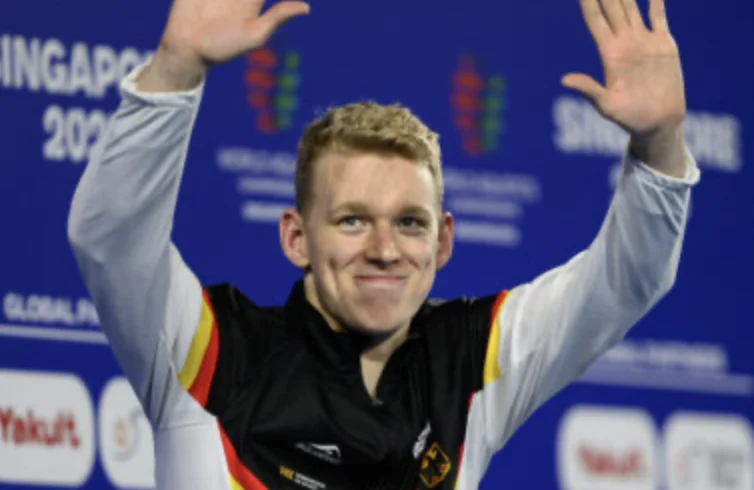
Sven Schwarz, arguably Germany’s most formidable distance freestyler, opened the championship with a performance that can only be described as clinical. Charging to a gold-medal finish of 14:20.66, Schwarz did more than just win; he dismantled the field.
To put the 24-year-old’s performance into perspective, he finished over twenty seconds ahead of his closest competitor. This was not merely a victory; it was a statement. The time marks a personal best for Schwarz, successfully eclipsing the 14:22.29 he recorded during his 5th-place finish at the 2024 Short Course World Championships. Had he replicated this evening’s performance in Budapest two years ago, he would have secured a 4th-place finish, tantalizingly close to the podium. This trajectory suggests that Schwarz is currently in the best form of his life, posing a genuine threat to the global elite as he prepares for next month’s international stage.
Women’s 200m Fly: The Kohler Efficiency
If the 1500m freestyle was a display of endurance, the women’s 200m butterfly was a clinic in class. World Champion Angelina Kohler demonstrated exactly why she is considered one of the world’s premier butterfliers. Touching the wall at 2:05.90, she secured the gold medal with a comfortable margin of more than four seconds over her nearest rival.
The race for the remaining podium spots was far more tightly contested. Yara Fay Riefstahl claimed the silver in 2:10.33, while Leni von Bonin took the bronze in 2:10.71. While Kohler’s time was well off her lifetime best—the 2:03.30 she clocked to win the 2023 European Short Course Championships—the performance was an exercise in controlled aggression. It was a race managed from the front, designed to secure the win without over-extending, allowing Kohler to conserve energy for subsequent events in the coming days.
Men’s 100m Breaststroke: A Tight Sprint
The men’s 100m breaststroke provided the most exhilarating finish of the day. In a discipline where millisecond margins define the difference between glory and disappointment, Melvin Imoudu emerged as the top performer, clocking 57.56 to claim the gold.
The race remained competitive until the final touch. Louis Hoffmann followed closely in 57.84, with Christopher Weidner completing the podium in 58.09. The narrow gap between the three medallists—less than half a second separating gold from bronze—highlights the immense depth of breaststroke talent currently residing in Germany. For Imoudu, this win is a testament to his tactical composure under pressure, maintaining his stroke rate even as the field surged toward the wall.
Supporting Data: Comparative Analysis and Performance Metrics
To understand the significance of today’s results, one must look at the statistical trends. The German national team has been aggressively pursuing underwater efficiency, an area that often separates the finalists from the podium-finishers in short-course events.
- Sven Schwarz (1500m Free): His 14:20.66 is a critical marker. In the last two years, Schwarz has demonstrated a consistent ability to hold his pace in the final 300 meters, an area where many distance swimmers suffer. His 20-second lead over the field indicates that he is currently swimming at a level significantly above the domestic standard, suggesting that his training focus has shifted toward international competition rather than regional dominance.
- Angelina Kohler (200m Fly): Kohler’s 2:05.90, while not a PB, remains a dominant domestic benchmark. The fact that she can win by over four seconds while operating nearly three seconds off her peak suggests she has significant "in the tank" for the World Championships. Her technical execution—specifically her turn transitions—remains the gold standard in German swimming.
- Breaststroke Depth: The 57-second barrier in the 100m breaststroke is the standard for international relevance. With three swimmers finishing within 0.53 seconds of one another, the competition is fostering a "rising tide" effect. Coaches note that this internal friction is exactly what is required to produce medal-winning performances on the world stage.
Official Responses and Tactical Implications
While the DSV has yet to release the official roster for the World Championships, the performances in Wuppertal provide a clear indication of who is currently in "pole position" for selection.
Federation officials, speaking on the sidelines, emphasized that the Wuppertal meet is not just about the times on the scoreboard, but about the process. "We are looking for swimmers who can replicate their best performances under the pressure of a selection environment," noted a representative. "Today was a strong start. We saw athletes who have clearly adjusted their training cycles correctly. The mental fortitude shown by the likes of Melvin Imoudu in a tight finish is exactly what we need to see."
The implications for the World Championships are clear: Germany is looking to field a squad that is not merely competitive, but capable of challenging for medals in key events. The distance freestyle and butterfly contingents, led by Schwarz and Kohler respectively, appear to be the primary pillars of the national strategy.
Looking Ahead: The Road to the World Championships
As the 2026 German Short Course Championships continue through the weekend, the focus will shift toward the sprint freestyle events and the individual medleys. Fans and analysts alike will be watching to see if the momentum generated on Day One can be sustained.
The challenge for the athletes now is recovery. Managing the physical toll of high-intensity racing over multiple days is the hallmark of a world-class swimmer. For those who secured gold today, the goal is to maintain that edge while avoiding the temptation to over-exert in preliminary heats. For those who missed the podium, the remainder of the meet serves as a final opportunity to prove their worth to the national selectors.
Wuppertal has served its purpose as an opening act, establishing a high bar for the days to follow. With the World Championships just weeks away, the clock is ticking, and the German elite are proving that they are ready to answer the call. The swimming world will be watching the results coming out of this German industrial city with great interest, as the times recorded here will undoubtedly influence the projections for next month’s global showdown.
As the sessions proceed, the narratives will continue to unfold—who will surprise, who will falter, and who will cement their status as a global contender? One thing is certain: the spirit of competition in Wuppertal is alive and well, providing a fitting prelude to the international battles that await.

 Asro

 Lina Irawan
 Raul Delapena Setiawan

 Iffa Jayyana

 Ali Ikhwan