
 rifanmuazin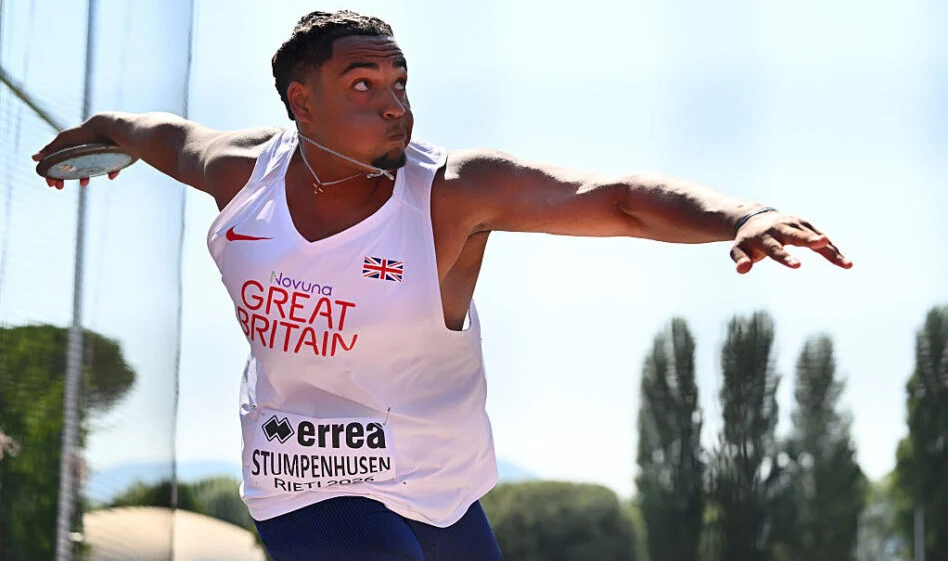
By Athletics Weekly Correspondent
Published: July 19, 2026 | Updated: July 19, 2026
The Stadio Raul Guidobaldi in Rieti, Italy, played host to a night of high-octane drama and historic achievement this Saturday, as the Great Britain and Northern Ireland squad etched their names into the annals of European age-group athletics. In a sequence of events that swung from the crushing disappointment of a disqualification to the euphoria of a championship record, British athletes demonstrated both the volatility of sprint competition and the sheer dominance of the country’s burgeoning throwing talent.
Bronson Hearn-Smith emerged as the evening’s unlikely hero, seizing gold in the 200m in a championship-record time of 20.70 seconds. His victory served as a defiant response to the earlier heartbreak of team-mate Ethan Heggarty, while thrower Moyo Stumpenhusen further solidified the British medal charge by shattering the UK Under-18 discus record with a massive heave of 64.92 meters.
The Main Facts: A Tale of Two Sprints
The narrative of the 200m final was supposed to center on Ethan Heggarty. As the world U18 number one, the Bingley Harrier had arrived in Italy with the weight of expectation on his shoulders. Having smashed the championship record with a 20.77 run in Thursday’s heats—backed by a formidable personal best of 20.51—Heggarty looked destined for the podium.
However, the unforgiving nature of championship sprinting reared its head during the semi-finals. In a decision that silenced the British support, officials ruled that Heggarty had committed a lane violation, effectively ending his campaign and denying him a shot at the title he was heavily favored to win.
Stepping into the void was Colchester Harrier Bronson Hearn-Smith. Often viewed as the secondary force in the British sprint hierarchy, Hearn-Smith seized the mantle with a performance of extraordinary maturity. Running from the challenging outside lane eight, he navigated the bend with precision and powered down the home straight, crossing the line in 20.70 seconds. This performance not only secured the gold medal but shattered his personal best of 20.95 by a significant quarter-second margin.
Chronology of the Evening
The drama unfolded in distinct phases, beginning with the technical disqualification of the favorite.
The Afternoon Disappointment
The day began with the confirmation that Ethan Heggarty would not advance to the final. The disqualification occurred during the semi-final rounds, where the slightest deviation from the lane markings triggered an automatic exit. The ruling, while technically sound, was met with shock from observers who had expected a dominant performance from the young sprinter.
The Evening Turnaround
By the time the final was called, the atmosphere at the Stadio Raul Guidobaldi had shifted from anticipation to a sense of uncertainty. Hearn-Smith, coached by Stephen Garnham, entered the blocks with a clear directive: to run his own race. The race itself was a masterclass in controlled aggression. Hearn-Smith’s transition from the curve to the straight allowed him to hold off a charging field, including Poland’s Bartosz Pytlik and Spain’s Iker Pineira, both of whom were left to contest the silver and bronze respectively.
The Field Event Dominance
As the track events concluded, eyes shifted to the field, where Moyo Stumpenhusen was already in the process of rewriting history. The Rugby & Northampton AC athlete, under the guidance of coach Gary Herrington, entered the circle with the confidence of an athlete who knew he was the man to beat. His winning throw of 64.92m—eclipsing his own previous record of 64.14m—cemented his status as the premier U18 thrower in Europe.
Supporting Data: By the Numbers
The metrics of Saturday’s performances highlight a significant leap forward for the British youth development pipeline.
- 200m Men’s Final:
- Gold: Bronson Hearn-Smith (GBR) – 20.70 (Championship Record)
- Previous PB: 20.95 (Difference: -0.25s)
- Men’s Discus Final:
- Gold: Moyo Stumpenhusen (GBR) – 64.92m (UK U18 Record)
- Previous Record: 64.14m (Difference: +0.78m)
The consistency of the British squad throughout the championship has been remarkable. With gold medals already secured by Divine Iheme (100m), Joe Scanes (3000m), and Sam James (high jump), the team has effectively established itself as the dominant force in the medal standings heading into the final day of competition.
Official Responses and Athlete Perspective
The reaction from the athletes themselves provided a window into the psychological demands of international age-group competition.
"It still has not kicked in," an emotional Bronson Hearn-Smith told European Athletics following his victory lap. "I am over the moon and I have no words. A couple of months ago, I was not sure I would make it to Rieti at all. The journey here has been a rollercoaster, particularly after the heats where the intensity of the competition really hit me."
Hearn-Smith credited a shift in his mental approach for his success. "I went into the semi-finals a completely new person—composed. When I stood at the start line for the final, I had this overwhelming sense of calm; I knew I was going to do something great. I am actually more surprised than anyone else by the result."
He added, "The heat and the pressure of an international environment were difficult to manage, but I focused on keeping my head down and running my own race. Being in Rieti is my first experience competing abroad, and it has only made me hungry for more."
Implications for British Athletics
The performances in Rieti carry weight far beyond the immediate satisfaction of gold medals.
Developing the Next Generation
Moyo Stumpenhusen’s success in the discus is particularly notable for its historical context. Not since Lawrence Okoye’s 2011 European U23 title has a British thrower shown such promise at a continental level. Okoye used that victory as a springboard for the London 2012 Olympic final, and there is a growing consensus that Stumpenhusen is on a similar trajectory. His technical proficiency at such a young age suggests a long-term future on the senior world stage.
Resilience in the Sprint Squad
The handling of Ethan Heggarty’s disqualification and the subsequent success of Hearn-Smith speaks volumes about the depth of the current British talent pool. Rather than folding under the weight of a high-profile exit, the sprint squad demonstrated a "next man up" mentality that is essential for long-term success at the senior level. The ability of coaching staff to refocus their athletes after such a demoralizing setback suggests a high level of maturity within the support structure.
Looking Toward the Closing Session
As the European U18 Championships draw to a close, Great Britain and Northern Ireland occupy the top spot on the medals table. This success is not merely a collection of individual accolades; it is a clear indicator that the investment in grassroots athletics, specifically in the technical disciplines of throwing and the speed-endurance requirements of the sprints, is yielding substantial dividends.
The final day of competition in Rieti will be defined by the pressure to maintain this momentum. However, based on the resilience displayed by Hearn-Smith and the clinical excellence of Stumpenhusen, the future of British athletics appears to be in safe, and exceptionally capable, hands. Whether these young stars can transition this form into the senior rankings remains to be seen, but for the residents of the Stadio Raul Guidobaldi on this July weekend, the promise of tomorrow was on full display today.


 Nana Wu
 Siti Muinah
 Neng Nana

 Lina Hope
 Sagoh
Sagoh
 Iffa Jayyana