
 Nana
By Retta Race
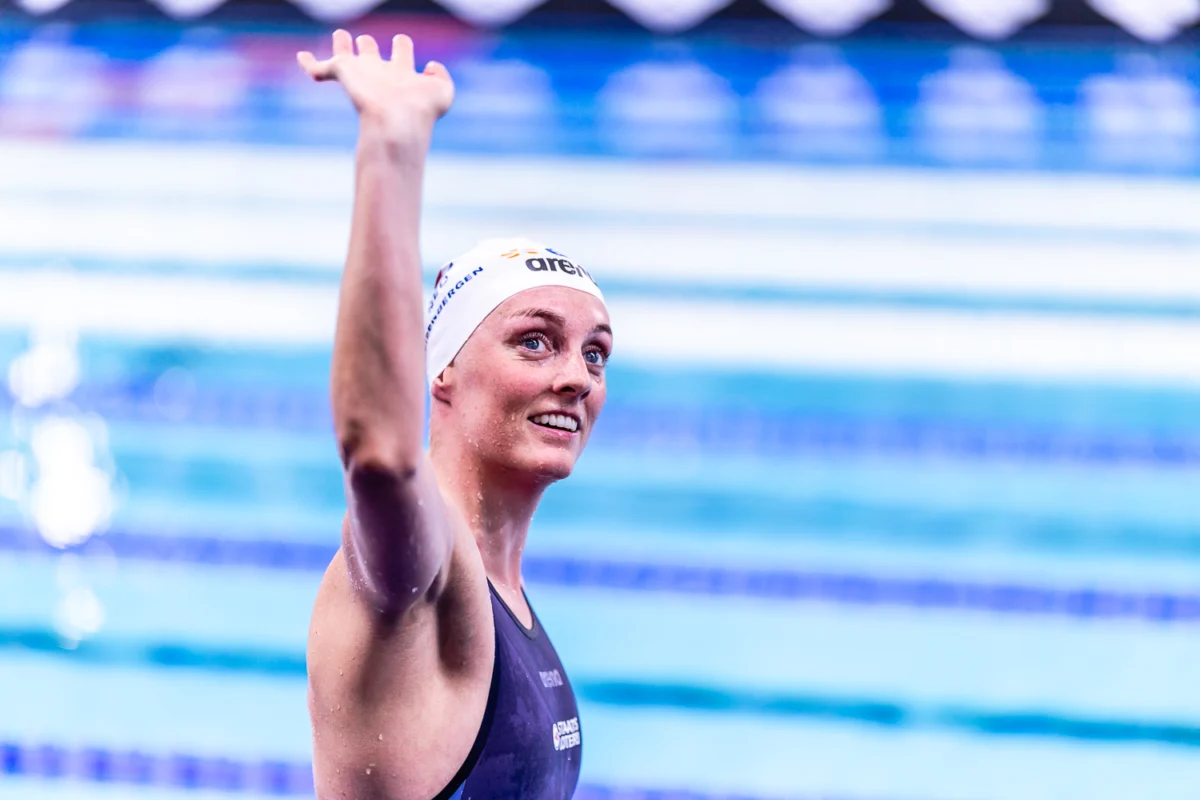
The Dutch swimming landscape witnessed a monumental shift this past weekend during the second round of the 2026 Eredivisie Swimming Competition. Marrit Steenbergen, a 26-year-old powerhouse and established World Record holder, underscored her status as one of the most versatile athletes in global aquatics. In a breathtaking display of endurance and technical precision, Steenbergen clocked a 4:31.08 in the women’s 400-meter individual medley (SCM), effectively dismantling a national record that had stood for over a decade.
The Main Event: A New Benchmark for the Netherlands
Steenbergen’s performance in the 400 IM was nothing short of clinical. As she touched the wall, the clock confirmed what many in the Dutch swimming community had suspected: the era of the old record was over. By stopping the clock at 4:31.08, she did more than just secure a victory at the Eredivisie; she erased the name of legendary retired open-water Olympic champion Sharon van Rouwendaal from the top of the Dutch record books.
Van Rouwendaal had set the previous standard of 4:33.15 back in 2014, a time that had withstood the test of time for twelve years. Steenbergen’s ability to slice over two seconds off that mark is a testament to her ongoing evolution as an athlete. Entering the meet with a personal best of 4:35.98—a time set only last November—Steenbergen successfully shaved nearly five seconds off her lifetime best in the span of just twelve months. This trajectory of improvement at age 26 is rare and speaks volumes about her training intensity and technical refinement.
A Chronology of Excellence: From Prospect to Legend
To understand the magnitude of Steenbergen’s latest achievement, one must look at the timeline of her career. Her journey has been defined by a relentless pursuit of versatility. While many swimmers specialize in a single stroke or distance, Steenbergen has spent the better part of the last decade building an exhaustive repertoire of skills.
In late 2025, she signaled her intent to conquer the grueling 400 IM, moving her personal best down to the 4:35 range. Throughout the early months of 2026, her training sessions in the Netherlands focused heavily on the transitions between strokes—specifically the backstroke-to-breaststroke and breaststroke-to-freestyle segments that often decide the outcome of an IM race.
During the Eredivisie round, her race plan was executed to perfection. She opened with a controlled butterfly leg, maintained a steady cadence in the backstroke, and surged through the breaststroke—her traditional strength—before closing with a powerful freestyle finish that left her competitors in her wake. By the time she finished, she had not only secured the record but had dominated the field by a staggering 17-second margin, with Kirsten Verhalle finishing in 4:49.90 and Janne Slegers rounding out the podium in 5:10.94.
Supporting Data: The Anatomy of a Record-Breaker
The numbers behind Steenbergen’s career are staggering. She is not merely a regional star; she is a global icon of the sport. Her trophy cabinet is a reflection of a decade of dominance, containing:
- 8 Long Course World Championship Medals
- 6 Short Course World Championship Medals
- 18 European Long Course Championship Medals
- 13 Short Course European Championship Medals
When comparing her 4:31.08 to her previous 4:35.98, the data reveals a marked improvement in metabolic efficiency. In swimming, "hacking" four seconds off a 400m race at this elite level is a massive jump. It suggests that her aerobic capacity has increased significantly, allowing her to maintain a higher heart rate through the final 100 meters without the typical lactic acid buildup that slows down most competitors.
Furthermore, her dominance over the field at the Eredivisie—beating her nearest rival by nearly half a pool length—highlights that she is currently operating in a league of her own within the domestic Dutch circuit. This level of internal competition, while challenging for the athlete, forces her to look toward international benchmarks, such as the upcoming Short Course World Championships, to find the resistance necessary to push her limits further.

Official Context and Future Outlook
The Dutch national team management has been quick to celebrate the result, viewing it as a pivotal indicator of the team’s readiness for the upcoming 2026 Short Course World Championships in Beijing. Steenbergen was officially named to the 15-strong Dutch roster, a team that hopes to rely on her leadership and versatility to climb the medal table in China.
"Marrit represents the pinnacle of Dutch swimming," noted a team spokesperson. "Her ability to pivot from the shorter, explosive events she is known for to a demanding race like the 400 IM shows an incredible breadth of talent. We expect her to carry this momentum into Beijing next month."
The selection of such a lean, high-performing roster for Beijing underscores a strategic shift for the Dutch federation. Rather than prioritizing quantity, they are betting on quality, with Steenbergen serving as the anchor of the delegation.
Implications: What This Means for the Global Stage
The ripple effects of this performance will be felt far beyond the borders of the Netherlands. The 400 IM is arguably the most demanding event in the sport, requiring a high level of technical proficiency across all four disciplines. By setting a new national record, Steenbergen has firmly established herself as a contender for the podium at the upcoming Short Course World Championships.
Critics and analysts have long debated the limits of the human body in middle-distance medley events. Steenbergen’s performance suggests that those limits are still being tested. Her success also challenges the "specialization" trend in modern swimming, where athletes often commit to a single stroke or distance in their late teens. By succeeding in the 400 IM at 26, she proves that the "versatility model" remains a viable and highly successful path for elite competitors.
Furthermore, this record places a target on her back. International rivals will be watching the Beijing results with keen interest. If Steenbergen can replicate or even improve upon her 4:31.08 in an international field, she will effectively change the landscape of the women’s IM, forcing her peers to reassess their own training protocols.
The Human Element: Training, Resilience, and Legacy
Behind the stats and the records lies a grueling training regime. Balancing the demands of international competition with domestic commitments, Steenbergen has remained a consistent presence in the pool. Her ability to thrive under pressure, particularly in a domestic meet where expectations are at their highest, speaks to her mental fortitude.
As she heads to Beijing, the conversation will shift from "can she do it?" to "how much further can she go?" The Dutch sporting public is rightfully expectant. For a nation with such a storied swimming history, a new national record-holder in the 400 IM is a significant milestone.
Steenbergen’s story is far from over. With her sights now set on the global stage in China, she is not just swimming for a record; she is swimming for a legacy. If the Eredivisie is any indication of her current form, the world of competitive swimming should be prepared for a standout performance in the coming weeks. Whether she captures gold in Beijing or not, the 26-year-old has already achieved the ultimate goal of the athlete: she has rewritten the history of her sport, ensuring her name is etched into the annals of Dutch swimming for years, if not decades, to come.
As the swimming community looks ahead to the final weeks of 2026, all eyes remain fixed on the water. Marrit Steenbergen has provided the spark; now, the world waits to see if that spark turns into a global blaze in the pools of Beijing. Her journey, marked by steady progression, unyielding hard work, and an inherent love for the sport, serves as an inspiration for the next generation of Dutch swimmers who now have a new standard to chase.

 Sagoh
 Muslim
 Pevita Pearce
 Ammar Sabilarrohman

 Dwi Wanna
 Iffa Jayyana