
 Pevita Pearce
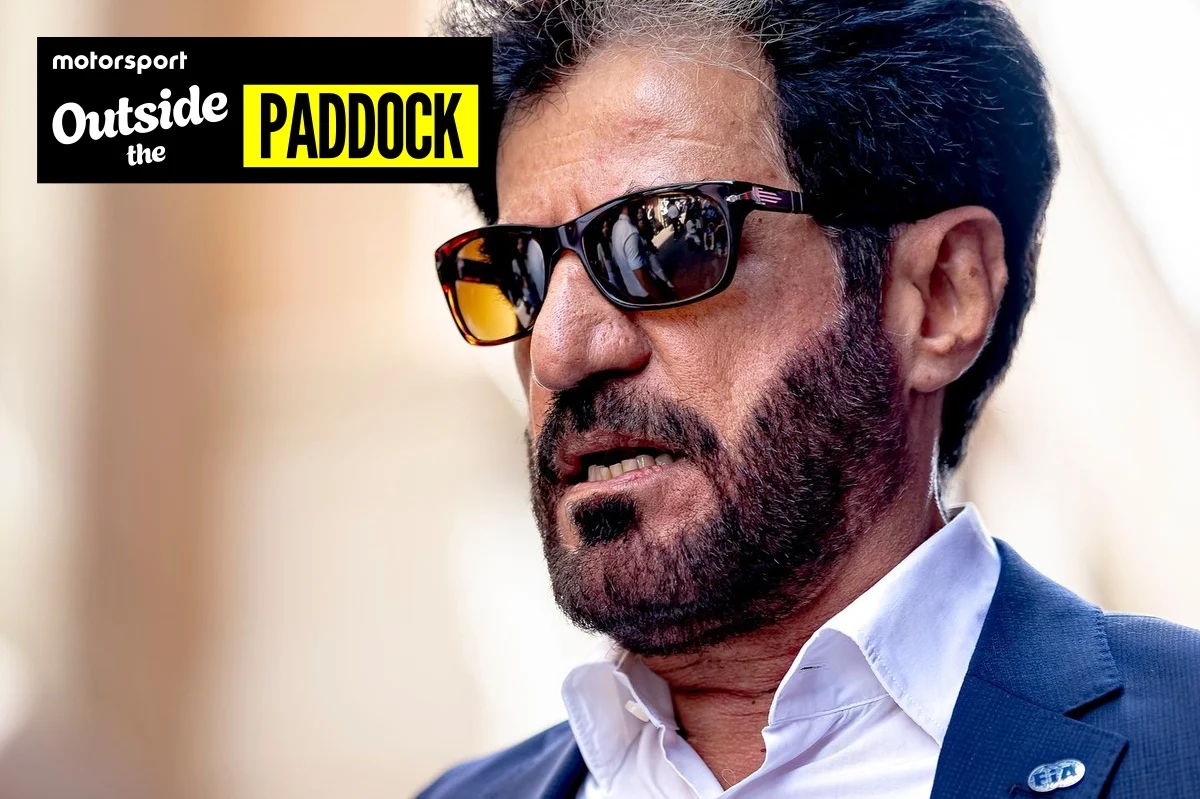
DOHA, Qatar — FIA President Mohammed Ben Sulayem has found himself at the center of a burgeoning controversy following an awkward and politically sensitive exchange with Formula 1 drivers George Russell and Lando Norris.
Captured on camera in the immediate aftermath of Saturday evening’s qualifying session at the Losail International Circuit, the FIA chief was filmed asking the two prominent Grand Prix drivers to compare the safety risks of visiting Qatar against those of Mexico and Brazil. The incident has since ignited a firestorm across global social media platforms, drawing sharp criticism from fans, pundits, and observers who have labeled the remark as insensitive, politically fraught, and unbecoming of the sport’s highest-ranking governing official.
The controversy underscores the delicate tightrope Formula 1 management and the Fédération Internationale de l’Automobile must walk as the sport continues its aggressive expansion into regions characterized by complex geopolitical dynamics, regional conflicts, and varying levels of security infrastructure.
Main Facts
The core of the controversy stems from a brief, unscripted, and awkward interaction that took place in the paddock area of the Losail International Circuit on Saturday evening.
Moments after the conclusion of a thrilling qualifying session for the Qatar Grand Prix—where Mercedes’ George Russell secured a stunning pole position, ahead of Kimi Antonelli in second and McLaren’s Lando Norris in third—FIA President Mohammed Ben Sulayem approached the drivers. Standing in close proximity to the podium contenders, Ben Sulayem posed a direct and politically loaded question:
"Which is more dangerous, being here or in Mexico, or Brazil?"
The query was met with immediate, palpable silence. Neither Russell nor Norris offered an answer, choosing instead to visibly distance themselves from the inquiry through non-verbal cues. Footage circulating widely online shows Russell flashing an awkward, tight-lipped smile while raising a hand defensively toward his face, whereas Norris immediately looks down at the ground, turning his body away to break eye contact.
The incident has since triggered widespread public condemnation. On platforms like X (formerly Twitter) and Reddit, users expressed astonishment at the remarks, with many calling for disciplinary action or the resignation of the FIA president, pointing to the underlying cultural and regional implications of contrasting Middle Eastern host nations with historically vibrant, yet occasionally crime-plagued, Latin American host countries.
Chronology of Events
To understand how the paddock arrived at this contentious moment, it is necessary to examine the timeline of events leading up to the Qatar Grand Prix weekend and the immediate fallout of the video’s release.
Saturday Evening: The Qualifying Fallout
- Post-Qualifying (Approx. 18:00 local time): Following the conclusion of the Qatar Grand Prix qualifying session, drivers gather in designated media and paddock zones. George Russell celebrates pole position for Mercedes, with Kimi Antonelli locking out the front row and Lando Norris securing third place for McLaren.
- The Exchange: FIA President Mohammed Ben Sulayem approaches Russell and Norris. In an impromptu remark caught by lingering broadcast and fan microphones, he asks the drivers to evaluate the relative dangers of Qatar compared to Mexico and Brazil.
- The Reaction: Both drivers freeze. Russell maintains an awkward smile and lifts a hand to his face while holding a beverage; Norris drops his gaze to the floor and physically turns away. The uncomfortable silence stretches on before the conversation naturally dissolves.
Digital Dissemination and Public Reaction
- Saturday Night: Video footage of the exchange is uploaded to social media. Within hours, clips accumulate millions of views across X, TikTok, and Reddit.
- Sunday Morning: Fan commentary reaches a fever pitch. Major motorsport forums and community boards fill with threads analyzing the drivers’ body language. Fans dissect the interaction frame-by-frame, noting how Russell attempted to stall with a sip of his drink to outlast the uncomfortable moment, while Norris visibly sought to distance himself from the conversation entirely.
- Post-Race Developments: As the Qatar Grand Prix weekend progresses toward its main-race conclusion, the incident threatens to overshadow the sporting action on the track, placing mounting pressure on the FIA communications team to address the growing public relations crisis.
Supporting Data: The Geopolitical and Logistical Backdrop of F1’s 2026 Calendar
The motivation behind Ben Sulayem’s curious comparison is deeply rooted in the severe logistical, security, and geopolitical anxieties that have plagued the Formula 1 calendar throughout the 2026 season. The sport’s administrative bodies have faced unprecedented challenges in securing safe passage for teams, personnel, and equipment across an increasingly volatile global landscape.
Middle Eastern Conflict and Calendar Instability
The final rounds of the 2026 FIA Formula One World Championship—specifically the destination double-header featuring Qatar and Abu Dhabi—were shrouded in uncertainty for several months due to escalating geopolitical tensions and ongoing armed conflicts in the Middle East.
- The Spring Cancellations: In April 2026, the structural fragility of the early-season Middle Eastern leg became starkly apparent when both the Bahrain Grand Prix and the Saudi Arabian Grand Prix were officially canceled due to heightened security threats in the region.
- The Sepang Contingency: To compensate for the loss of Bahrain, Formula 1 management orchestrated a logistical pivot, utilizing the Sepang International Circuit in Malaysia to host a replacement Bahrain Grand Prix event in October.
- Contingency Plans for the Finale: Internal paddock documents and regulatory discussions revealed that F1 organizers maintained serious contingency plans throughout the autumn. Had the security situation in the Persian Gulf deteriorated further, or if intelligence assessments deemed travel to Doha and Yas Island unviable, plans were prepared to relocate the season-ending races to the Autodromo Internazionale Enzo e Dino Ferrari in Imola, Italy.
Latin American Security Concerns
By contrasting Qatar with Mexico and Brazil, Ben Sulayem touched upon a longstanding, sensitive topic within the Formula 1 community: the persistent security challenges faced by teams and personnel during the Latin American leg of the championship.
- Historical Incidents in Brazil: The Autódromo José Carlos Pace in Interlagos, São Paulo, has frequently been the site of security breaches targeting F1 personnel. In past years, mechanics, engineers, and team media members have been subjected to armed robberies, carjackings, and targeted thefts outside the circuit perimeter, prompting strict security protocols, including unmarked team vans and heavy private security escorts.
- Logistical Realities in Mexico: Similarly, the Autódromo Hermanos Rodríguez in Mexico City presents immense crowd-control challenges. Team personnel regularly encounter aggressive fan behavior, logistical bottlenecks, and localized security threats that require heightened vigilance from local law enforcement and private security details.
By invoking these specific nations in a comparative safety metric, the FIA president inadvertently reopened debates regarding how the governing body evaluates risk, safety, and human rights across vastly different cultural, political, and geographical landscapes.
Official Responses and Stakeholder Silence
As of Sunday afternoon, neither the FIA nor Mohammed Ben Sulayem’s personal office has issued an official statement addressing the viral video or the specific wording of the question posed to Russell and Norris. Similarly, representatives for Mercedes-AMG Petronas F1 Team and McLaren Racing have declined to comment on the matter, likely seeking to insulate their drivers from regulatory blowback or political controversy during the heat of a championship weekend.
Motorsport insiders note that the silence from the governing body is standard operating procedure during high-stakes Grand Prix weekends, where attention is traditionally monopolized by on-track competition. However, public relations experts warn that letting the narrative stew online unchecked could inflict lasting damage on the perceived neutrality and professionalism of the FIA leadership.
The lack of immediate rebuttal has only served to amplify user-generated criticism across digital platforms. Independent racing commentators and motorsport journalists have noted that while private conversations among paddock insiders frequently touch upon the relative safety and logistical hurdles of various host countries, verbalizing such comparisons on camera—particularly in a manner that pits host nations against one another—represents a severe miscalculation in public diplomacy.
Broader Implications for Formula 1 and the FIA
The controversy surrounding Ben Sulayem’s remarks highlights several systemic issues facing modern Formula 1 as it balances commercial expansion, global diplomacy, and the safety of its travelling circus.
1. The Burden of Diplomacy on Drivers
Formula 1 drivers are increasingly placed in untenable positions where they are expected to navigate complex geopolitical, social, and cultural landscapes without offending host governments, commercial partners, or the sport’s governing bodies. The visible discomfort displayed by George Russell and Lando Norris illustrates the modern driver’s dilemma: how to remain professional and politically neutral while caught in the crosshairs of unscripted remarks from the sport’s most powerful figures.
2. Scrutiny Over Global Expansion
F1’s current calendar features a record 24 races, spanning authoritarian states in the Middle East, democratic nations with deep-seated infrastructural challenges, and traditional European heartlands. Each venue brings distinct risk profiles. Incidents like the one in Doha expose the underlying tensions of a sport that chases lucrative financial contracts in regions facing geopolitical instability, while simultaneously relying on traditional racing strongholds that present their own unique socioeconomic hurdles, such as urban crime in Latin America.
3. Leadership Accountability and Public Perception
The presidency of Mohammed Ben Sulayem has frequently courted controversy due to his outspoken nature, direct engagement with fans and media, and departures from traditional diplomatic norms established by his predecessors. Critics argue that the top official of motorsport’s governing body must maintain a higher standard of discretion, avoiding statements that can be construed as dismissive of a host nation’s security environment or derogatory toward the socio-political realities of developing racing markets like Mexico and Brazil.
As the 2026 Formula 1 season barrels toward its conclusion in Abu Dhabi, the fallout from the Losail paddock serves as a stark reminder that off-track commentary can carry just as much weight as on-track performance. Whether the FIA will issue a formal clarification or choose to let the digital storm pass remains to be seen, but the incident has undeniably left a sour note on an otherwise dramatic race weekend in Qatar.

 Jia Lissa

 Nana Wu

 Raul Delapena Setiawan
 Asep Darmawan

 Layla Zulfa
 Reynand Wu
 Evan Lee Salim