Basiran
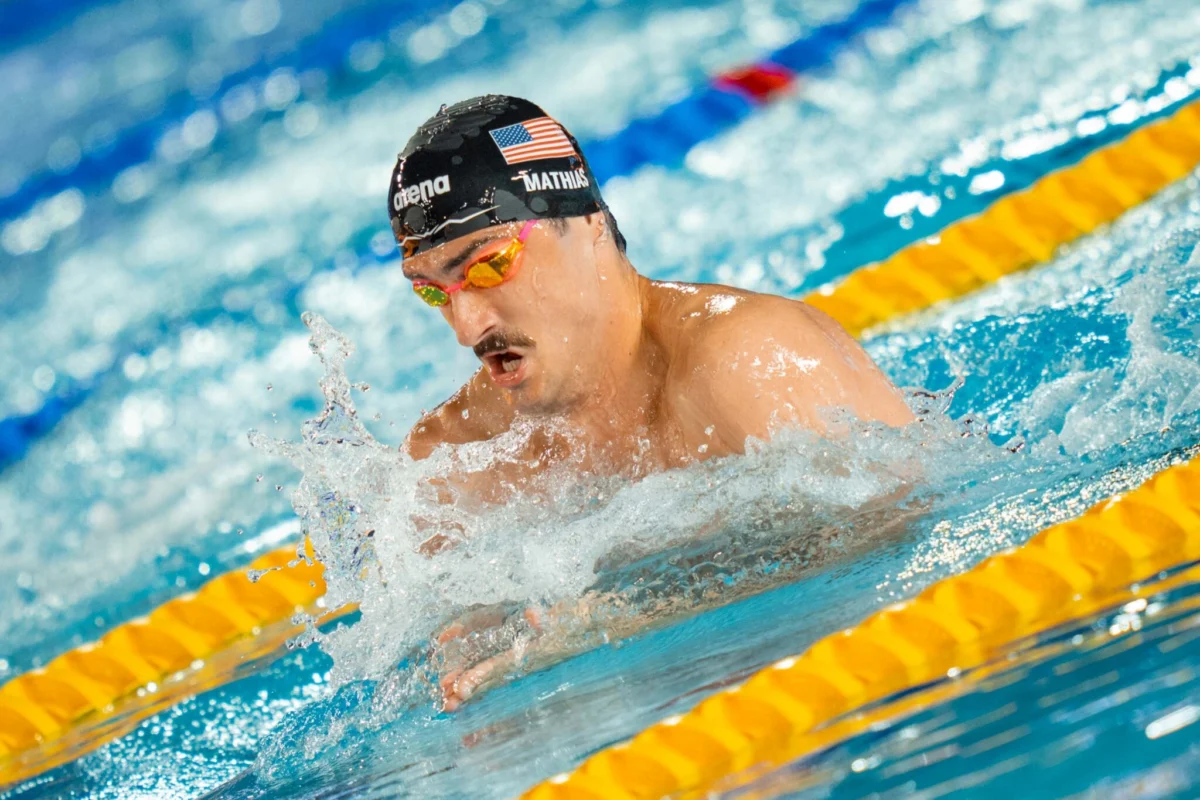
The atmosphere in Westmont, Illinois, reached a fever pitch on Day 2 of the 2026 U.S. Short Course World Championship Trials. As the pool deck transformed into a crucible of speed, the nation’s elite swimmers proved that the short-course format is not merely a training exercise, but a premier stage for rewriting the history books. With twelve high-stakes finals on the docket, the session delivered a masterclass in precision, intensity, and relentless athletic pursuit.
A Historic Opening: Records Fall in Rapid Succession
If Day 1 was a tactical prologue, Day 2 served as the explosive main act. The tone was set early, not just by the anticipation of watching stars like Gretchen Walsh and Kate Douglass, but by the tangible reality of records being dismantled.
The headline of the morning belonged to Van Mathias. Choosing to forgo the 50-meter freestyle in favor of the 100-meter breaststroke, Mathias executed a high-stakes pivot that yielded a historic payoff. Clocking a 55.48, Mathias secured both the American and U.S. Open records, signaling a seismic shift in the hierarchy of American breaststroke.
Simultaneously, the men’s 100-meter butterfly field pushed the limits of human performance. Tyler Ray, who emerged as a frontrunner during the morning prelims, equaled Noe Ponti’s U.S. Open record of 48.47. This performance propelled Ray to the top of the 2026 world rankings, setting the stage for one of the most anticipated finals of the meet.
The Men’s 100 Butterfly: A Fight for the Record Books
The evening’s session culminated in a dramatic showdown in the men’s 100-meter butterfly final. The race was a masterclass in pacing, with the middle four lanes separated by mere fractions of a second at the turn. Ilya Kharun, showing nerves of steel, blasted out to a 22.68 at the halfway mark, holding a razor-thin lead over a pack that included Luca Urlando, Tyler Ray, and the legendary American record holder, Caeleb Dressel.
The second 50 meters proved to be the decider. Kharun, maintaining a technical composure that belied his youth, unleashed a field-best 25.77 closing split. He touched the wall in 48.45, officially claiming the U.S. Open record for himself. For Kharun, the victory was more than just a time on the clock; it secured his maiden voyage representing the United States at a major international championship.
Tyler Ray, while unable to replicate his morning heroics, held strong for a 48.56 silver medal finish. In a testament to the depth of the field, Luca Urlando and Caeleb Dressel finished in a dead heat for third, both stopping the clock at 48.57.
Katharine Berkoff’s World-Record Masterpiece
While the men’s butterfly provided the tension, the women’s 50-meter backstroke provided the evening’s crowning achievement. Katharine Berkoff delivered a performance for the ages, storming to a 25.21 to establish a new world record.
This swim was particularly significant, as it eclipsed the 25.23 mark set by Olympic teammate Regan Smith two years prior. The intensity of the competition was palpable, as Claire Curzan—a standout for the Virginia Cavaliers—pushed Berkoff to the limit, finishing in 25.26. Curzan’s time was also well under the previous world record, underscoring the extraordinary level of competition present in Westmont.
Following the race, a composed Berkoff credited her success to technical discipline. "I felt that I executed the details—the start, the breakout, the turns, and the finish—much better than I did this morning," she noted. Her ability to translate technical adjustments into a world-record time serves as a blueprint for the high-performance culture currently dominating the U.S. swimming scene.
Chronology of Competition: A Packed Schedule
The scope of the trials is vast, encompassing a grueling 12-event final program that tests the endurance and versatility of every athlete. The session included:
- Men’s 100 Butterfly
- Women’s 50 Backstroke
- Men’s 200 Backstroke
- Women’s 200 Breaststroke
- Men’s 100 Breaststroke
- Women’s 400 Freestyle
- Men’s 400 Freestyle
- Women’s 50 Freestyle
- Men’s 50 Freestyle
- Women’s 200 Butterfly
- Women’s 100 IM
- Men’s 100 IM
This cadence of events demands not only physical recovery but immense mental fortitude. Athletes like Gretchen Walsh and Kate Douglass, who are managing multiple events, are effectively demonstrating the depth of their training and the maturity of their race-day strategies.
Implications for the 2026 Short Course World Championships
The performances in Westmont carry significant weight as the U.S. looks toward the upcoming Short Course World Championships. The emergence of new record-holders like Kharun and the continued dominance of veterans like Berkoff provides the coaching staff with a formidable roster.
Furthermore, the narrow margins in events like the men’s 100 butterfly—where four of the world’s best finished within 0.12 seconds of one another—demonstrate that the U.S. trials are arguably more competitive than the international meets themselves. The "Trial Effect," where the pressure of making the team drives swimmers to unprecedented speeds, is in full force.
For the swimmers, the implications are clear: there is no room for complacency. Even those who hold records find themselves in a precarious position, as the next generation of American talent continues to bridge the gap.
Strategic Depth and The Path Forward
The success of the 2026 Trials is a direct result of the evolution in training methodologies. Coaches are increasingly focusing on the "micro-details"—the underwater transitions, the efficiency of turns, and the precision of the final touch. As Berkoff’s post-race analysis highlighted, the difference between a national champion and a world-record holder is often found in the millimeters of the breakout or the milliseconds saved at the wall.
As the meet progresses, observers are keeping a close watch on how the endurance athletes handle the recovery process between the morning preliminaries and the evening finals. With the 400 freestyle and the 100 IM remaining on the schedule, the physical toll on the athletes will reach its peak.
Official Outlook
While the meet is still in its infancy, the U.S. delegation has sent a loud message to the global swimming community. The records set by Mathias, Ray, Kharun, and Berkoff are not anomalies; they are indicators of a broader upward trajectory.
The U.S. coaching staff remains optimistic, noting that the depth of the field is allowing for a higher standard of internal competition. By the time the final wall is touched in Westmont, the U.S. team will not only be battle-tested but likely the strongest contingent the nation has fielded in years for a short-course cycle.
As the competition continues, the focus shifts to the remaining events. With the momentum generated by the opening sessions, the expectations for the remainder of the meet have been recalibrated. The question is no longer whether more records will fall, but rather, who will be the next athlete to etch their name into the annals of swimming history.
The 2026 U.S. Short Course World Championship Trials in Westmont have proven to be a showcase of talent, technique, and the relentless pursuit of excellence. For the fans in the stands and the viewers at home, the message is clear: when the world’s best gather on the blocks, the impossible becomes routine. As we look toward the final days of the meet, one thing is certain—the speed in Illinois is only just beginning to reach its full potential.

 Nana Wu
 Layla Zulfa
 Ali Ikhwan
 Neng Nana
 Raul Delapena Setiawan

 Ammar Sabilarrohman