
 Iffa Jayyana
By Motorsport News Desk
The wheels of change are officially in motion for premier-class motorcycle racing. MotoGP has released its official calendar for the 2027 season, and it promises to be the most expansive, geographically diverse, and physically demanding championship in the storied history of the sport. Spanning an unprecedented 22 rounds across 19 countries, the 2027 schedule represents a paradigm shift for the series under its commercial leadership, blending high-profile street circuits, long-awaited returns to historic venues, and a strategic reshuffling of traditional dates.
Yet, alongside the excitement of global expansion, the 2027 blueprint arrives amid logistical re-evaluations, geopolitical realities, and significant venue shake-ups. Most notably, the legendary Phillip Island circuit loses its long-standing status as the home of the Australian Grand Prix, making way for a high-stakes, €60 million semi-urban project in Adelaide. Meanwhile, Hungary’s Balaton Park has vanished from the immediate horizon, replaced by the triumphant return of Buenos Aires.
As teams digest the grueling logistics of five double-headers and a punishing late-season triple-header, the paddock is preparing for a season that will test man and machine to their absolute limits.
Main Facts: A Landmark 22-Round Odyssey
The headline takeaway from the 2027 calendar is sheer scale. For the first time, the MotoGP world championship will consist of 22 Grands Prix, solidifying its status as a truly global motorsport spectacle.
Key highlights of the 2027 championship blueprint include:
- The Scale: 22 rounds visiting 19 distinct nations, cementing the most international schedule ever devised for the series.
- New Additions: The debut of a semi-urban circuit in Adelaide, Australia—taking over the country’s Grand Prix hosting rights from Phillip Island—and the return of Buenos Aires at the Autodromo Oscar y Juan Galvez, marking a comeback to Argentina’s capital after nearly three decades. These additions effectively absorb the space left by Hungary’s Balaton Park.
- The Calendar Architecture: The season features five strategic double-headers and one intense late-season triple-header.
- Middle East Adjustments: Qatar has been moved up significantly to Round 2, acting as an immediate back-to-back following the season opener in Thailand, driven heavily by regional security concerns and ongoing Middle Eastern geopolitical shifts.
- The Finale: Valencia will once again bring the curtain down on the championship campaign in late November.
The 2027 season is not merely about adding numbers to a spreadsheet; it represents a calculated commercial and sporting expansion orchestrated by Liberty Media and Dorna Sports. By breaking into metropolitan settings like Adelaide and returning to major South American hubs like Buenos Aires and Brazil, MotoGP is aggressively pursuing broader mainstream demographics.
Chronology and Geographic Flow: From Buriram to Valencia
Mapping out 22 races requires a masterclass in global logistics. The 2027 campaign kicks off on 7 March at the Chang International Circuit in Buriram, Thailand, exactly one month after the venue hosts the final pre-season winter tests.
The Early-Season Sprint
Mindful of ongoing geopolitical tensions and conflicts in the Middle East, Dorna has structured the opening rounds with swift transit in mind. Immediately following the Thai GP, the entire paddock will pack up and travel directly to Losail for the Qatar Grand Prix on 14 March, serving as Round 2. This rapid transition minimizes downtime and ensures the series clears the region efficiently before heading west.
After a brief, one-week breather, the championship crosses the globe for an intense American swing. Brazil hosts Round 3 on 4 April, followed closely by the historic return of Buenos Aires to the MotoGP calendar on 11 April at the Autodromo Oscar y Juan Galvez. The flyaway-heavy opening phase concludes at the Circuit of The Americas (COTA) in Austin, Texas, on 25 April.
The European Heart
The championship then returns to its traditional heartland for a massive European leg featuring 12 races between mid-May and early October.
The European swing begins slightly later than usual at Jerez for the Spanish Grand Prix on 9 May, shifting one week back from its traditional slot. From there, the paddock embarks on a relentless summer tour across iconic European tarmac:
- Le Mans (French GP): 16 May
- Mugello (Italian GP): 30 May
- Barcelona (Catalan GP): 13 June
- Assen (Dutch GP): 27 June
- Sachsenring (German GP): 11 July
- Brno (Czech GP): 18 July
- Silverstone (British GP): 15 August (following a summer break)
- Austria (Austrian GP): 29 August
- Misano (San Marino GP): 12 September
- Aragon (Aragon GP): 19 September
- Portimao (Portuguese GP): 3 October
Portimao serves as the temporary close for European competition, after which the teams load up their freight for a demanding overseas voyage.
The Asian-Oceanian Finale and Valencia
October introduces the most physically exhausting stretch of the 2027 season: the sport’s sole triple-header. The championship will roar through Japan (Motegi, 17 October), Malaysia (Sepang, 24 October), and Indonesia (Lombok, 31 October) in three consecutive weeks.

This Asian leg acts as a natural launchpad for the journey into Oceania. On 14 November, the Australian Grand Prix makes its historic debut at the new Adelaide circuit. Finally, the endurance test concludes back in Europe, with the traditional season finale taking place in Valencia, Spain, on 28 November.
Supporting Data: The 2027 MotoGP Calendar in Full
| Round | Date | Grand Prix | Location / Circuit |
|---|---|---|---|
| 1 | 7 March | Thai Grand Prix | Buriram, Thailand |
| 2 | 14 March | Qatar Grand Prix | Losail, Qatar |
| 3 | 4 April | Brazilian Grand Prix | Brazil |
| 4 | 11 April | Argentine Grand Prix | Buenos Aires, Argentina |
| 5 | 25 April | Americas Grand Prix | Austin, USA |
| 6 | 9 May | Spanish Grand Prix | Jerez, Spain |
| 7 | 16 May | French Grand Prix | Le Mans, France |
| 8 | 30 May | Italian Grand Prix | Mugello, Italy |
| 9 | 13 June | Catalan Grand Prix | Barcelona, Spain |
| 10 | 27 June | Dutch Grand Prix | Assen, Netherlands |
| 11 | 11 July | German Grand Prix | Sachsenring, Germany |
| 12 | 18 July | Czech Grand Prix | Brno, Czech Republic |
| 13 | 15 August | British Grand Prix | Silverstone, United Kingdom |
| 14 | 29 August | Austrian Grand Prix | Red Bull Ring, Austria |
| 15 | 12 September | San Marino Grand Prix | Misano, Italy |
| 16 | 19 September | Aragon Grand Prix | MotorLand Aragon, Spain |
| 17 | 3 October | Portuguese Grand Prix | Portimao, Portugal |
| 18 | 17 October | Japanese Grand Prix | Motegi, Japan |
| 19 | 24 October | Malaysian Grand Prix | Sepang, Malaysia |
| 20 | 31 October | Indonesian Grand Prix | Mandalika, Indonesia |
| 21 | 14 November | Australian Grand Prix | Adelaide, Australia |
| 22 | 28 November | Valencia Grand Prix | Valencia, Spain |
Official Responses and Context: The Shadow of Geopolitics and Venue Shifts
The release of the 2027 calendar does not exist in a vacuum; it is deeply intertwined with recent global disruptions and strategic corporate pivots.
A prime example is the ongoing uncertainty surrounding the tail-end of the current racing era. This year’s (contemporary) Qatar Grand Prix was originally pencilled in for April but faced a forced postponement due to the Iran conflict. While series organizers have maintained that the intention is to salvage the event in November of this year—pending security clearances and regional stabilizations—the 2027 schedule proactively accounts for potential volatility by moving Losail directly to the second round of the year, pairing it instantly with Thailand to streamline travel and mitigate regional risks.
Furthermore, the structural shift in Australia has sent shockwaves through the traditionalist fan base. For decades, Phillip Island has been revered by riders and fans alike as one of the most thrilling, high-speed coastal tracks on earth. However, the decision to shift the Australian Grand Prix to Adelaide—anchored by a €60 million semi-urban circuit project—signals a distinct new strategy.
Liberty Media, which holds significant influence over the commercial direction of top-tier motorsport, views semi-urban and city-integrated circuits as vital tools for accessibility, tourism integration, and global market penetration. The Adelaide project is explicitly viewed as a test case. If successful, organizers hope it will provide a blueprint for capturing the attention of major urban centers worldwide, mirroring the commercial strategies seen in other tier-one motorsport categories.
Simultaneously, the quiet removal of Hungary’s Balaton Park from immediate scheduling highlights the ruthless nature of modern circuit homologation and financial backing, opening the door for the triumphant return of Buenos Aires. The Autodromo Oscar y Juan Galvez last hosted the premier class nearly thirty years ago, and its reintroduction taps into South America’s ferocious passion for motorcycle racing, complementing the newly scheduled Brazilian round.
Implications: What a 22-Round Calendar Means for the Future of MotoGP
As teams, engineers, and riders parse through the 22-round itinerary, the implications for the sport are profound, stretching across physical endurance, technical reliability, and financial sustainability.
1. Paddock Burnout and Physical Toll
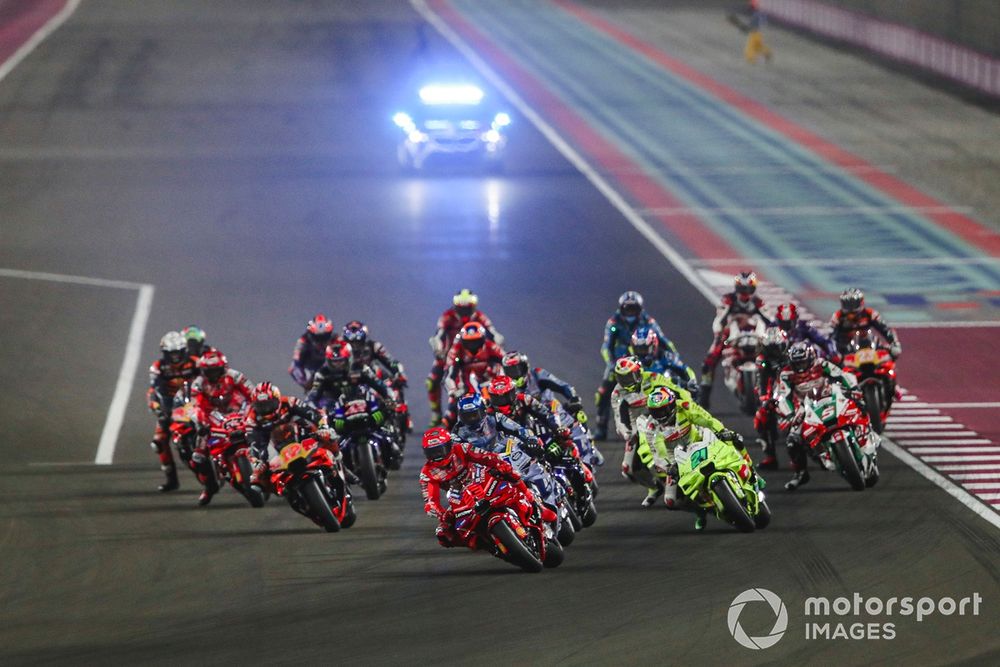
With 22 Grands Prix—each featuring a Sprint race on Saturday and a Grand Prix on Sunday—riders will face a staggering 44 competitive starts over the course of the year. When factoring in five double-headers and a brutal triple-header in Asia (Japan-Malaysia-Indonesia) late in the season, the physical and mental toll on the athletes cannot be overstated. Mechanics, hospitality staff, and media personnel will face a grueling travel schedule that pushes the limits of human endurance, prompting renewed discussions within the paddock regarding rotation policies and workload management.
2. Technical Reliability and Injury Management
In an era where bike performance is fiercely competitive, the margin for error is razor-thin. A 22-round season drastically increases the probability of crash-induced injuries and mechanical failures. Managing power unit allocations, aerodynamic upgrades, and spare parts across a globe-spanning calendar will stretch factory budgets and logistics teams to the maximum. Teams that can maintain deep squad depth and efficient recovery protocols will hold a distinct championship advantage.
3. The Commercial and Cultural Footprint
From a business perspective, 2027 is a watershed moment. By balancing traditional European strongholds (which still command 12 rounds) with high-value international destinations like Thailand, Qatar, Brazil, Argentina, Austin, Japan, Malaysia, Indonesia, and Adelaide, MotoGP is maximizing its television broadcast windows and commercial partnerships. The pivot toward metropolitan tracks like Adelaide suggests that the championship is actively seeking to modernize its fan acquisition funnel, bringing racing directly closer to population centers rather than relying solely on legacy rural circuits.
Ultimately, the 2027 MotoGP calendar is a high-stakes gamble on global growth. It sacrifices some of the romantic isolation of historic tracks like Phillip Island in exchange for urban spectacle and commercial muscle, while fiercely safeguarding logistical efficiency in an unpredictable geopolitical climate. Whether the grid can survive the physical gauntlet of 22 rounds intact will define the narrative of what promises to be a revolutionary era for motorcycle racing.


 Pevita Pearce
 Evan Lee Salim

 Neng Nana

 Nana Wu

 Lina Hope


 Sagoh