
 Iffa Jayyana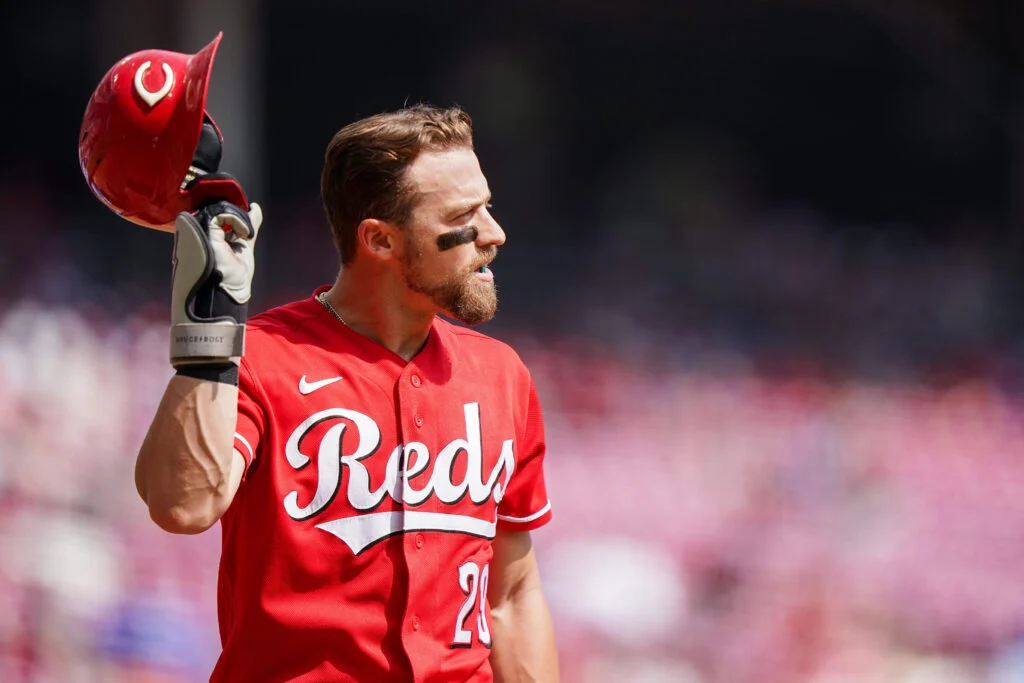
The Cincinnati Reds organization underwent a significant personnel shift this week, signaling both the end of a long-standing tenure for a former fan favorite and the preservation of a burgeoning superstar. On September 20, the club announced the selection of right-handed pitcher Carson Spiers’ contract from Triple-A Louisville, necessitating a corresponding move to clear space on the 40-man roster. That vacancy was filled by the designation for assignment (DFA) of outfielder TJ Friedl.
By September 22, the administrative dust had settled: Friedl successfully cleared waivers and accepted an outright assignment to the minors. This procedural move allows the veteran outfielder to collect the final week of his $3.8 million salary for the 2026 season before transitioning into minor league free agency this winter. Simultaneously, the Reds placed their breakout pitching sensation, Chase Burns, on the 15-day injured list with a right groin strain, effectively closing the book on a stellar individual campaign.
The Fall of a Fan Favorite: TJ Friedl’s Rocky Road
The departure of TJ Friedl marks a poignant chapter in recent Reds history. Signed as an undrafted free agent out of the University of Nevada in 2016, Friedl was long cited as a quintessential "scrappy" player, embodying the grit often associated with Cincinnati baseball.
A Rise and a Plateau
After a brief 36-plate appearance cameo in 2021, Friedl established himself as a reliable major league contributor in 2022. He posted a respectable .240/.314/.436 slash line, showcasing a disciplined approach with a 15.5% strikeout rate. The 2023 season, however, represented his absolute zenith. In 556 plate appearances, Friedl slashed .279/.352/.467, clubbed 18 home runs, and swiped 27 bases. His 117 wRC+ established him as the second-most effective hitter on the roster behind Spencer Steer, while his defensive metrics—highlighted by +6 Outs Above Average—cemented his status as a key piece of the Reds’ core. FanGraphs valued his 2023 output at 4.1 wins above replacement (WAR), a career-best performance.
The Underlying Warning Signs
Despite the 2023 success, advanced metrics provided a grim forecast. Friedl’s production was bolstered by a .308 BABIP, but his peripheral statistics were concerning. He consistently ranked in the 11th percentile or lower in average exit velocity, hard-hit percentage, and expected slugging. These figures suggested that his 2023 power output was an outlier rather than a sustainable baseline.
The decline arrived in 2024, exacerbated by a series of injuries. Between a right wrist fracture, a left thumb fracture, and a nagging right hamstring strain, Friedl struggled to find rhythm. His slugging percentage dipped to .380, and his wRC+ dropped to 93, leaving him 7% below the league-average hitter. While he managed a statistical bounce-back in 2025 with a 112 wRC+ and 3.1 WAR, his isolated power (ISO) plummeted to .117, confirming the loss of his slugging ability.
The 2026 Freefall
The 2026 season saw a total collapse of production. Despite remaining healthy for the duration of the campaign, Friedl posted a dismal .179/.259/.256 line. By June 3, his wRC+ sat at a staggering 44, leading to his first demotion to Triple-A since 2022. His return to the Majors in late June provided no spark, as he struggled to a 40 wRC+ over his final 94 plate appearances. With the Reds looking toward the future, the organization decided to cut ties, finalizing the DFA process this week.
Chase Burns: Protecting the Franchise Cornerstone
While the DFA of Friedl signals the end of an era, the placement of Chase Burns on the 15-day injured list is a calculated move to protect the future of the franchise.
A Statistical Masterclass
Burns’ 2026 campaign has been nothing short of spectacular. Through 154 1/3 innings, the 23-year-old registered a 2.86 ERA with a dominant 29.4% strikeout rate. Even with the limitations of a groin strain, his peripheral metrics remain elite, with an xERA of 3.24 and an fWAR of 4.3. By virtually every metric, Burns has established himself as the team’s legitimate ace, a status further underscored by the club’s $105 million, seven-year extension signed this past July.
Strategic Shutdown
The decision to place Burns on the IL is as much about logistics as it is about health. With the Reds effectively eliminated from postseason contention, the organization has no incentive to rush a core piece back onto the mound. By ending his season now, the team ensures he has ample time to recover from the groin strain and begin his offseason training program early. Following the devastating news last month that Hunter Greene will miss the entirety of the 2027 season due to Tommy John surgery, the Reds are viewing the preservation of Burns as a non-negotiable priority for their long-term competitiveness.
The Return of Carson Spiers
To fill the roster void created by the Burns move, the Reds have recalled right-hander Carson Spiers. Spiers enters the final stretch of the season with a complicated history. After undergoing elbow surgery last year, he spent the majority of 2026 on the minor league 60-day injured list.
Spiers’ career to date has been marked by inconsistency; from 2023-25, he logged 117 innings at the big-league level with a 5.69 ERA and a 19.3% strikeout rate. This call-up provides the Reds with a "look" at a player who is still finding his footing post-surgery, while also allowing the organization to evaluate his health and readiness for a potential depth role in the 2027 pitching staff.
Organizational Implications and Financial Outlook
The moves made this week reflect a broader organizational strategy as the Reds approach the off-season.
Financial Flexibility
Friedl’s departure provides a modicum of payroll clarity. By clearing him from the 40-man roster, the Reds essentially acknowledge that they are moving on from his arbitration-eligible salary. Because Friedl has over three years of service time, he possesses the right to reject an outright assignment to become a free agent immediately. However, doing so would require him to forfeit the remainder of his $3.8 million salary. By accepting the assignment, he opts for financial security through the end of the season.
It is widely expected that the Reds will non-tender Friedl once the season concludes. While there is a remote possibility of a reunion on a minor league "prove-it" deal, the current trajectory suggests both parties are moving toward a clean break.
Looking Toward 2027
The current state of the Reds roster is defined by a dichotomy: the uncertainty of the outfield and the necessity of elite pitching. With the loss of Hunter Greene for the coming year, the front office is likely to spend the winter months focused on building a rotation around the healthy, extended Chase Burns.
The front office’s decision to promote younger, experimental options like Spiers, while simultaneously purging underperforming veterans, indicates that the Reds are entering a period of recalibration. For the fans in Cincinnati, the end of the TJ Friedl era serves as a reminder that the window for any core group of players is fleeting. As the club looks toward 2027, the focus will undoubtedly be on the health of their young arms and the development of a new offensive identity to complement their established ace.
The 2026 season may be fading, but for the Reds, the work of rebuilding a contender has already begun in earnest.

 Evan Lee Salim
 Suro Senen
 Ali Ikhwan
 Jia Lissa
 Neng Nana
 Dwi Wanna