
 Nana Wu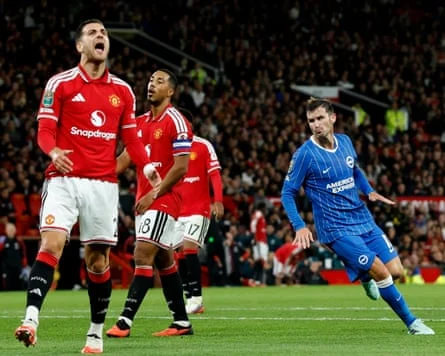
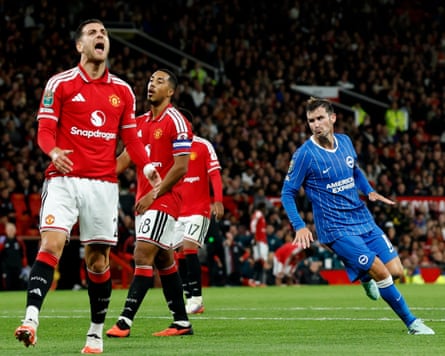
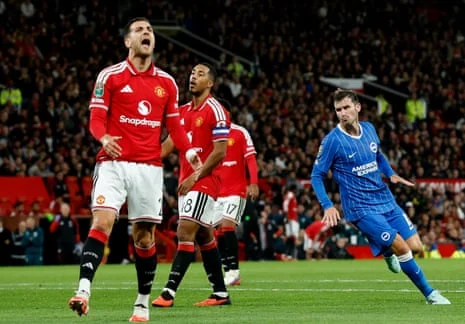
The walls are closing in on Michael Carrick. In the span of a grueling four-day period that will likely be remembered as the nadir of his tenure, Manchester United have suffered a sequence of body blows that threaten to derail their entire 2026/27 campaign. Following the heartbreak of a 199th derby defeat to Manchester City last weekend, the club was rocked by the revelation that JJ Gabriel—the crown jewel of their academy—has formally requested to leave. To cap off this disastrous week, United surrendered a two-goal lead at home to Brighton, crashing out of the Carabao Cup in a 3-2 defeat that has left the Old Trafford faithful reeling.
For a club of United’s stature, the defeat was more than just an early exit from a domestic cup competition; it was a symptom of a deeper, structural malaise. Having managed only four points from their opening twelve in the Premier League, the pressure on Carrick has transitioned from "background noise" to a deafening roar. With a vital league fixture against Fulham looming this Sunday, the margins for error have effectively evaporated.
A Tale of Two Halves: The Chronology of a Collapse
The evening at Old Trafford had begun with a deceptive promise. Seeking to channel the frustration of their controversial derby loss, United started with a ferocity that suggested a point to prove. Manager Michael Carrick, who had publicly criticized officiating decisions during the City match, looked to his squad to provide a response on the pitch.
The Early Ascendancy
The catalyst for optimism was 19-year-old Shea Lacey. Making his full debut, the youngster provided a moment of brilliance in the seventh minute. A slick buildup involving Benjamin Sesko’s hold-up play allowed Youri Tielemans to thread a pass to Lacey, who shimmied past Jaouen Hadjam before clinically firing beyond Jason Steele.
The momentum was palpable. Less than 120 seconds later, the advantage was doubled. Marcus Rashford, demonstrating the pace and directness that has been sporadically missing from his game, surged down the left flank. Though his initial effort was thwarted by the outstretched boot of Steele, the ball ricocheted kindly into the path of Mason Mount. The midfielder drove the ball home via the turf, netting his first goal for the club since December 2025. At 2-0, Old Trafford felt like a fortress restored.

The Turning Tide
However, Brighton, managed by the astute Fabian Hürzeler, refused to be intimidated by the atmosphere or the scoreline. As the first half drew to a close, cracks began to appear in the United rearguard. A long, diagonal ball from Hadjam exposed a slumbering defensive line, allowing Charalampos Kostoulas to break free and slide the ball through the legs of goalkeeper Karl Darlow.
The goal acted as a tonic for the visitors. While United attempted to dictate play in the second half, their control was brittle. A lack of clinical edge—evidenced by missed opportunities from Tielemans and Sesko—kept Brighton in the contest.
The Final Capitulation
The turning point came in the 69th minute. A botched clearance from Diogo Dalot landed at the feet of Luka Vuskovic, who teed up Brighton captain Pascal Gross. Gross, finding space with alarming ease, leveled the scores. The sucker punch followed moments later: a cross from Kostoulas deflected off the backside of Noussair Mazraoui, falling perfectly for Maxim De Cuyper to slot home the winner.
Desperation set in immediately. Carrick threw on Bruno Fernandes and Matheus Cunha in a bid to salvage the tie, but the team looked devoid of ideas. When Rashford found himself with a golden opportunity to force extra time in the dying embers, his strike found the chest of Jason Steele rather than the back of the net—a microcosm of a side currently lacking the composure required to win at the highest level.
The Weight of Expectation: Tactical and Internal Failures
The fallout from this defeat touches on every facet of the club’s current operation. Beyond the tactical failings on display—specifically the inability to manage a game state after establishing a two-goal lead—there is the looming shadow of the JJ Gabriel situation.
Gabriel, a player viewed as the future of the Manchester United midfield, has reportedly informed the club hierarchy that he sees his future elsewhere. This is not merely a transfer request; it is a signal of waning faith in the club’s long-term trajectory. If a player groomed in the United system no longer believes in the project, it becomes increasingly difficult for the manager to convince the squad that they are on the right path.
Furthermore, the inconsistency in recruitment and performance is stark. With only one win over Ipswich to their name this season, the squad appears to be suffering from a lack of identity. Whether this is a failure of coaching, a lack of squad depth, or a systemic cultural issue at the club, the results speak for themselves.
Supporting Data: A Statistical Snapshot
The numbers paint a grim picture for the Carrick era:
- Points Per Game: A dismal four points from four league matches.
- Cup Pedigree: Following last year’s early exits from both the Carabao Cup and the FA Cup, the club has failed to establish a winning momentum in secondary competitions for the second consecutive season.
- Goal Productivity: While individual flashes of brilliance—such as those from Lacey and Mount—provide hope, the team’s failure to "kill off" games remains a persistent, chronic issue.
- Recent Form: Brighton has remained a thorn in United’s side, having lost only one of their last five visits to Old Trafford, a record that underscores the tactical superiority the Seagulls have displayed in recent encounters.
Official Responses and Managerial Posture
Post-match, the mood in the Old Trafford tunnel was one of grim resignation. Michael Carrick, known for his composed demeanor, appeared visibly shaken by the nature of the collapse. While he has been quick to defend his players in the past, his post-match comments suggested a realization that time is running out.
"We controlled the game, we had the two-goal cushion, and we allowed them back into it through individual errors and a lack of concentration," Carrick noted. "At this level, you cannot afford to switch off. The responsibility lies with us to fix this, and we have to do it starting Sunday against Fulham."
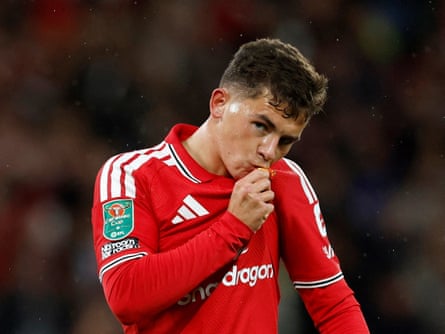
The club’s hierarchy, meanwhile, has remained largely silent, though sources suggest that the "internal review" of the squad’s performance is no longer a matter of ‘if’, but ‘when’. The departure of a talent like Gabriel, coupled with the early cup exit, has placed the board in a position where they may soon have to decide if Carrick is the man to lead this team through the winter months.
Implications: The Road Ahead
The road ahead is treacherous. If Manchester United fails to secure a convincing victory against Fulham this weekend, the international break—or even the immediate aftermath—could bring significant changes to the coaching staff.
The implications of this week extend beyond the league table. If the team continues to oscillate between moments of brilliance and collective defensive breakdowns, the club risks a lost season. The fans, who have been remarkably patient despite years of transitional football, are beginning to demand accountability.
Manchester United are a club defined by their history, but they are currently being defined by their inability to escape a cycle of mediocrity. The Carabao Cup exit is not just a lost trophy; it is a lost opportunity to build confidence. As the lights dimmed at Old Trafford on Tuesday night, the overwhelming sentiment was that the "dizzying blows" of the last four days may be the prelude to a much larger tremor.
The match against Fulham is no longer just a fixture; it is a referendum on the current regime. For Michael Carrick, the message is simple: improve, or face the consequences of a project that is rapidly running out of time.

 Reynand Wu
 Siti Muinah
 Dwi Wanna
 Lina Hope
 Jia Lissa
 Basiran