
 Ammar Sabilarrohman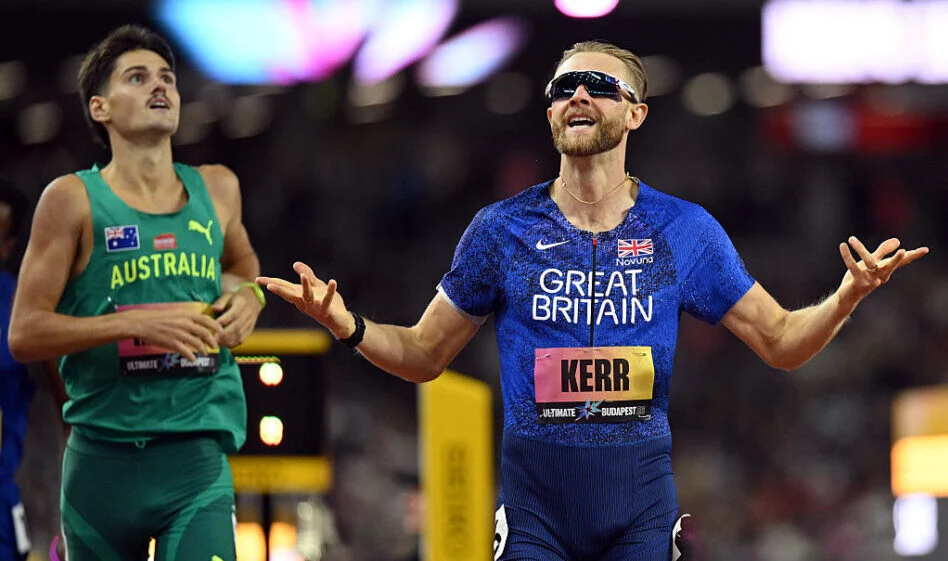
BUDAPEST — In a tactical masterclass that underscored his status as the premier middle-distance runner of his generation, Great Britain’s Josh Kerr delivered a commanding performance at the Ultimate Championship in Budapest. The 28-year-old Scot fended off a relentless challenge from Australia’s teenage sensation Cam Myers, claiming the 1500m title in 3:29.35 and putting a definitive exclamation point on a stellar, highly calculated 2026 campaign.
Kerr’s victory on the banks of the Danube was more than just another medal to add to his overflowing trophy cabinet; it was a vindication of a controversial scheduling philosophy. By prioritizing selective, high-impact racing over the grueling grind of the traditional Diamond League circuit, Kerr proved that absolute freshness and meticulous preparation can trump sheer racing volume.
As the dust settles on the global track and field calendar, Kerr’s triumph in the Hungarian capital serves as a defining moment for the sport, offering a glimpse into how elite athletes are redefining peak performance in the modern era.
Main Facts: A Tactical Masterpiece in Budapest
The men’s 1500m final at the Ultimate Championship was billed as one of the marquee showdowns of the athletics season, and it delivered on every front. Kerr crossed the finish line in 3:29.35, holding off a charging Cam Myers, who secured the silver medal in 3:29.68. The American duo of Hobbs Kessler and Cole Hocker rounded out the top four, clocking impressive times in a race that showcased the astonishing depth of contemporary middle-distance running.
Despite boasting a glittering resume that includes the 2023 world title on this very same track, Kerr’s sparse racing schedule played a humorous trick on the pre-race algorithms. Official championship "predictions" humorously ranked the reigning global force 13th in a 12-man field—a statistical anomaly born from his self-imposed exile from the European circuit following his early-summer exploits.
Yet, when the gun sounded, any doubts regarding Kerr’s sharpness were immediately dispelled. Navigating a congested pack through the early stages, the Scot relied on his veteran poise to stay out of trouble before launching a devastating kick over the final 200 meters.
"If it was slow and I was boxed in and needed to make a move at 800m, then to be honest, it was fine," Kerr reflected after the race. "I was very happy with my positioning. There was never a move I wasn’t able to cover. I was able to float my way up the back stretch. I can’t ask for more than that."
Chronology: From the US Training Blocks to the Home Straight
To fully appreciate Kerr’s victory in Budapest, one must trace the timeline of his remarkably lean 2026 season. Unlike many of his competitors who chased points across multiple continents, Kerr mapped out a campaign centered entirely around singular peaks.
The Summer Buildup
Kerr’s last competitive outing prior to Budapest came on August 1, when he secured the Commonwealth Games mile title in Glasgow with a commanding 3:54.12. Rather than capitalizing on that momentum with appearances at subsequent Diamond League meetings or the European Championships, Kerr made the bold decision to pack his bags and return to the United States.
Working closely with coach Danny Mackey and his training partners at the Brooks Beasts Track Club, Kerr spent weeks in intense isolation, focusing on foundational strength and speed endurance rather than race-day adrenaline.
The Budapest Final: Lap by Lap
When Kerr arrived in Budapest, his preparation was immediately tested by a tightly bunched field. Early pacing was erratic, causing the pack to compress and leaving the Brit momentarily boxed in during the middle laps. However, his trademark tactical awareness saved him.
By the bell lap, Kerr found clear air. He methodically made up ground down the back straight, matching strides with the elite field. As the race entered the final bend, Myers made a brave bid for glory, pushing the pace at the front. But Kerr, monitoring the stadium’s big screen to gauge the gap, maintained his composure.
As they hit the final 200 meters, Kerr engaged his finishing gear, drawing away mercilessly to cross the line first, leaving Myers to settle for silver and cementing a tactical masterclass.
Supporting Data: A Statistical Snapshot of Excellence
Kerr’s 2026 season is best understood through the lens of quality over quantity. Every time the Scot stepped onto the track this year, he made history or delivered a championship-winning performance:
- July 18, London: Kerr shattered expectations by clocking a world record in the mile at 3:42.66, while also setting a blistering 1500m personal best of 3:27.62 at the same meeting.
- August 1, Glasgow: Captured Commonwealth Games gold in the mile with a time of 3:54.12.
- Winter/Spring 2026: Added the world indoor 3000m title to his resume, alongside a notable personal best in the 800m on US soil.
- Budapest Ultimate Championship: Secured the 1500m crown in 3:29.35, leading a historically fast race where the minor podium placings and top five were tightly contested by Myers (3:29.68), Kessler, Hocker, and an astonishing fifth-place finish by America’s Yared Nuguse—who remarkably completed the race in 3:30.76 despite losing a shoe with 600 meters remaining.
Official Responses: In Their Own Words
Speaking to the media after his victory, Kerr was candid about the criticism he faced for skipping major summer meets in favor of targeted training blocks.
"Sometimes that happens at this time of year, and it might have to some guys today, but I didn’t kill myself on the circuit," Kerr said. "I’ve recouped and filled my cup up. It’s not what people love sometimes, and I’ve been bagged on by the media, but I’ve had a near-perfect year, so I’m happy."
Kerr was quick to clarify that his absence from events like the British Championships and European Championships was never intended as a snub to fans, but rather a necessary measure for long-term health and peak performance.
"I don’t want to disappoint the fans and people who pay money to come out and see me, but I never said I was doing Europeans or British Champs," he explained. "We ran a time trial last week that I was very happy with… and it was about pushing the barriers and not feeling empty with 350m to go."
Looking ahead, the newly crowned champion expressed relief at finally securing a proper offseason—a stark contrast to the physical toll he carried at the end of previous years.
"Danny Mackey is nice to me and gives me a good end-of-season break," Kerr said with a smile. "I’m going to enjoy it, as it’s not like I’m limping out of a stadium as I was last year. I’m going to enjoy the offseason with my wife and family as much as possible."
When asked about a brief interaction with arch-rival Jakob Ingebrigtsen—who opted out of the 1500m in Budapest after claiming the 5000m title two nights prior—Kerr kept his cards close to his chest.
"I’ll let you guys think about that one," Kerr teased regarding their conversation at the winners’ celebration. "He congratulated me and said ‘well done,’ and I said he was a great 5000m runner."
Implications: A New Era for Professional Athletics
Kerr’s victory in Budapest—and his outspoken endorsement of the Ultimate Championship format—highlights a shifting landscape in professional track and field. With lucrative prize purses and a race structure designed to pit the world’s best against each other without the interference of pacemakers, athletes are beginning to weigh traditional championship calendars against high-stakes, innovative commercial events.
"It’s a lot more money for sure," Kerr noted when assessing the value of the Ultimate Championship. "To have as many Americans, East Africans, Brits, etc., means it allows the best people to race each other without pacemakers. This is the best way to figure out the best runners."
Furthermore, the race in Budapest served as a broader showcase of middle-distance supremacy. In the men’s 800m, Algeria’s Djamel Sedjati delivered a breathtaking performance to claim his maiden global title, clocking 1:41.91 in a race where the first seven finishers all broke the 1:43 barrier. Sedjati’s victory—surging past Canada’s Marco Arop and Olympic champion Emmanuel Wanyonyi in the final 25 meters—further emphasized the extraordinary standard of racing witnessed in the Hungarian capital.
For Josh Kerr, however, the night belonged to the 1500m. By validating his training methods, silencing his critics, and defeating a world-class field on fresh legs, the Scot has set a formidable blueprint for success. As he heads into a well-earned winter hibernation, his rivals are left with a sobering realization: when Josh Kerr is healthy, focused, and fully rested, he is virtually untouchable.

 Nila Kartika Wati
 Lina Irawan
 Laily UPN
 Nana
Nana
 Lina Hope
 Evan Lee Salim
 Asro
Asro
 Ali Ikhwan