
 Iffa Jayyana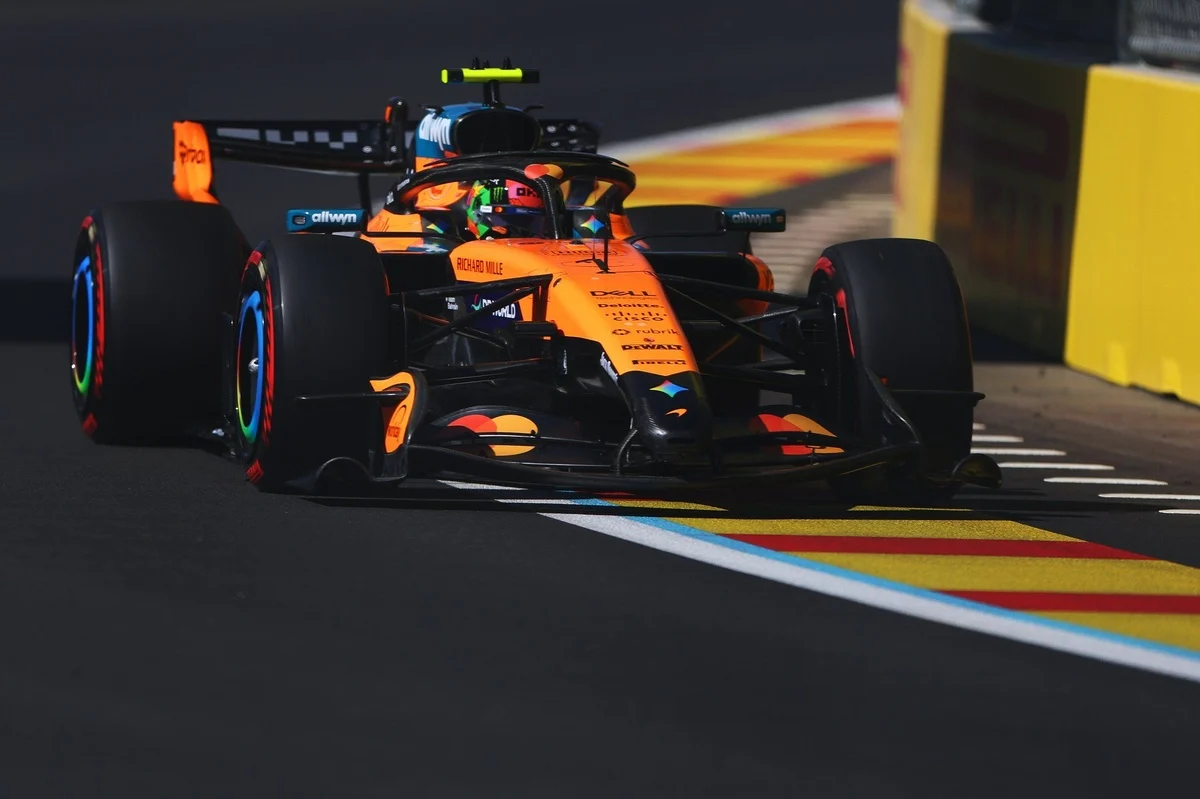
BARCELONA — In Formula 1, legends are rarely forged in comfort; they are carved out of the razor-thin margins between brilliance and disaster. At the Spanish Grand Prix, Lando Norris etched his name into the weekend’s headlines with a Saturday performance that defied both his machinery’s limitations and his own post-session self-assessment.
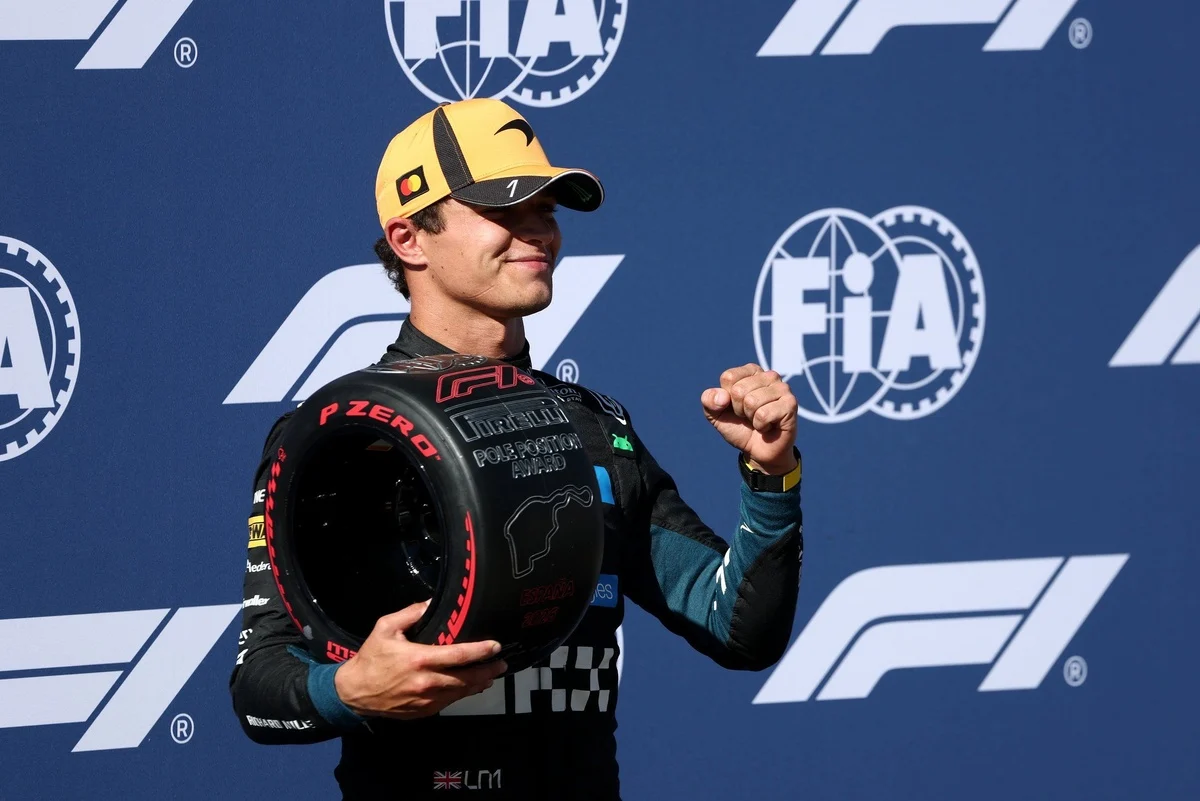
Snatching pole position by a microscopic 0.011 seconds ahead of Kimi Antonelli, the McLaren driver produced a qualifying lap that team principal Andrea Stella unhesitatingly labeled “a masterpiece.” Yet, the path to the top of the timesheets was anything but straightforward. It was a heart-stopping, ragged-edge triumph born of supreme driver commitment, mechanical bravery, and a mistake that almost cost him everything in the final seconds.
Main Facts: Defying the Odds at the Circuit de Barcelona-Catalunya
The overarching narrative of the Spanish Grand Prix qualifying session was simple: the McLaren MCL38 had no business sitting on pole. Throughout Friday practice and Saturday morning’s final preparations, the papaya-liveried cars lacked the definitive pace to challenge for the front row.
Mercedes had commanded the practice sessions, closely shadowed by Ferrari. As the knockout qualifying format progressed from Q1 into Q2, the Silver Arrows and Red Bull engaged in a familiar duel for supremacy, while McLaren hovered a stubborn couple of tenths adrift.
Against this backdrop, Norris’s pole position felt less like an expected outcome and more like an anomaly engineered by sheer willpower. Beating Antonelli by a mere 0.011 seconds, Norris secured a crucial psychological and strategic advantage for Sunday’s race, proving once again that a driver extracting every ounce of performance from an imperfect car can alter the competitive landscape. Meanwhile, his teammate, Oscar Piastri, struggled to find the same harmony with the chassis, qualifying down in seventh place, a notable 0.470 seconds behind the sister McLaren.
Chronology of Q3: From the Brink of Disaster to Elation
To understand the magnitude of Norris’s pole, one must trace the breathless, frantic evolution of Q3 at the Circuit de Barcelona-Catalunya.
When the top-ten shootout commenced, the initial runs offered little comfort to the British driver. As the dust settled on the first fliers, Norris found himself languishing in a disappointing sixth position, a sizeable 0.446 seconds away from the pacesetting Mercedes of Lewis Hamilton. The early advantage belonged to the competition, and the mathematical probability of a McLaren pole appeared remote.
What followed on the second and final run, however, was a seismic shift in pace. Norris unleashed a sensational sector-by-sector improvement, clawing back 0.701 seconds on his previous effort. The car came alive under his command, dancing across the curbs with surgical precision.

Yet, the pinnacle of high-stakes motorsport is rarely clean. Carrying immense speed into the final complex of corners, Norris over-rotated. He lost the rear end of his car momentarily on the entry to the sweeping final turn, sliding wide and bleeding roughly three-and-a-half tenths of a second in the final quarter of the lap alone.
Convinced that his momentary loss of control had ruined his chance at glory, Norris delivered an immediate, expletive-laden critique over the team radio.
“Sorry, I fucked up man,” Norris told his race engineer, Will Joseph.
When Joseph instructed him to wait on track as other cars completed their laps—hinting that a strong result might still be on the cards—a disbelieving Norris retorted, “Fucking idiot,” convinced his engineer was either misinformed or playing a cruel joke.
It took several moments in the cool-down room for the reality to sink in: despite the error, his breathtaking pace through the first two-thirds of the lap had done the damage. He was on pole.
Supporting Data & Telemetry: The Anatomy of a Flawed Perfection
The dichotomy of Norris’s pole-sitting lap lies in the telemetry data, which tells a story of staggering extremes. According to Andrea Stella—who boasts the perspective of analyzing telemetry data across roughly 450 Grands Prix—the lap was a unique study in metre-by-metre execution.
“The thing that makes the lap unique, when you look especially at the telemetry, is the precision, the braking, the speed you carry in entry, the striking of the kerb, the going on power,” Stella explained. “Everything is executed with a pretty unique level of precision. For me, that’s if anything the main attribute that I would associate to this lap: just incredible precision in the metre-by-metre execution.”
The data revealed that Norris was driving on an entirely different plane compared to his earlier runs, generating a lap time running roughly a full second faster than his standard baseline. However, that immense speed came with a heavy thermodynamic and mechanical tax.

Because Norris had extracted so much performance out of the Pirelli rubber earlier in the lap, the tires were severely depleted by the time he reached the final corner. Unaccustomed to managing tires operating at such an extreme threshold of exhaustion, Norris attacked the final turn with the same aggressive entry speed he had used on fresher tires earlier in the weekend. The result was snap oversteer, a blown racing line, and a self-inflicted time loss of over three tenths of a second.
Had he negotiated that final corner cleanly, Stella noted, the margin of victory would not have been a nerve-shredding 0.011 seconds, but a comfortable, resounding statement of dominance.
Official Responses: Inside the McLaren Garage
The reaction from the McLaren pit wall encapsulated the emotional rollercoaster of modern Formula 1.
Will Joseph’s calm reassurance over the radio stood in stark contrast to Norris’s self-flagellation. “It wasn’t your best final corner, but it’s still pole, so well done,” Joseph calmly told his driver, who spent several minutes questioning whether he was the butt of a team prank.
Addressing the media after the session, Norris offered a candid breakdown of the heart-stopping moments that defined his lap:
“By the last corner, I just had a bit of a, I don’t know, a little moment,” Norris reflected. “I think I got a bit excited in the car and I just overpushed the entry and, honestly, I thought I was in the wall. So, yeah, luckily a short run to Turn 1. But the lap really was just perfect, from good exits, good kerbs, just getting all the little things that are very important around here correct. And I did that only on my last lap and it all worked out.”
Andrea Stella expanded on the physical and mental mechanics behind the lap, emphasizing that the team simply did not possess the fastest car package on merit over the weekend.
“We were lacking quite significantly in the first sector, low-speed [corners] and kerbing, and for the drivers it was a very difficult car to nail a lap,” Stella admitted. He noted that while flashes of potential were visible during practice, stitching them together eluded the team until Q3.

Discussing Norris’s late error, Stella was quick to defend his driver’s aggressive philosophy:
“He just paid the price of the fact that the lap was coming, like, one second faster than any other lap, therefore there was quite a lot more that was extracted from the tyres… He oversteered in entry, and this means that he loses completely the racing line, and like I said, he lost more than three tenths. It’s nothing calculated; if anything, he’s not taking enough into account that the tyres were tired. I don’t think he knew [he was going to be in trouble]. I think he just was in attacking mode, but it was a bit too much for what the tyres had left.”
Implications: Setting the Stage for Race Day
As the dust settles on an electrifying Saturday qualifying session in Spain, the ramifications of Norris’s masterclass ripple across the paddock.
Securing pole position at the Circuit de Barcelona-Catalunya is traditionally a massive statistical advantage, given the circuit’s notoriously difficult overtaking nature and the relatively short run down to Turn 1. For McLaren, holding the premier grid slot provides a strategic shield against the relentless race pace of Mercedes, Ferrari, and Red Bull.
However, the team also faces internal questions. The significant performance delta between Norris and Oscar Piastri—who starts down in seventh—suggests that unlocking the razor-thin operating window of the MCL38 requires a driving style that remains deeply sensitive to setup and execution. While Norris was able to dance along the precipice of disaster and pull off the impossible, Piastri and the engineering crew will need to comb through the data overnight to find race pace consistency.
For Lando Norris himself, this pole position serves as a potent psychological milestone. To pull off a transcendent lap in a car that fundamentally lacked the pace of its rivals demonstrates a championship-caliber resilience. If he can convert Saturday’s breathtaking precision into Sunday race execution, the Spanish Grand Prix may well be remembered as the turning point where Norris transformed raw speed into undeniable dominance.

 Raul Delapena Setiawan
 Reynand Wu
 rifanmuazin
 Ali Ikhwan
 Dwi Wanna
 Laily UPN
 Ammar Sabilarrohman