
 Reynand Wu
AUSTIN, Texas — Formula 1 is a sport perpetually defined by the razor-thin margins between triumph and despair. Yet, rarely do those extremes manifest quite as visibly as they did beneath the Mercedes-AMG Petronas team awning on Sunday evening at the Circuit of the Americas (COTA).
If one were to walk down the central aisle of the Silver Arrows garage following the checkered flag at the United States Grand Prix, the atmosphere resembled a fractured timeline. On the left side, the air was thick with euphoria. Young sensation Andrea Kimi Antonelli was basking in the glow of a miraculous, masterclass driving performance, celebrating a dominant race victory that sent shockwaves through the paddock.
Just a few feet away, however, the mood was remarkably bleak. George Russell sat slumped in his engineering debrief room, visibly exasperated after a miserable afternoon that had been systematically dismantled by a combination of harsh officiating, a severe lack of mechanical grip, and a W15 chassis that simply refused to cooperate with his driving style.
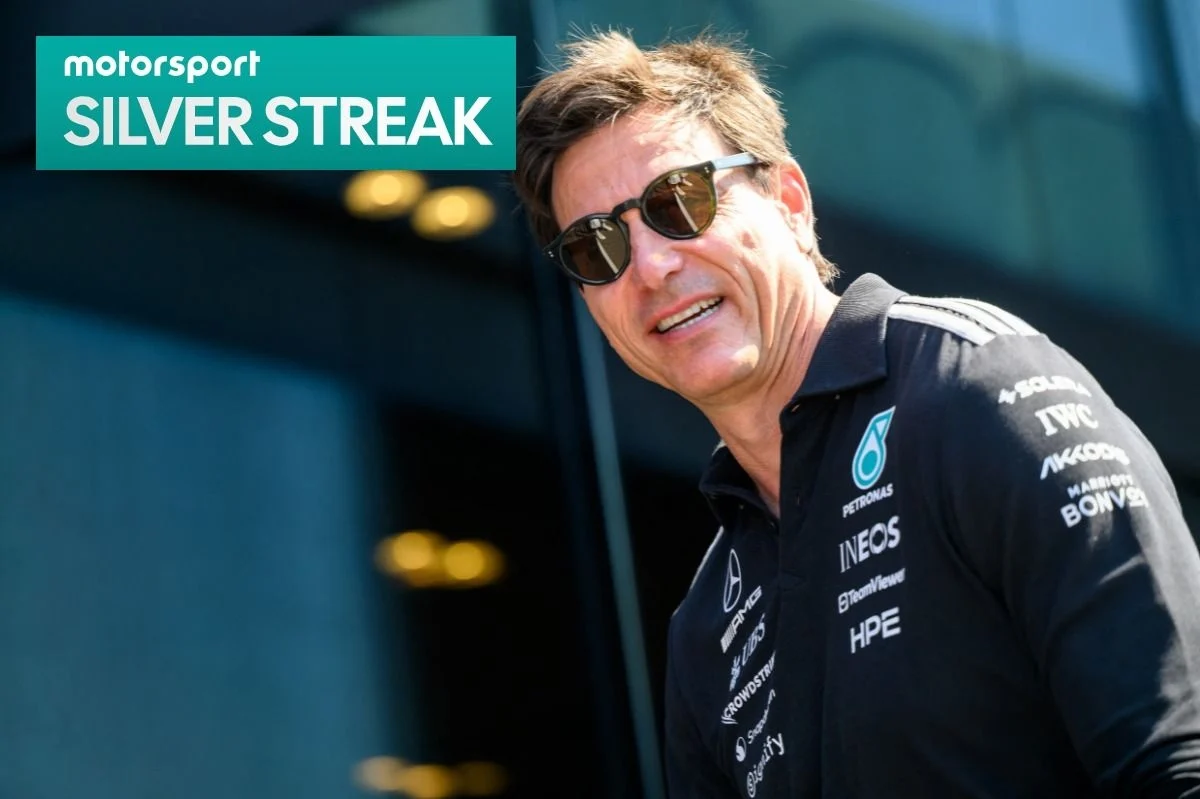
For Mercedes Team Principal Toto Wolff, the contrasting fortunes of his drivers present a fascinating psychological and engineering puzzle—one that he addressed with his trademark blunt honesty in the media pen following the race.
Main Facts: The Tale of Two Worlds in Texas
The story of Mercedes’ weekend in Austin cannot be told without highlighting the stark divergence in performance between the team’s two entries.
- The Victor: Andrea Kimi Antonelli delivered a sensational performance, showing poise, speed, and tactical maturity well beyond his years to secure a dominant victory. The rookie’s ability to command the race pace left seasoned engineers and rivals alike stunned.
- The Struggle: George Russell endured a nightmare campaign. Compounded by a controversial five-second time penalty assessed on the opening lap and a total absence of rear grip, the British driver struggled near the back of the competitive points-paying positions, looking entirely disconnected from the machinery beneath him.
- The Controversy: A contentious five-second penalty levied by the FIA stewards for leaving the track and gaining an advantage during the chaotic Turn 1 scramble severely hamstrung Russell’s race strategy before it could even properly unfold.
- The Leadership Stance: Toto Wolff stepped up to protect his driver, taking direct aim at the FIA stewards over the penalty while aggressively falling on his own sword, admitting that Mercedes’ engineering department is currently failing to provide Russell with a predictable, competitive tool.
Chronology of a Disastrous Sunday
To understand how Russell’s race unraveled, one must trace the timeline of events beginning from the extinguishing of the lights at COTA.
Lap 1: The Chaos and the Penalty
As the 20-car field thundered toward the steeply banked Turn 1—a notorious bottleneck at the Austin circuit—mid-pack jostling created immediate turbulence. Caught in the thick of the midfield melee, Russell was forced wide to avoid contact, taking his Mercedes across the run-off area.
While drivers frequently navigate evasive actions on opening laps under the unwritten "let them race" ethos of modern Formula 1 enforcement, the FIA stewards took a dim view. Within minutes, race control slapped Russell with a five-second time penalty for leaving the track and gaining an advantage.
The decision drew immediate criticism from pundits and team personnel alike, setting a frustrating tone for the remainder of Russell’s afternoon.
The Stint: Battling a Ghost Car
Serving the penalty at his first pit stop erased any early strategic gains, but the real issue ran far deeper than a five-second time loss: the car simply had no pace.
While Antonelli streaked away at the front of the field, managing his tires and dictating the tempo of the race, Russell was heard repeatedly over team radio complaining of unpredictable balance shifts, sudden snaps of oversteer, and an acute lack of traction out of COTA’s slower-speed technical complexes.
Lap by lap, the data confirmed his sensory feedback. The telemetry showed that Russell was losing tenths of a second in identical corners where his rookie teammate was seemingly defying physics. By the time the checkered flag waved, the psychological damage of being comprehensively outpaced in identical equipment weighed heavily on the former Grand Prix winner.
Supporting Data: Unpacking the Engineering Breakdown
The glaring disparity between Antonelli and Russell has forced Mercedes’ technical director and trackside engineers to pour over terabytes of data to find answers.
According to trackside engineering director Andrew Shovlin, the team’s most recent package of aerodynamic upgrades—introduced to extract maximum performance in high-speed corners—has inadvertently created an extraordinarily narrow operating window.
- The Setup Window: The W15 (or its current evolutionary iteration) requires an exact balance of ride heights, rake, and mechanical platform stiffness. Miss that window by even a millimeter or a couple of clicks on the anti-roll bar, and the car’s behavior transitions abruptly from stable to treacherous.
- Driving Style Clashes: Antonelli’s natural driving style appears more adaptable to the razor-thin limits of the current aero map, allowing him to lean heavily on the front end of the car. Russell, known for his methodical, precise technical feedback and preference for a stable rear platform, has found himself caught in a perpetual loop of under-rotation and sudden rear snap.
- Pace Deficit: Over a race distance in Austin, the delta between the two Mercedes garages was not measured in hundredths, but in chunks of time across entire stints—a statistical anomaly that points directly to setup and correlation issues rather than driver error.
Official Responses: Wolff Unleashed
Faced with probing questions from former F1 driver David Coulthard during his post-race media obligations, Toto Wolff did not attempt to mask the team’s internal struggles.
The conversation immediately zeroed in on the first-lap penalty, prompting Coulthard to query the logic of the stewards.
"One at the garage, celebration on the stage, on the garage, frustration," Coulthard remarked, setting the scene. "I think the five-second penalty was, I’m not sure what they were smoking. This was racing on the first lap. So hopefully that gets spoken to the stewards about."
Without missing a beat, Wolff delivered a deadpan response that drew chuckles from the media pen:

"It’s legal here to smoke, you know."
"Yeah, that’s maybe what they’ve been doing," Coulthard laughed back, before steering the conversation toward the more critical issue: how Mercedes plans to handle a premier driver who is currently struggling to extract performance from his car.
Shifting from humor to absolute seriousness, Wolff fiercely defended Russell’s caliber while accepting full accountability for the engineering shortcomings at Brackley and Brixworth.
"I mean, on the other side with George, we have a champion. We have someone that has it all, but he’s not clicking with the car," Wolff explained candidly. "And we need to find out why that is, because it’s not satisfying for us to see someone that walks on water on the other side of the garage, and a guy who, with all his ability, not being able to extract the performance out of the car."
Rather than pointing fingers at the cockpit, Wolff placed the burden squarely back onto the pit wall and the factory drawing boards.
"And this is on us, and we’re just together," he concluded.
Implications: The Road Ahead for Mercedes
The events of the United States Grand Prix carry profound implications for the Silver Arrows as the season enters its final stretch.
- Internal Dynamics: Managing a team with two drivers operating at completely different ends of the confidence spectrum is one of the toughest challenges a team principal can face. Russell’s mental fortitude will be tested as he works alongside a surging rookie who has proven he can win on any given Sunday.
- Development Direction: Mercedes must carefully evaluate their upgrade path. If updates are creating a setup window so narrow that a world-class driver like Russell cannot find a comfortable baseline, the team risks destabilizing their car development ahead of major upcoming regulatory shifts.
- The FIA Dialogue: Wolff’s sharp critique of the stewards highlights a broader, ongoing paddock frustration regarding inconsistent first-lap penalty applications. Expect Mercedes to formally raise the Austin incident in upcoming team-manager briefings with race control.
Ultimately, Antonelli’s victory serves as a brilliant beacon of hope for Mercedes’ future, proving that their machinery is capable of winning at the highest level. However, until the engineering squad can bridge the telemetry gap and unlock the setup keys for George Russell, the celebration in one half of the Mercedes garage will continue to be tempered by quiet frustration in the other.

 Ali Ikhwan
 Asro
 Muslim
 Neng Nana