
 Suro Senen

In a night defined by clinical precision and defensive frailties, Barcelona asserted their dominance in the Champions League, securing a resounding 3-0 victory over Aston Villa at the iconic, albeit under-renovation, Camp Nou. Raphinha proved the architect of the Catalan triumph, while Unai Emery’s side suffered from the consequences of their own insistence on playing out from the back.
Main Facts: The Night in Numbers
The encounter on Tuesday, November 3, 2026, was billed as a litmus test for Unai Emery’s burgeoning Aston Villa side. Instead, it became a demonstration of why Barcelona remains a formidable force in European football. Lamine Yamal opened the scoring in the 7th minute, setting the tone for an evening where the hosts capitalized on Villa’s high-risk strategy.
Raphinha, arguably the man of the match, struck twice—once in the 52nd minute and again in the 64th—to put the result beyond doubt. The victory leaves Barcelona comfortably positioned in the league phase table, while Villa, who had entered the match with a perfect three-from-three record in the competition, must now reflect on the dangers of over-committing in their own defensive third.

Chronology: How the Match Unfolded
The Early Shock
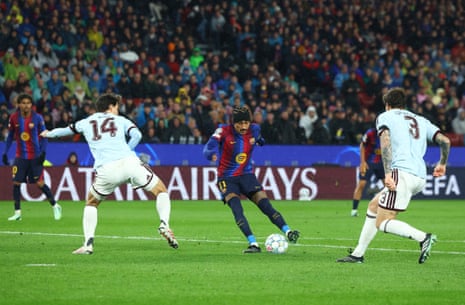
The match began with a palpable sense of anticipation. However, the atmosphere inside the Camp Nou shifted in just the seventh minute. A lapse in concentration at the back, coupled with an ill-advised attempt to play out from the defensive line, gifted the ball to Barcelona. Lamine Yamal, displaying the composure of a veteran, capitalized on the chaos to slot home the opening goal. The goal was a microcosm of Villa’s struggles throughout the night: a willingness to play progressive football that was repeatedly punished by Barcelona’s relentless, high-intensity press.
The Mid-Match Stalemate
Following the goal, the game settled into a fascinating tactical battle. Aston Villa did not fold; in fact, they produced several moments of genuine threat. Nicolas Jackson found himself in acres of space on multiple occasions, testing the Barcelona high line, only to be thwarted by the agility of goalkeeper Joan García. The visitors managed to maintain possession, yet they were consistently undone by the individual brilliance of the Barcelona front three. By the time referee Davide Massa blew for half-time, the score remained 1-0, with both sides looking capable of finding the net again.
The Second Half Collapse
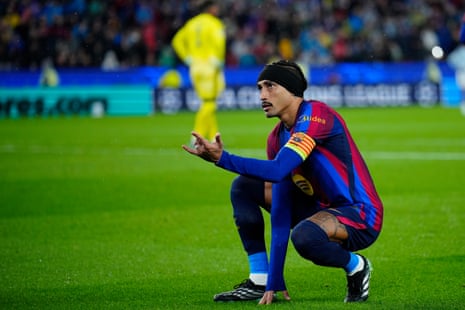
The second half saw Barcelona shift gears. The introduction of Marc Bernal for Rodri suggested a tactical shift toward ball retention, but the hosts remained clinical in the final third. In the 52nd minute, Raphinha doubled the lead, finishing a crisp move that left the Villa back line scrambling.

Just 12 minutes later, the Brazilian winger struck again. This time, it was a piece of pure artistry; João Cancelo, exploiting the space down the left flank, delivered a spectacular pass with the outside of his boot. Raphinha met the delivery with an unerring run into the six-yard box, hammering the ball into the corner. At 3-0, the game was effectively over. Despite a triple substitution from Emery—bringing on Mbaye, Barkley, and Goretzka—the spark of a comeback never materialized.
Supporting Data: Tactical Analysis
The statistics tell the story of a match where efficiency trumped possession. While Villa saw a fair share of the ball, their inability to handle the pressure in their own half was fatal.
- Lamine Yamal’s Influence: The youngster was a constant thorn in the side of Ian Maatsen. His ability to create from the right wing forced Villa to pull players out of position, opening gaps for Raphinha and the midfield runners.
- Defensive Risks: Villa’s goalkeeper, Suzuki, was the focal point of criticism. His persistence in playing short passes under immense pressure became a source of anxiety for the traveling supporters. Multiple interceptions by Barcelona inside the final third were direct results of this high-risk strategy.
- The Midfield Battle: The withdrawal of Rodri at halftime was a significant moment. While some speculated it might offer Villa a route back into the game, Barcelona’s control in the center of the park remained largely undisturbed by the substitution.
Official Responses and Managerial Sentiment
Post-match, the mood in the respective camps was one of resignation for the visitors and quiet confidence for the hosts. Unai Emery, visibly frustrated during the match, acknowledged the difficulty of competing against a side of Barcelona’s pedigree when basic errors are committed.
"We wanted to play our game, but at this level, mistakes are magnified," Emery noted in the post-match press conference. "We showed courage, but we lacked the necessary precision to stop a team that thrives on transition."
Hansi Flick, the Barcelona manager, praised the discipline of his squad. "We knew their system. We knew that if we pressured the backline, they would eventually offer us an opening. The boys executed the plan to perfection."
The match also saw a rare moment of camaraderie amidst the intensity, as both managers recognized the tactical evolution of their respective teams. However, for Villa, the focus now turns to internal reviews regarding their defensive philosophy—specifically, the "playing out from the back" mandate that has caused so much friction this season.
Implications: The Road Ahead
This defeat serves as a sobering reality check for Aston Villa’s Champions League ambitions. While their performance showed glimpses of the form that earned them three straight wins, the tactical inflexibility displayed at the Camp Nou will be a concern for their coaching staff.
For Barcelona, the win reinforces their status as genuine contenders for the title. With Raphinha in such scintillating form—registering his 18th goal of the season—and the continued emergence of Lamine Yamal, the Catalan side appears to have found a balance between defensive solidity and attacking flair.
The Wider Context
The result also reverberates through the European landscape. With other English clubs, such as Manchester United, suffering their own crises in the Champions League, the pressure is mounting for teams to adapt to the high-pressing systems favored by the continent’s elite.
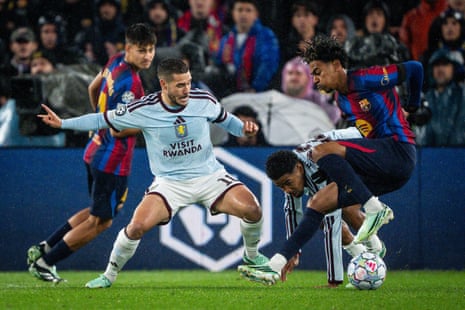
Furthermore, the backdrop of the match—the ongoing renovations at the Camp Nou and the surrounding noise of domestic football politics—seemed to have little effect on the players. The atmosphere, characterized by the sea of rain ponchos in the stands, served as a reminder of the resilience of football, even in the face of structural or organizational challenges.
As the Champions League moves deeper into the group stages, both teams face a defining month. Barcelona will look to build on this momentum, while Aston Villa must regroup. Whether this result forces Emery to abandon his preferred defensive style remains to be seen, but one thing is certain: the lessons learned on this humid November night in Catalonia will be debated in the boardrooms and locker rooms of Birmingham for weeks to come.
Final Reflections
The scoreline may read 3-0, but the narrative is far more nuanced. It was a game of "what-ifs" for the visitors, and a game of "what-is" for the hosts. Barcelona is currently exactly what they claim to be: a team capable of tearing apart even the most organized opponents with a blend of youthful exuberance and experienced ruthlessness. For Aston Villa, the challenge is now to ensure that this heavy defeat is a footnote in their season, rather than the start of a downward trajectory. As the final whistle blew, the echo of the Camp Nou crowd was clear: this is the level of football they expect, and tonight, they were treated to a masterclass.

 Neng Nana
 Dwi Wanna

 Lina Irawan

 rifanmuazin

 Siti Muinah

 Layla Zulfa