
 Ammar Sabilarrohman
FRANKFURT — On a damp and blustery Sunday in late October, the 43rd edition of the Mainova Frankfurt Marathon delivered an extraordinary chapter in the storied history of Germany’s oldest city marathon. Despite persistent rain and gusting winds that effectively neutralized any ambitions of world records, the race provided relentless drama, tactical masterclasses, and historic milestones.
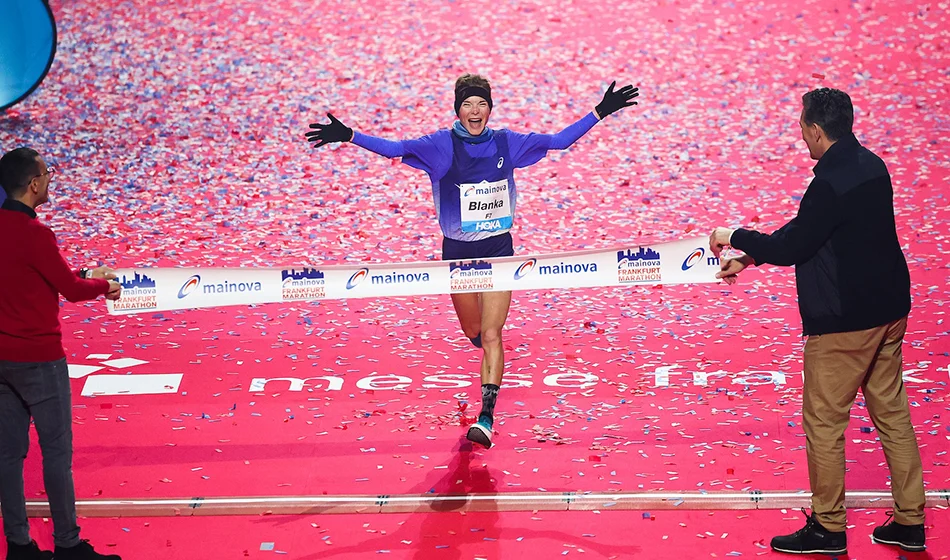
Ethiopia’s Jirata Dinki and Zeineba Yimer etched their names into the winner’s circle, capturing the men’s and women’s titles with disciplined and resilient performances in times of 2:05:26 and 2:19:45, respectively. Yet, the emotional heartbeat of the race belonged to the host nation. Local heroes Blanka Dörfel and Amanal Petros produced scintillating, podium-finishing runs that electrified the rain-soaked crowds lining the streets and filling the majestic Festhalle finish line.
Beyond the athletic achievements, the 2025 event marked the end of an era for the German road-running institution, serving as the emotional farewell race for long-serving race director Jo Schindler after a quarter-century at the helm. With a record-breaking 19,720 runners from 128 nations toeing the starting line, Frankfurt once again solidified its reputation as one of the world’s premier, fast-course autumn marathons, even when Mother Nature refused to cooperate.
Main Facts: Conquering the Rain and Wind
The headline narrative of the 43rd Mainova Frankfurt Marathon was twofold: the tactical supremacy of the East African contingents and the phenomenal, breakthrough performances delivered by German distance running.
In the women’s elite race, Ethiopia’s Zeineba Yimer lived up to her billing as the pre-race favorite. The 28-year-old orchestrated a commanding wire-to-wire campaign, ultimately clocking 2:19:45. Her time not only secured the gold but also stands as the sixth-fastest women’s mark in the history of the Frankfurt race. However, the performance of the day—and arguably the surprise of the entire weekend—came from 24-year-old German debutante Blanka Dörfel. Running entirely without the guidance of a GPS watch, Dörfel leaned purely into instinct and physical sensations to carve out a sensational 2:20:46. Her runner-up finish instantly catapulted her into the history books as the second-fastest German woman ever over the marathon distance and the eighth-fastest European woman in history.
In the men’s division, the race culminated in a tactical duel that ultimately favored Ethiopia’s Jirata Dinki. Clocking 2:05:26, Dinki seized the victory in only the third marathon of his career, showcasing remarkable poise under pressure. Germany’s Amanal Petros, who entered the race with designs on breaking his own national record, pushed the pace aggressively before ultimately settling for second place in 2:05:46—just 20 seconds adrift of Dinki. By claiming the runner-up spot, Petros achieved a historic milestone: he became the first German man to land on the Frankfurt podium in over 25 years. Defending champion Benard Biwott of Kenya rounded out the men’s podium, taking third in 2:06:23.
Chronology of the Race: From Early Ambitions to Hard-Fought Finishes
The Men’s Race: A High-Stakes Battle of Attrition
From the opening gun, the men’s elite lead pack signaled aggressive intentions. Paced by strong early splits, the group was right on track to challenge the German national record of 2:04:03, held by European championship silver medalist Amanal Petros. Petros, alongside compatriots Samuel Fitwi and Richard Ringer, intended to dictate a blistering tempo.
The weather, however, had other plans. As the rain intensified and puddles accumulated along the asphalt, maintaining the record pace proved unsustainable. The lead pack passed the 10-kilometer mark in 29:55 and reached the halfway point in a cautious 1:03:01.
As the race entered its latter stages, the attrition rate climbed. With roughly 10 kilometers remaining, Petros and Kenya’s Benard Biwott injected a surge of pace, successfully splintering the lead group. Samuel Fitwi began to struggle with acute muscle problems and steadily drifted backward, while 2022 European champion Richard Ringer could not bridge the gap to the front-runners.
Quietly biding his time was 24-year-old Jirata Dinki. Armed with a pre-race personal best of 2:08:18, Dinki systematically closed the deficit, latching onto Petros and Biwott around the 37-kilometer mark. Sensing danger, Petros unleashed a fierce counter-attack with just over two kilometers remaining. While the surge successfully shook off Biwott, Dinki responded with remarkable tenacity. Capitalizing on Petros’s fatigue—compounded by his grueling preparations at the European Championships just two and a half months prior—Dinki swept past the German and strode home unchallenged to claim victory.
The Women’s Race: Yimer’s Grit and Dörfel’s Intuitive Flight
The women’s race unfolded as a masterclass in front-running fortitude. Zeineba Yimer assumed control immediately, joined in the early stages by compatriot Siranesh Yirga. The relentless pace and heavy rain began to take a toll as the kilometers ticked by. Yirga finally cracked just past the 30-kilometer mark, leaving Yimer to battle the elements—and mounting physical fatigue—alone through the final grueling stretches.
While Yimer was grinding out her victory at the front, a sensational drama was unfolding just behind her. Blanka Dörfel was orchestrating a tactical masterpiece of her own. Running with an effortless, fluid stride, Dörfel detached herself from a competitive chase pack of ten runners. She cruised through the halfway mark in 1:05-territory (specifically 70:29) and methodically reeled in seasoned international contenders, including American veteran Betsy Saina and Kenya’s Marion Kibor.
By the 33-kilometer mark, Dörfel had surged into second place. Propelled by the roaring crowds, she steadily closed the gap on the leaders, maintaining such ferocious momentum that spectators momentarily wondered if a sub-2:20 shock was on the cards. Though she ultimately fell just short of that barrier, her time of 2:20:46 on debut left the athletics world in awe.
Supporting Data & Official Results
The adverse meteorological conditions—marked by saturated roads and persistent headwinds—prevented course records, yet the depth of the fields remained deeply impressive.
Official Podium Results
Men’s Elite Division:
- Jirata Dinki (ETH) – 2:05:26
- Amanal Petros (GER) – 2:05:46
- Benard Biwott (KEN) – 2:06:23
Selected Finishers: - Richard Ringer (GER) – 2:07:07
- Samuel Fitwi (GER) – 2:08:57
Women’s Elite Division:
- Zeineba Yimer (ETH) – 2:19:45
- Blanka Dörfel (GER) – 2:20:46
- Beriha Gebreslasie (ETH) – 2:22:46
Official Responses and Reflections
The post-race press conferences offered profound insights into the psychological and physical landscapes navigated by the elite athletes.
For Zeineba Yimer, the victory was deeply satisfying despite the meteorological hurdles. "I was hoping I would win," Yimer reflected, wiping away the rain from her face. "The weather was not on our side. The rain slowed me down significantly in the latter stages, but I am very happy with my overall performance and how I managed to close out the race."
Blanka Dörfel provided one of the most endearing and unconventional post-race debriefs of the athletic season. Revealing that she ran the entire 42.195 kilometers without a timepiece, Dörfel explained: "I ran without a watch, exactly as I do in training, going purely by how my body felt rather than staring at splits. It was always a bit of a mystery to me what time I could actually achieve. It wasn’t until I crossed the threshold into the Festhalle that I saw the 2:20 clock and realized just how fast I had gone."
Detailing the physical toll, she added: "The wet course was a massive challenge—I ended up with my feet submerged in water plenty of times. I felt incredible right up to the half-marathon mark, but after that, it got progressively tougher. The last five kilometers were really hard for me, but the crowd was brilliant. Hearing so many people shouting ‘Blanka, run!’ carried me through. It has been a brilliant day."
Amanal Petros was pragmatic yet analytical regarding his runner-up finish, reflecting on his aggressive tactics and the demanding calendar he has maintained. "I hadn’t reckoned with [Dinki]," admitted Petros, whose time of 2:05:46 stands as by far the fastest ever recorded by a German man in Frankfurt. "I gave it a go, but in that weather, it was clear early on that a national record was not going to happen. Then I suppose I attacked a bit too early—I will certainly learn from that mistake. Of course, I would have loved to take the win on home soil, but that is simply how the marathon goes."
Men’s champion Jirata Dinki echoed sentiments of cautious optimism paying off. "The weather was not ideal, so I decided to start off more cautiously than planned," Dinki noted. "However, I was confident in my training and sure I would run a good race. This is a huge victory for me—by far the biggest success of my career."
Implications: A Passing of the Torch and a Bright Future for German Running
The 43rd Mainova Frankfurt Marathon will be remembered as a watershed moment for multiple reasons. Most notably, the event marked the formal retirement of Jo Schindler, who steps down after 25 years as race director. Under Schindler’s stewardship, Frankfurt evolved into one of the gold-label road races of the global calendar.
Addressing the media and the running community during his farewell, Schindler expressed confidence in the event’s trajectory. "I will continue to be available as an adviser," Schindler stated graciously. "We have found a fantastic strategic partner in London Marathon Events, and in Holger Kranz, we have a successor who is ideally placed to take this event to even further heights."
From a competitive standpoint, the 2025 Frankfurt Marathon signals a vibrant transition in German long-distance running. While Amanal Petros continues to anchor the men’s elite scene as a world-class contender, the emergence of Blanka Dörfel introduces a formidable new star to the international marathon stage. Running a 2:20:46 on debut without the pacing metrics of a watch suggests an innate, world-class talent that will undoubtedly draw the attention of selectors and sponsors alike as the buildup to future international championships begins.
Ultimately, despite the unrelenting rain and puddle-strewn boulevards, the Frankfurt Marathon proved once again why it remains a sacred fixture in the global running calendar. It is a race where grit eclipses weather charts, where tactical gambles define legacies, and where the fierce roars inside the Festhalle can transform a grueling test of endurance into an unforgettable celebration of human spirit.

 Iffa Jayyana
 Nana Wu
 Muslim
 Pevita Pearce
 Siti Muinah
 rifanmuazin

 Basiran