
 Nila Kartika Wati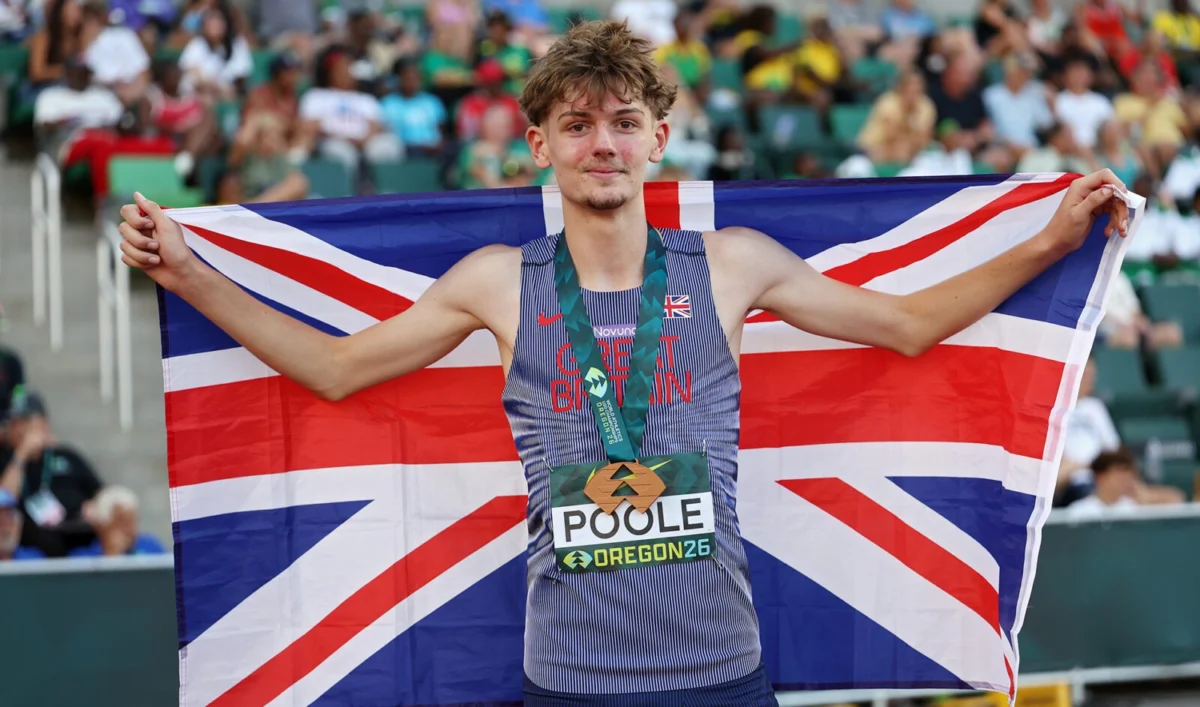
Main Facts: A Breakthrough Season and a Historic Milestone
For 19-year-old British high jumper Otis Poole, the transition to collegiate life in the United States can be encapsulated in a single, telling phrase: "It feels like I’m being treated like an elite athlete."
Sitting down after completing his very first day of classes at Texas A&M University, Poole is reflective yet visibly energized. The young star arrived in the Lone Star State at the end of a whirlwind summer, carrying the weight of a monumental athletic achievement. Just weeks prior, at the World U20 Championships in Eugene, Oregon, Poole cleared 2.21 meters to secure a prestigious bronze medal. In doing so, he equaled the personal best he had set earlier in the season at the English Schools Championships and ended a frustrating, 30-year drought for Great Britain in the men’s high jump at the global under-20 showcase.
While a bronze medal on the world stage is the stuff of dreams for most teenagers, Poole’s initial reaction was defined by fierce ambition. "I was annoyed at the start because of how close I was to winning," he admits. "It sunk in what I missed out on, and then, as time has passed, it’s now trying to be appreciative of how far I actually came to get that medal."
That medal is just the crown jewel in a breakout 2025 campaign that saw Poole capture the British indoor title with a 2.20m clearance before adding a European U20 silver medal to his growing trophy cabinet. Yet, what makes his trajectory genuinely astonishing is not just the hardware, but the timeline: Poole only took up high jumping four years ago.
Just five days after returning to the UK from Oregon, Poole was back on a transatlantic flight, packing his bags for College Station, Texas. There, he is balancing a rigorous business degree with the unforgiving, high-stakes environment of NCAA Division I track and field—marking the next major chapter in a meteoric athletic career.
Chronology: From a School Sports Day to the World Stage
To understand Otis Poole’s meteoric rise is to witness a masterclass in raw natural talent combined with rapid technical development. His journey into athletics reads like a Hollywood script, beginning entirely by accident in 2022.
The Accidental Discovery (2022)
Before the spikes, the professional coaching, and the international travel, Poole was just a schoolboy participating in a routine sports day. The venue was modest: a standard gymnasium with wooden floors, offering barely two steps of approach before a random crash mat.
"I think I even missed the mat, but I broke the school record, clearing 1.62m," Poole recalls. Following that impromptu display of explosive ability, teachers urged him to test his mettle at a local athletics club.
Walking through the gates of Yate & District Athletic Club, however, was not love at first sight. "I didn’t really enjoy it at first, but I think that’s just because it’s a new environment," he reflects. Salvation came in the form of familiarity. A childhood friend whom Poole had practiced martial arts with since the age of five was already training at the club, providing the vital social anchor needed to keep the young athlete engaged.
Finding His Stride: The Coaching Transition
Under the guidance of Mark Gale—father of Olympic high jumper Tom Gale—Poole began to learn the nuances of the Fosbury Flop. However, the true catalyst for his explosive growth came when he transitioned to coach Joy Bray.
The partnership unlocked a new level of performance. Thanks to a radically different training methodology and an overhauled approach to conditioning, Poole saw his personal best skyrocket from 2.07m to a remarkable 2.20m within a single season.
The 2025 Breakthrough
Poole’s ascent shifted into hyperdrive in 2025. He announced himself on the senior domestic stage by claiming the British indoor title with a 2.20m clearance. International recognition quickly followed as he secured a silver medal at the European U20 Championships.
This momentum carried him across the Atlantic to Eugene, Oregon, for the World U20 Championships. Despite battling nerves and world-class competition, Poole cleared 2.21m under pressure, securing bronze and breaking a three-decade medal drought for British men’s youth high jumping.
Less than a week after touching down on British soil, Poole was bound for the United States, officially checking into Texas A&M University to begin life as an NCAA student-athlete.
Supporting Data: By the Numbers
To fully grasp the magnitude of Poole’s achievements and the fierce competitive landscape he navigates, the numbers tell a compelling story:
- 1.62m: The height of Poole’s very first impromptu clearance on a school sports day gym floor in 2022.
- 4 Years: The remarkably short span of time it took Poole to transform from a novice schoolboy jumper into a global U20 medalist.
- 2.21m: Poole’s current personal best, achieved at the English Schools Championships and equaled under pressure at the World U20 Championships in Eugene.
- 30 Years: The length of the drought broken by Poole’s bronze medal, ending a 30-year absence of British men’s high jump medals at the World U20 Championships.
- 2.20m / 2.15m: The dramatic inflation of domestic standards in British high jumping. While 2.14m won the outdoor British Championships just a year prior, a clearance of 2.27m was required to claim gold in subsequent domestic clashes, leaving marks like 2.15m outside the medal podium.
- 2.24m: The personal best of Poole’s primary training partner at Texas A&M—a strategically chosen rival who stands just a few months older and serves as a daily benchmark for Poole’s development.
Strategic Decisions: Why Texas A&M?
The decision to leave the UK and commit to an NCAA powerhouse was not made lightly. For Poole, the move was a calculated professional step designed to harden his competitive edge and expose him to a level of athletic infrastructure rarely replicated in European collegiate systems.
Seeking the "Small Fish" Mentality
When evaluating his options, Poole recognized a unique paradox in British high jumping. While the nation’s overall jumping standards were rapidly surging, the domestic ecosystem suffered from a lack of competitive variety.
"When I was getting recruited, British high jumping wasn’t the best at the time, and I really wanted to go over and have this top-level competition. I wanted to be that small fish again," Poole explains.
In the UK, elite athletes frequently lock horns against the exact same pool of competitors week in and week out. "You don’t get the nerves any more because you’re almost friends with everyone from the British scene. You want to be against these new names."
The Search for the Perfect Training Partner
Poole was exceptionally selective during his campus recruitment visits, refusing to settle for a program simply based on prestige. He needed a precise athletic ecosystem.
"Most schools would either have someone that’s too old that was going to graduate or too many people," he notes. Texas A&M, however, offered a tailor-made environment. The program featured elite facilities coupled with a single, highly specific training partner: an athlete just a few months older, competing in the year above, with a personal best of 2.24m.
"I really wanted to have someone that I could work off and fight my way to being better than," Poole says. That daily, internal friction is precisely what he believes will push him past the 2.30m barrier.
Implications: The State of British High Jumping and Future Horizons
Poole’s emergence and subsequent migration to the United States arrive at a fascinating cultural and athletic crossroads for British track and field.
A Domestic Renaissance
From a purely statistical standpoint, British men’s high jumping is experiencing a profound renaissance. The domestic depth and elite-level heights currently being cleared rank Britain among the best nations in the world.
Poole points directly to the shifting metrics at the British Outdoor Championships. A competition that was comfortably won with a clearance of 2.14m just a year prior now demands heights upwards of 2.27m. Even clearing 2.15m—a mark that would have previously contended for major domestic hardware—now frequently leaves athletes entirely off the podium.
This domestic arms race has a rising-tide effect, forcing every competitor to elevate their technical execution. However, Poole cautions that the insular nature of the domestic circuit risks plateauing psychological growth. By combining the booming baseline of British talent with the brutal, high-volume competitive cauldron of the NCAA, athletes like Poole are positioning themselves to bridge the gap between junior dominance and senior global success.
Mentorship and the Evolution of Rivalries
Every great champion requires a blueprint, and for Poole, that blueprint was embodied by British Olympian Tom Gale and his father, Mark. In the formative years of his career, the Gale family acted as a vital educational resource—not just for Otis, but for his parents, helping them navigate the complex, often opaque world of high-performance athletics administration and training management.
Yet, as Poole steps further into senior competition, the dynamic has inevitably shifted. Tom Gale is no longer just an inspirational poster on the wall or a guiding mentor; he is a direct adversary.
"Tom was an inspiration, but since last season he’s come back [to competition] and as soon as I’m against him, he’s not an inspiration anymore. He’s a competitor," Poole states firmly.
Looking Ahead
As he settles into life in College Station—juggling biomechanics, bar clearances, and business textbooks—Otis Poole remains remarkably grounded. Looking back at the bewildered peers from his early school days who struggled to understand the esoteric nature of the Fosbury Flop compared to traditional British staples like football and rugby, his advice to his younger self is simple:
"I would just say just keep doing what you want to do. With high jump, it’s not exactly football or rugby and people at school don’t know how it works. People don’t think it’s normal, but I think I’ve been quite good to just do what I want to do."
With a historic world bronze medal secured, elite collegiate backing unlocked, and an unyielding appetite to chase down bigger bars, Otis Poole is no longer just doing what he wants to do—he is soaring higher than anyone could have predicted.

 Azzam Bilal Chamdy
 Siti Muinah
 Iffa Jayyana
 Ali Ikhwan
 Jia Lissa
 Neng Nana
 Dwi Wanna